
Why does everyone love "disgraced" Justice RBG?
RBG who is it?

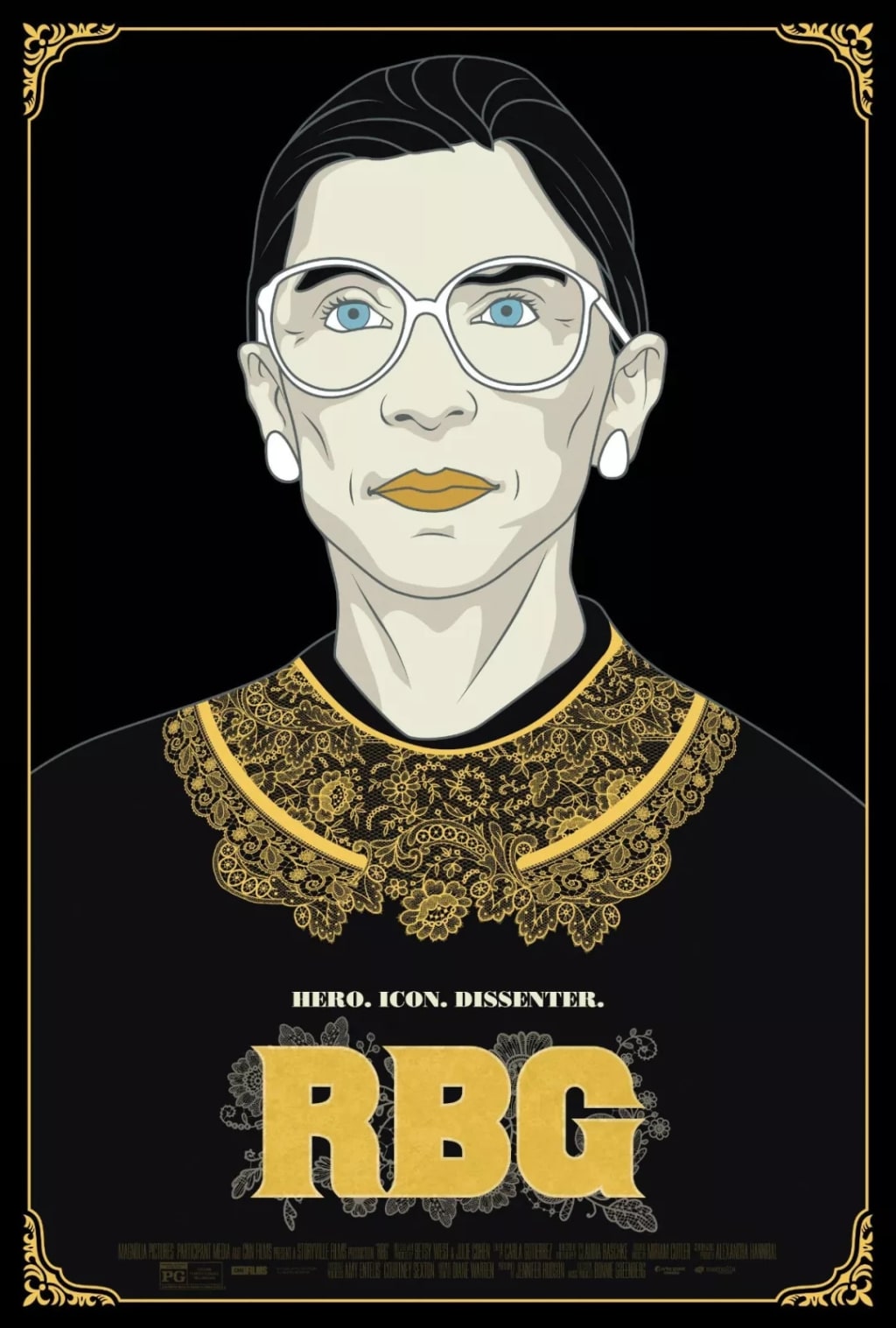
1. She's Ruth Bader Ginsburg, or RBG as she's affectionately known.
2. She's a high-achieving Jewish girl born in Brooklyn. She attended Harvard Law School and became the first woman to receive tenure at Columbia.
3. She's a golden women's rights lawyer. In 1973, RBG served as lead litigator for the Women's Rights Project of the American Freedom Union. Over the next decade or so, she made a series of landmark arguments before the Supreme Court.
4. She is a Supreme Court justice. Nominated to the Supreme Court by President Clinton in 1993, Ms. RBG was the second woman to serve on the bench, joining Sandra Day O'Connar.
5. She's the most popular old lady on social media. People are keen to imitate her dress, make her memes, buy her accessories...
6. She's the punkiest old lady. Not retired at 85, working every day, working out.
7. She has an enviable love. Her husband Martin, who jokingly referred to himself as the "first husband", championed RBG's career in an era when wives were expected to take care of the family. "I think the most important thing I ever did was help Ruth get where she is," he once said.
8. She was known as "The Notorious RBG," her fans' way of paying tribute to her for her angry dissents when The Supreme Court made ridiculous decisions.
"What could be worse than an old woman? But everyone wants to hang on every word the old woman says."
Who is this RBG WHO is admired by countless people?
Here's a look back at her life through some cases that truly changed history
01. Show a group of men what real sexism is
Frontiero, now white-haired and wearing a plaid shirt, sat on a sofa and recalled that day more than 40 years ago.
In the 1970s, when the U.S. Air Force was aggressively recruiting women, the slogan was often inspiring:
Who says a woman should be restricted to three aspects of her life? Does being a woman mean she has no choice? Join the US Air Force and you can explore the world too!
Fresh out of college and eager to become financially independent, Frontiero joined the U.S. Air Force. Besides finding a job, she had good news: She married her husband.
A new job, a new life, everything is new for Frontiero, who is in his early 20s.
However, the reality is not quite as exciting as the advertisement suggests. Soon after joining the workforce, Frontiero discovered the unfairness of being surrounded by male colleagues who received housing allowances as long as they were married. And she can't get that benefit just because of her gender.
Upon hearing the news, the naive Frontiero thought it was "just an administrative mistake". When she entered the accounting office, she received a blow:
"You were lucky enough to get the chance to join the army. You should be lucky to have you in the Air Force." "Said the treasurer icily.
Frontiero got a lawyer. The lawyer hit the nail on the head: this was not an administrative error, but a legal one. At the time, there were hundreds of pieces of state and federal law that were grossly sexist:
The law that came into force in 1970 provided that:
Employers in most states can legally fire pregnant women because they are pregnant.
Banks require women to get their husbands' signatures to apply for credit.
It is generally assumed that men are the breadwinners and that women, if they work, are just saving pocket money. If you want to change that, you have to litigate it.
RBG, then working as a women's rights lawyer at the ACLU, accepted the case without hesitation. The Frontiero case, in her view, is a catalyst for legal change, because she represents a common dilemma faced by women across America.
The session was in the afternoon, and it was an important day not only in the life of the young girl Frontiero, but also in the life of RBG - because this time, it was her first plea before the Supreme Court. RBG was so nervous that he skipped lunch. The court was solemn and exalted, she recalled, but what impressed her most were the portraits on the walls: oil portraits of successive American judicial leaders from different eras but with one thing in common -- they were all men.
"I was very nervous, but when I looked up at the judges, I realized I had an impatient audience."
In sharp, sober language, RBG combs through the language of how women have been treated differently in the United States since its founding: "The husband is the master of the house," "the woman must obey him unconditionally." She explained to the male members of the court exactly what it was like to be a "second-class citizen" --
"I was aware that I was speaking to men who were not aware at all that discriminatory behaviour on the basis of sex existed. My strategy is to make them understand that this is real discrimination."
In the end, Frontiero received a call from a reporter at home and won. Frontiero got her security money, and RBG won her first lawsuit.
02. What about sexism against men?
When it comes to sexism, most people think that it is discrimination against women. What we often forget is that men are also victims of sexism.
1975 was a tumultuous year for Stefan Wiesenfeld. His wife died in childbirth, but the child survived. He had to quit his job because he had to take care of his children alone, and his finances became a problem.
He applied to the government for single-parent family support, but was turned down because it was "mother's compensation" -- a benefit widows automatically receive in normal times, but widowers do not because it is generally assumed that only women need to take care of the family, and that "stay-at-home husbands" like Stephen do not exist.
RBG took up the case decisively. In society's pervasive sexism, the victim is always not just a woman, but everyone in society.
"When we walked into the courtroom, she asked me to sit at the table with her. She wanted to put a male face in front of the courtroom, which the judges could relate to more." "Very clever strategy," Stephen recalls.
RBG heard the verdict on the car radio. She was on her way to work at Columbia University: "My first thought was that I had to control my excitement or I was going to get into an accident." Another friend confided that she had cried a lot because she had won the case.
The case was won, and the stay-at-home husband got the money.
"I think men and women will work together to make the world a better place." "Not women's liberation, but everyone's liberation."
The young father, now gray, smiled as he talked about his victory more than 40 years ago.
03. Two defenses Nearly 40 years Apart: What Does It Really Mean to Be a Woman?
These are two cases spanning nearly 40 years. RBG went from being a litigator to a Supreme Court justice.
Let's go back to 1970. Susan Skorak is an Air Force nurse. She was a brave woman who loved her job and volunteered to fight in the Vietnam War.
That year, Skorak got pregnant. Instead, the Air Force coldly gave her two options: resign or have an abortion.
This condition pained Skorak because, on the one hand, she was a Catholic who did not want to have an abortion because of her faith; On the other hand, she also loves her job and doesn't want to quit. She wanted to compromise, asking the troops: After she had the baby, why not put it up for adoption? He was still rejected.
Faced with a dilemma, Skorak approached the American Civil Liberties Union, and RBG, then a litigator, took the case without hesitation. In her brief, she said:
"Among the various obstacles to women's pursuit of equal rights, the discrimination caused by women's unique fertility is the first. Until recently, jurists believed that any discrimination against pregnant women and mothers was really 'for their own good.'"
The opposing lawyers decided to compromise: the army lifted its rule on firing pregnant women. This case directly promoted the development of women's reproductive rights, and in October 1978, Congress passed the Anti-Pregnancy Discrimination Act.
Today, Ms. Skorak lives in Arizona with "four dogs, eight cats, nine chickens, a rooster and a horse," according to a 2014 visit.
Just over 30 years later, however, RBG is wearing the uniform of a Supreme Court justice, and in a new capacity, from litigator to justice, RBG is once again confronting the issue of abortion rights in the United States.
Anti-abortion movement was at its peak, in 2003, President George w. bush will ban "partial birth abortion" in the federal law, the ban on the Supreme Court 5-4 is passed, the difference between the reasons of discrimination: "protect the vagaries of women, lest they regretted his decision, and protect them from life's cheating." "Women who have had an abortion regret their decision and suffer severe depression and loss of confidence."
In the eyes of the RBG, this is a step backwards in the law, and again she demurs:
Women's ability to reach their full potential is closely related to their ability to make independent decisions about their own reproductive plans. Therefore, the law does not allow excessive restrictions on a woman's right to abortion. This not only protects women's privacy, but also protects women's autonomy, which gives women the right to freely decide the course of their lives and thus enjoy equal civil rights with men.
These two cases, which span nearly 40 years, demonstrate RBG's understanding of reproductive rights: true reproductive freedom -- not only the right to have children, but also the right not to have children.
In today's society, this topic is still not outdated. Under the policy of encouraging childbearing, the government, while "giving birth", restricts women's right to terminate pregnancy and denies women's body autonomy; On the other hand, workplace discrimination against pregnant women has not diminished, placing restrictions on their career paths.
04. Can't women attend military schools?
In the documentary, RBG, 85, is seen staring at a photograph on a shelf, her expression as serious and calm as ever, making it hard to guess what she's thinking.
In this photo, RBG stands in the center, surrounded by a group of women in uniform. There's an exciting story behind this photo -- the woman in it, because of RBG, got into her dream school at Virginia Military Institute.
VMI (Virginia Military Institute) is a century-old Military academy, where strict discipline and strict conditions have produced many outstanding officers. However, it is also an all-boys school.
In 1996, a high school girl wanted to attend VMI, but was rejected by the school because it only accepted boys. She sued the state of Virginia, arguing that the rules violated the Constitution's principle of gender equality.
The all-male Virginia Military Institute at the time
At that time, the opposing lawyer for justice ginsburg have heard earlier, in the 90 s, American society has gone through a number of discrimination cases, at this point, then use the "women's job is to stay at home, is not fit to join the army," the tone has been inappropriate, the opposing lawyer came up with a more modest defense strategy, which is now still common protective "discrimination" :
The Virginia Military Institute claims that admitting women would undermine its teaching goals, which include training cadets in a "strike training style" that is too rigorous to be used to train women.
The college set up a parody program at a sister school and called it the Virginia Women's Leadership Institute, but it instilled gentle, feminine values.
"A military academy that is male-only, that teaches' male 'values that only men can learn, and that makes it clear that men can withstand the rigors of training and succeed," Paul Bender, an assistant deputy attorney general, said during the debate.
As RBG has repeated throughout her career: "Women seem to be held on a pedestal, but on closer inspection they are locked in a cage disguised as a pedestal."
This is the first case on women's rights that RBG has taken on as a Supreme Court justice. The case was won, and RBG was given the opportunity to write the judgment:
"A high school student wanted to go to this military school. This case is not just about VMI, it's about the whole idea that you can't exclude women just because of their gender."
Today, the girls in the photos have been trained by VMI to become scientists and engineers. As it turned out, they all fit in well at VMI.
Ginsburg understood that "anything that looks like a special favor for women ends up limiting them in return."
05. Moment of Disagreement: Do Women get paid half as much?
The experience was not always smooth. RBG's liberal wing often loses when faced with the other eight justices who disagree with her party.
And losing is not the end of the discussion. In American litigation, there is a majority opinion on the decision, and those judges who disagree with the decision will dissent
While it can't change a current decision, it's a persuasive authority that other judges can use for reference when a decision is later argued or overturned. In some cases, it was these dissenting opinions that drove the change in the law.
RBG has been one of the court's most vocal dissenters.
People often say, "You can't spell Truth without Ruth" (" You can't spell Truth without Ruth ") to compliment and thank RBG.
Because beneath RBG's spectacular life lies an even grander picture of women's rights
Women who want to go to military school, women who want equal pay for equal work, stay-at-home husbands who want security... What RBG has changed is not only the fate of these individuals, but also the progress of the entire judicial community and society behind it.
Women's rights and interests are never easily obtained, but through the efforts and struggles of generations of women, hard to obtain.
As the chapter title of the RBG biography says: "Don't let them hold you back, reach for the stars."
About the Creator
Keep reading
More stories from Cowx Keeana and writers in Photography and other communities.
Is getting married and having children a scam? Eight female love dramas with high scores
01. A Guide to Tokyo Women "Don't you think it's a little sad to show off your children?" From 20 to 40 years old, the heroine Ayame gave up the warm life in her hometown to struggle in Tokyo, it is easy to resonate with women. The web series began as a magazine column about the lives of single women in Tokyo.
By Cowx Keeana4 years ago in Photography
Gold Chrysotype Photography Is Back and the Colours Are Breathtaking
There is a moment when a chrysotype print is lifted from its chemical bath and held up to the light stops people mid-breath. The colours that bloom across the surface — soft dusty pinks fading into deep magenta, rich cyans pooling at the edges, velvety blacks settling into the grain of the paper — look less like a photograph and more like something pulled from a dream.
By CurlsAndCommasabout 21 hours ago in Photography
Lycan Lore
As the students of my 10am mythology class take their seats, I decide to steer the day's curriculum away from Greek and dive into a Western European discourse on the misaligned beliefs of the Werewolf. A tale of truth or fiction. No one really knows.
By Lamar Wigginsabout 9 hours ago in Fiction



Comments
There are no comments for this story
Be the first to respond and start the conversation.