
Visual Artist RaMell Ross Is Redefining How We View The Black Experience
How Hale County This Morning, This Evening Demystifies Black Culture in The Historic South
On his website, RaMell Ross describes himself as a “visual artist, filmmaker, writer and liberated documentarian.” Ross is as articulate and poetic in his words as he is in his imagery. He studied Sociology and English at Georgetown University on a basketball scholarship, but serious injuries early on in his athletic career realigned his interests and decided to pursue photography. In an interview with Filmmaker Magazine, he attributes his experience as a point guard to how he ‘look[s] at things in terms of movement and their relationship to what came before and after.’ So, the evolution from his photography to his first and only documentary, Hale County This Morning, This Evening - award winning experimental documentary that covers the everyday lives of the black folk living in rural Alabama - is only natural. Although, in a virtual interview with filmmaker Garret Bradley (via Film At Lincoln Center), he claims that film and photography operate differently:
...it forgot all about the nuances of semiotics and the nuances of perception...the image being the most complex space that you can create in a single instant...and kind of forgo...the instant for the multiplicity of instances for the greater thesis...me going to film from photography, I thought…we need to address notions of blackness here...if the problem of representation...exists in the image, I can’t...start with the image logic first...everything has to...question the fundamental act of perceiving the idea of blackness
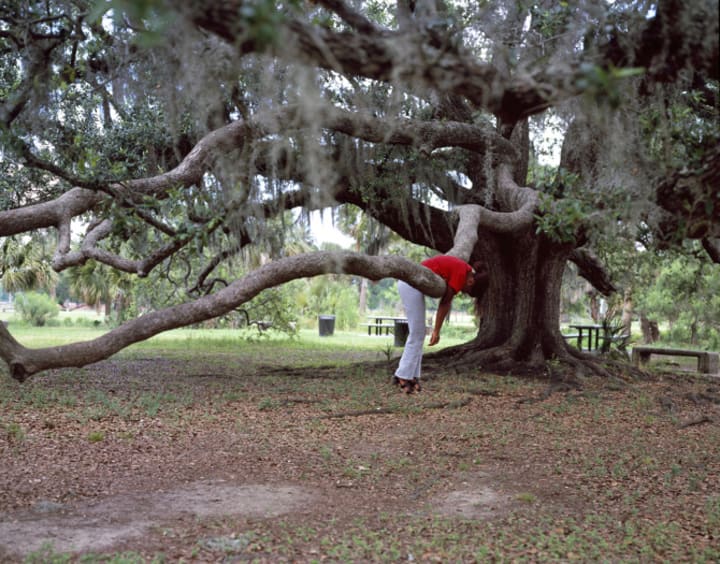
In 2009, Ross moved to rural Alabama to teach photography and coach basketball. So, he did not necessarily move to the state with the intention of creating this documentary. He spent several years photographing the people of Hale County before the filming of Hale County. The documentary focuses on the different worlds of Daniel Collins, a basketball player determined to make it the NBA and Quincy Bryant, an athlete, musician, and young father. What this documentary does is add complexity to the image of “blackness” by documenting the mundane, something that does not really exist in mainstream media. Even though black people exists all over the United States and the globe, there is a specific connoation“the south,” a historical one that we all learn about early on in school accompanied by images of cotton fields, lynching, plantations, and whealthy white people. Gone with the Wind (1939), for example, would be the epitome of romanticizing this version of the historical south.
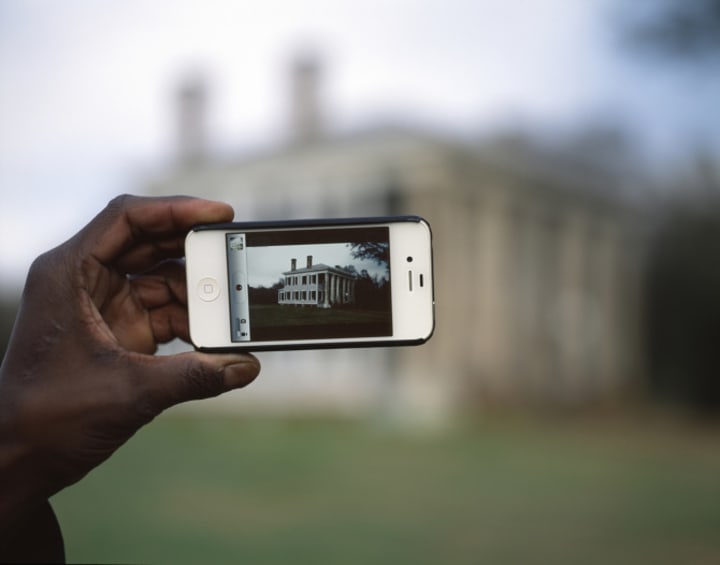
RaMell Ross takes back control over the image of black people in this documentary. Historically, the “white gaze” has been widely accepted by the United States and even across the globe as the standard perception in mainstream media, especially in the documentary form. Ross offers a good analogy in an interview with Jule Collins Smith Museum of Fine Art: when you are representing someone, you are putting a costume on them, but when you are representing yourself, you are choosing your own clothes.
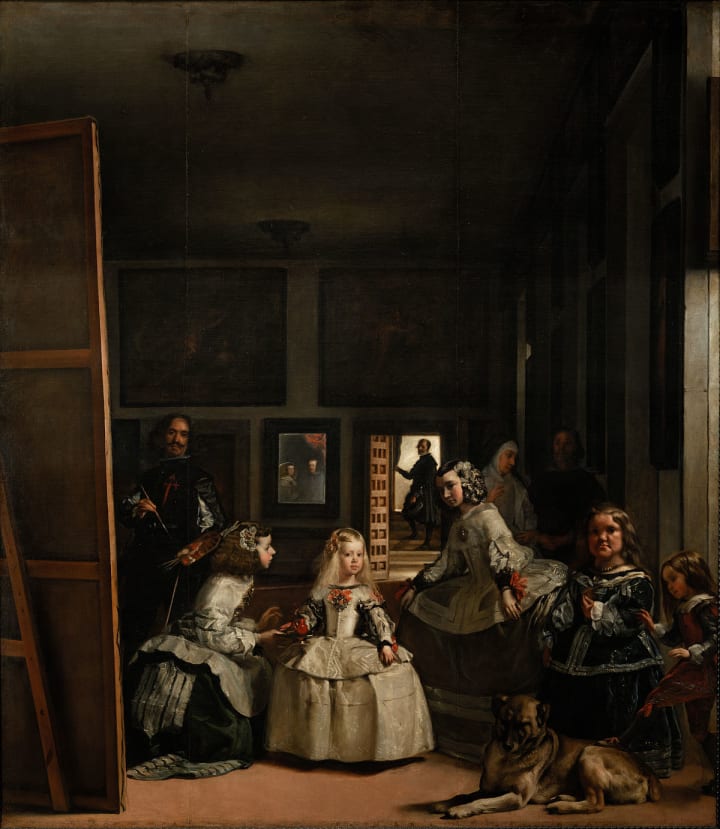
Hale County This Morning, This Evening is an experimental documentary in many different ways from the sound design to the editing style, but the most powerful experimental technique that Ross engages in is “the gaze.” It is a concept that describes the ideological effect on the viewer. It appears a lot in theoretical texts that psychoanalyze visual mediums. One famous example that illustrates this concept is in a painting by Diego Velázquez titled Las Meninas (1656). It depicts a small girl looking straight at the assumed spectator surrounded by many other people in mid action, including the painter; some are looking towards the viewer and others are not. What makes this painting even more interesting is that the back of a wooden easel with a white canvas is visible in the frame forcing us to question the idea of perspective. I did not originally make this connection in terms of the concept of “the gaze.” I saw a video on YouTube.com by a man named Tom McGowan titled “The Gaze in Cinema.” I just applied his connection to this specific documentary. With that said, there are several shots in the film where not only are we subjected to the gaze, but we are also put in line with RaMell’s perspective - a metaphorical wooden easel, so to speak. Ross alternates between both ends of “the gaze” throughout the documentary.
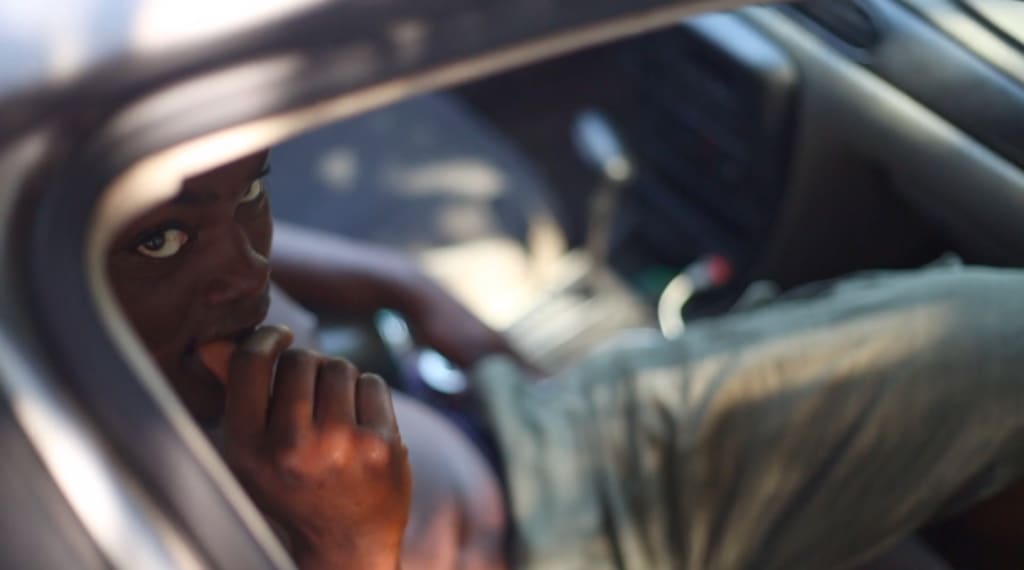
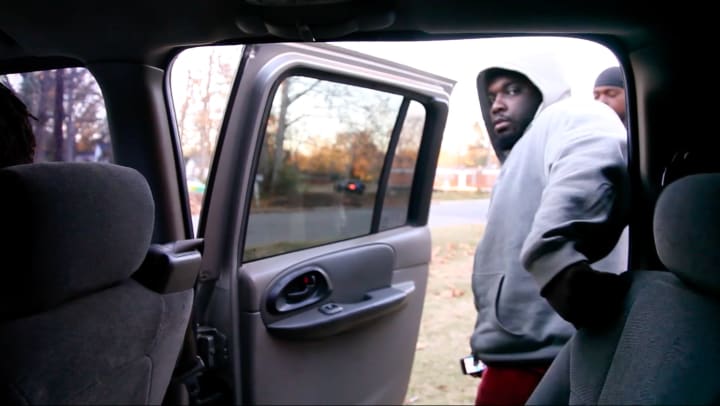
This gaze is first evident from the opening shot where the filmmaker is literally in the back seat of the car. He is a passenger on this ride not the driver which I interpreted as a metaphor for the perspective of Hale County that we are about to witness.
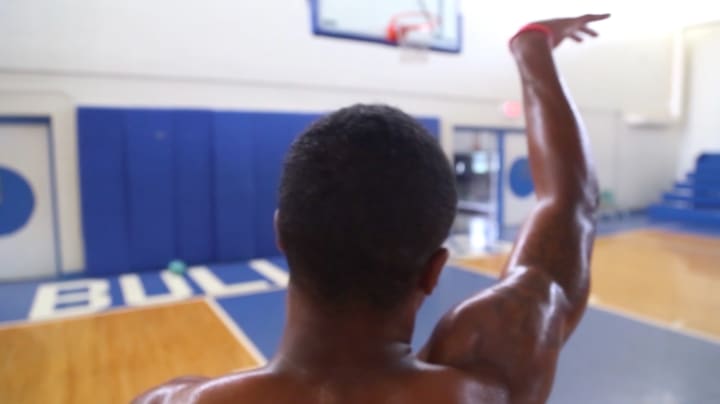
Another instance where we are put inline with Ross’ subjectivity is a long take of Daniel Collins playing basketball at university. A long take is a scene where there is no visible editing or “cutting.” We only see the back of Collins covered in sweat as he dribbles and shoots into the basketball hoop over and over again. There aren’t any scenes where he is practicing with his other teammates, most scenes of Collins consists of him exercising or training one on one with his coach, which contributes to the overall theme of intimacy.
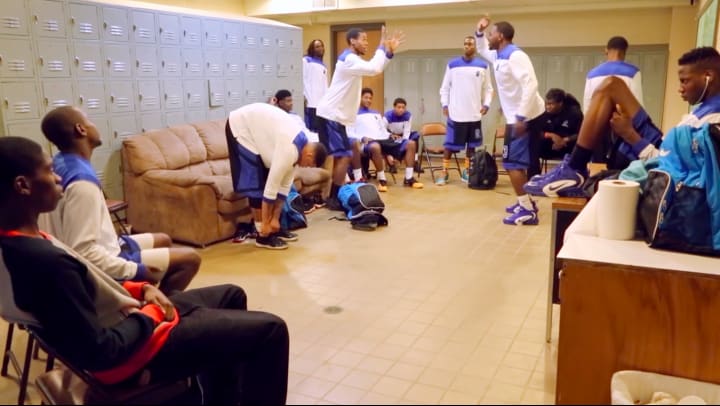
I would also argue that the way Ross positions the camera is characteristic of the cinéma-vérité style - it is French for “truth Cinema.” In layman's terms, it is that “fly on the wall” style of filmmaking. In one particular shot, Ross positions himself in a corner of a locker room where it appears as if he is a literal fly on the wall. This shot plays out like a moving photograph. It lasts over two minutes without a single cut as we witness how Collins and his teammates interact alone with each other. This locker room scene is followed by another really long take of Quincy’s son, Kyrie, running back and forth in his living room. Ross addresses the duration of the shot of Kyrie in an interview hosted by Hammer Museum in Los Angeles:
...I want to bring complexity, I want to bring ambiguity to blackness in order to open up its meaning...and this is an opportunity...for you, the viewer, to go through a range, a full range of thoughts...you’re forced to think...
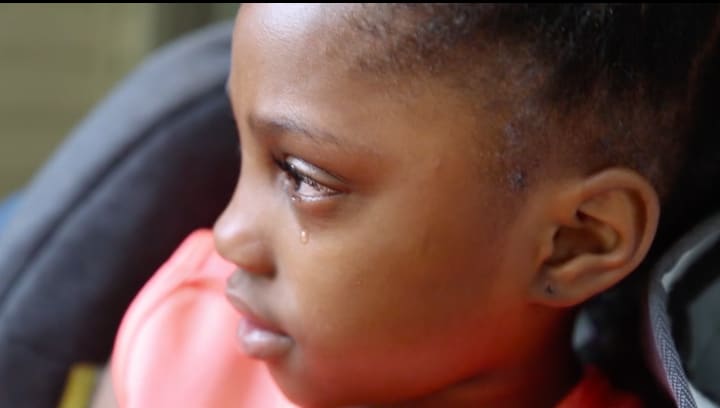
This cinematographic style allows the director to hone in on the idiosyncrasies of black culture. For example, when Collins’ mother is telling him that he is scolding him for being around her house too much, she is doing her daughters hair. Ross focuses the camera on the girl’s eye that has a single teardrop rolling down her cheek. It wasn’t a particularly sad moment, at least it didn’t appear that way. So, it made me wonder if she was crying because of the pain from her mothers hand or another reason. I am Mexican American, but braids are also a characteristic of latino culture. I grew up with two of my nieces, so I watched them tear up from how hard their mother would comb and braid their hair. That is my best guess, I couldn’t find any input from Ross on this specific moment anywhere.
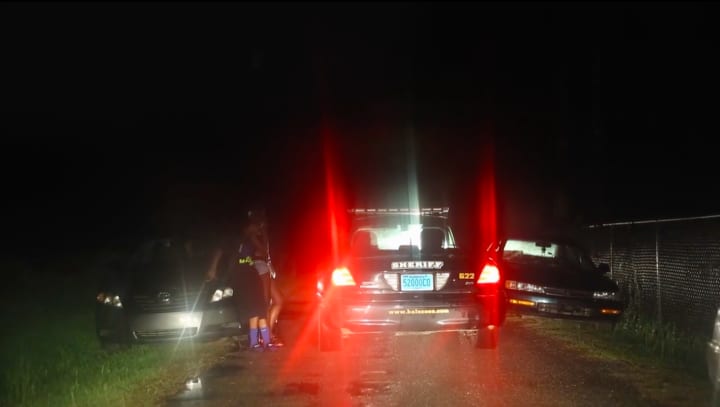
RaMell Ross avoids any sensationalization of the everyday lives of the black people living in the Hale County portion of Alabama, but Ross does acknowledge the police in the lives of black people in a couple notable scenes. Early on in the film, there is a scene where a police car slowly drives by people hanging out on a dirt road like a shark in the water. In a later scene, Ross is in the backseat of a car pointing the camera towards Collins in the passenger side which then cuts to a scene of the cop in the side view mirror. They’re only brief moments in the film.
Hale County This Morning, This Evening is a relatively short documentary - the duration time is barely over an hour in length - but it is packed with subtext in every shot. There is so much to cover in this film I think one could write a dissertation on it. I admire RaMell Ross’ work because it is self-reflexive and not just for the sake of being self-reflexive, but for the sake of demystifying or even deconstructing the image of “blackness.” I find his sensibility inspiring as an aspiring working filmmaker and photographer.
About the Creator
Keep reading
More stories from writers in Photography and other communities.
My Year, in Prattling and Photos
It's been a year since... last year. Ironically, it seems I've found myself a new tradition of getting sick during the New Year holidays. At least, this year (that is, this inter-year period remarkable for its shiny decorations in the streets and houses, and closed supermarkets and pretty much everything), I'm doubtlessly doing better: I've managed to come visit my friends in Germany for Christmas (which I failed to do last year) and—after having some good quality time eating machanka, playing Munchkin and swinging machetes (the last one obviously crept into this checklist only for the sake of the phonological form)—I came back home via proverbial Deutche Bahn and probably less known Schweizerische Bundesbahnen, my body hosting a family of viruses, virions and who knows what other tiny critters somewhere inside my chest.
By Andrei Z.16 days ago in Photography
The People We Meet on Vacation: Moments, Connections, and Lasting Impressions
The People We Meet on Vacation: Moments, Connections, and Lasting Impressions Vacations are more than a break from daily routines. They are a unique social experience where people from different backgrounds cross paths in unexpected ways. The people we meet during a holiday often leave strong impressions, even if the interaction lasts only a few minutes. These encounters can shape memories, influence perspectives, and sometimes turn into lifelong friendships. Understanding who we meet on vacation helps explain why travel feels so meaningful to many people.
By America today 5 days ago in Photography


Comments
There are no comments for this story
Be the first to respond and start the conversation.