
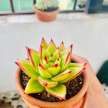
How to handle newly purchased succulents
Step 1: Check the condition of the plant (roots, leaves, stems)
As soon as you bring the succulent home, you need to check the overall condition of the plant.
Carefully observe the roots to see if they are waterlogged or rotten. Next, check if the leaves and stems are broken, crushed, wilted or have signs of pests during transportation. This is an important step to help you assess the health of the plant to have a suitable treatment direction.
Step 2: Trim damaged roots, remove wilted leaves
After detecting damaged parts, you need to use sharp and clean scissors to completely cut off the waterlogged, rotten or crushed roots. Similarly, remove all yellow, fallen, soft or diseased leaves. This helps prevent pathogens from developing, while creating conditions for the plant to recover faster and grow healthier later.
Step 3: Place the plant in a dry, airy place, do not water for 2-3 days
After treatment, absolutely do not replant or water immediately.
Place the succulent in a dry, airy place with diffused light, avoid strong sunlight. Let the plant "rest" for about 2-3 days to help the cuts dry, limit infection or rot later when replanting.
Important note
This is an important adaptation stage in how to care for succulents when newly purchased. If not treated properly, the plant can easily rot the roots, lose leaves, or even die after a few days. Therefore, be gentle and follow the correct step-by-step process for the succulent to recover best.
Choose the substrate:
Succulents are suitable for a loose, airy, and fast-draining substrate. The composition can be flexible depending on local conditions, as long as about 60% of the ingredients have good drainage.
Basic ingredients include:
• Honeycomb charcoal (or akadama stone, pumice stone)
• Perlite stone
• Organic fertilizer (worm castings, dry cow dung, bat dung, etc.)
• Clean soil for planting
• Raw rice husks
• Disease prevention substances (potassium permanganate, agricultural lime or trichoderma)
Suggestion: Honeycomb charcoal is a popular, easy-to-find and free material. You should use the fully burned type, crushed into small pieces (0.5 - 1 cm), soaked in lime water for 2 days to detoxify and treat pathogens.
If you want convenience, you can replace it with akadama stone or pumice. They do not need to be processed and are well ventilated. Perlite stone also helps drain water but should only be used in small amounts because it retains high humidity, which can easily cause root rot.
Raw rice husks help ventilate the soil but rot quickly, so they should only be used in low proportions. Organic fertilizer and clean soil play a role in providing nutrients, helping plants adhere to the substrate effectively.
Mixing formula for growing succulents (suggested):
• 30% honeycomb charcoal
• 30% perlite
• 15% organic fertilizer
• 15% clean soil
• 10% raw rice husk
You can flexibly adjust depending on the available materials, as long as the drainage component always accounts for more than 60%.
Note when adding disease prevention substances
You should add potassium permanganate, agricultural lime or trichoderma to prevent fungi and diseases in the soil. However, do not mix trichoderma with potassium permanganate or lime because trichoderma is an antagonistic fungus and is easily destroyed.Caring for succulents after planting
Light: How long does a succulent need to be exposed to sunlight each day?
In the first 3-5 days after planting, the succulent needs to be placed in a cool, light place, avoiding direct sunlight. This is the "recovery" period to help the plant adapt to the new environment after repotting.
Do not leave the plant in complete shade because lack of light will cause the leaves to fade, the stem to stretch, and lose shape. After the initial period, you can let the plant expose to light sunlight in the early morning for 2-3 hours a day.
Maintaining good light is an important factor in caring for succulents when you first buy them, helping the plant to keep its beautiful color and increase its ability to photosynthesize and grow stably.
Watering: How often should you water the succulent?
Succulents are succulents that are drought-resistant, so you should not water them immediately after planting. Wait at least 3-5 days for the roots to stabilize before watering.
After the first watering, do not water according to a fixed schedule but need to observe the dryness of the soil and the condition of the leaves. Only water when the soil is completely dry and the leaves are slightly wrinkled to avoid waterlogging.
In hot and sunny climates, you can water 1-2 times/week, depending on conditions. In the rainy season or in humid places, you should limit watering and ensure good drainage.
How to water succulents
When watering succulents, you should water directly into the soil, avoiding water stagnation on the leaves. Large water drops that stay on the leaves for a long time can cause softening of the leaves and root rot, especially in humid environments.
You can use a spray bottle to spray a light mist to better control the amount of water. On hot sunny days or when the plant is placed in the West, you can increase the watering frequency, but only when the soil is completely dry.
Proper watering is an important factor in caring for succulents when you first buy them, helping the plant not to be shocked by water or have waterlogging after planting.
Fertilizing: What type of fertilizer is suitable for succulents?
After about 1 month of planting, you can start fertilizing to supplement nutrients for the plant. Prioritize using decomposed organic fertilizers such as vermicompost, dry cow manure or bat droppings.
You can also use diluted NPK fertilizer, slow-release fertilizer or microbial fertilizer to stimulate root growth and help leaves retain color better. Fertilize once a month, in small doses, to avoid causing fertilizer shock to the plant.
Pest control: How to treat mold and mealybugs on succulents
Succulents have very few pests, however, in high humidity conditions or improper care, the plant can be affected by mealybugs, white fungus, or root rot.
To treat mealybugs, use a cotton swab soaked in 70-degree alcohol to gently wipe the leaves. You can spray neem oil solution or biological pesticides to prevent pests. Always keep the plant in a well-ventilated place, avoid standing water.
If you see rotten leaves, cut off the damaged part and check the roots. Replant the plant with new substrate, treat with trichoderma to prevent fungus. This is an essential note in how to care for succulents when you first buy them.
About the Creator
HieuDinh
- Loves nature, likes to grow ornamental plants such as succulents, lotus (participates in volunteer activities to plant forests, protect forests in the locality)
- Loves dogs and cats (participates in local wildlife rescue activities)
Keep reading
More stories from HieuDinh and writers in Photography and other communities.
We are England
Met a dear friend for a coffee the other day, walking to the appointment through familiar territory. I twice lived in South Norwood in the 1970s, a district of South London (SE25) so named for the great North Wood that covered the land 500 years ago. Some tiny remnants of this once expansive forest remain, as does considerable industrial archaeology and broader social and economic history.
By Raymond G. Taylor15 days ago in Photography
I was in a Toxic Relationship, with my Workplace
“You got that?” My ex yelled. His hands were balled into fists at his side. At six foot three, he towered over me. A normal person would have been afraid, but I looked up a video of George Lopez repeatedly saying, “I got this,” and showed it to him. I had grown used to this treatment, so much so that I didn’t blink when he ripped the phone from my hand and threw it across the room.
By Jade M.a day ago in Confessions




Comments
There are no comments for this story
Be the first to respond and start the conversation.