
Proof of Life
It's the little things. Really, really little...
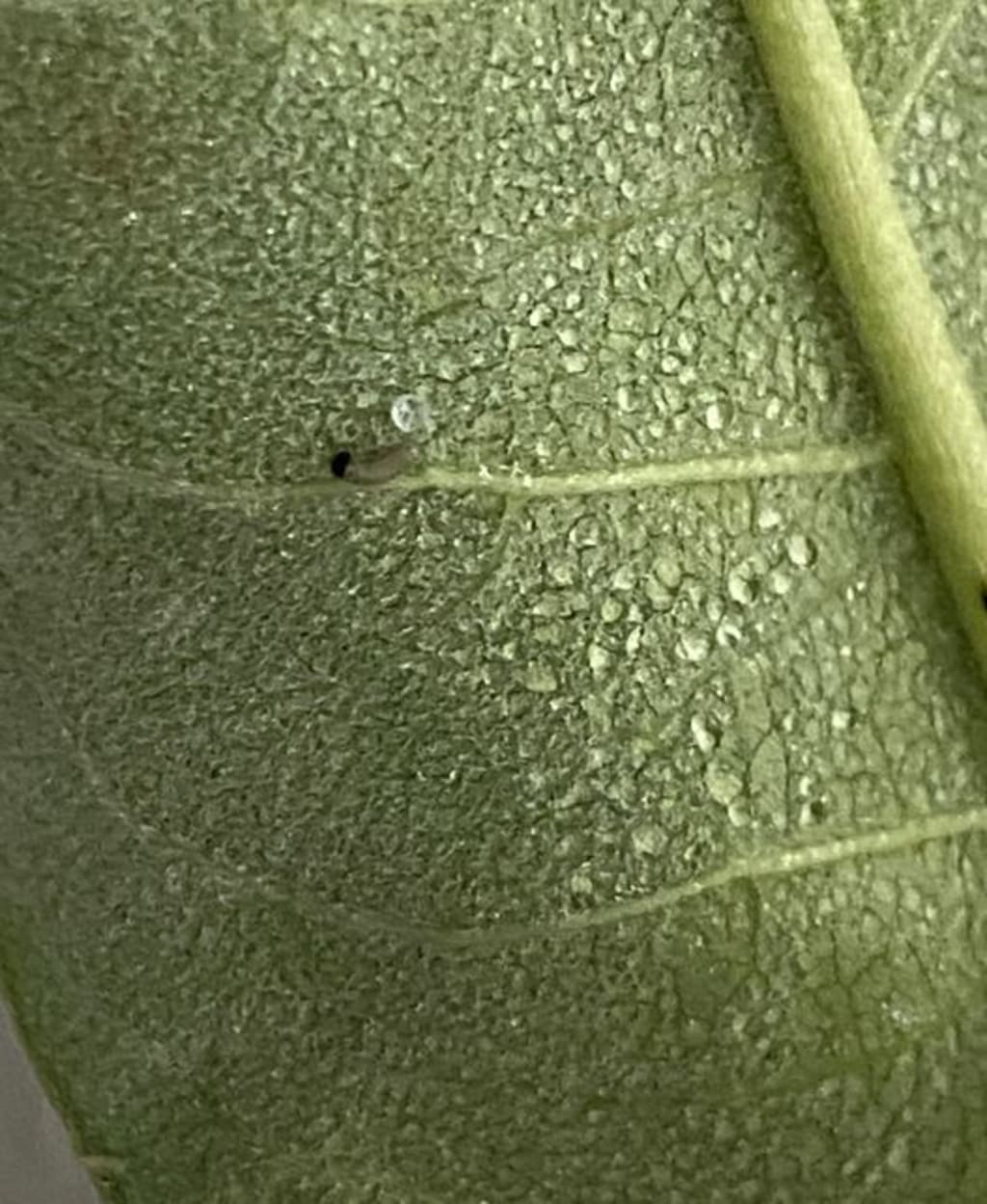
I know it’s tiny and hard to see, but can you guess what this is?
Though there are water droplets on the back side of this leaf, that biggest drop-looking thing is an empty, clear, egg case. The black spots are the eyes, and the yellow smudge behind it is the caterpillar body.
This was my first, and only, successful time at catching on film the moment a monarch caterpillar hatches.
How do I know? Because that egg case is the first thing a caterpillar eats, before it chomps down on the milkweed leaf it’s born on.
Normally, when I raise caterpillars, I take the them from the outdoors. I go out every other day, hunting through the forest of leaves at both my house and my parents’ house. They only come in on their comfort leaf to my mud room, so they’re exposed to regular sunlight and night sounds... and the occasional bat squeezing through the gap in one of the screen windows, because you can hear my proto-flutters chewing at night, and he’s heard we have a terrible infestation and perhaps he can take care of it for us? At least they’re polite, and we nicely decline and open the door for them to fly out and continue their back yard forage.
One thing I had never done before, till last year, was bring the eggs we found inside. I do that with the black swallowtail eggs, but I know I have to separate them, because when caterpillars are eating, they don’t know the difference between egg and leaf. As far as they know, they just got an extra bit of protein in their salad, cool, crunchy crouton, nom.
I even separate my little caterpillars from my big ones, for the same reason. All caterpillars know is eat, sleep, frass. (Frass is a nicer word than “poop,” apparently, to entomologists.) “Be nice and don’t eat your younger cousins” is not on their diet plan.
It is best to get caterpillars inside as soon as possible to prevent predation. There are parasitic wasps and flies, and bacteria, and viruses. Carnivorous insects, like assassin beetles, are everywhere in our yard. It’s a nice and healthy environment, for everything. The whole food chain. It’s what Nature’s all about, even if we don’t like it.
We bring them in to minimize the risk factors. It works, because monarchs have a 2% survival rate in the wild. With me, 85-97%. We still get the occasional bacterial infection, or a small case of OE, a protozoan infection. We get the latter in drought years especially. That’s what got me this year, I lost five to it. One tachinid fly parasitization, and two bacterial infections. Pretty phenomenal rates for an individual!
But, the rates would be even better if I could raise them from eggs.
I don’t like experimenting with critters. Their lives are important too, so I don’t have to right to mess with them, unless it’s for the positive. We’ve messed with their environment so much, that we have to mess around a little bit more to set it right. So I plucked one leaf with its tiny yellow egg, and brought it in. I put in a dish with a bit of water – enough to keep the leaf fresh, but not enough to drown any tiny fresh-born caterpilars, because dang those guys migrate fast! (I’m glossing over other details, because this might soon be illegal, and I don’t want to give anyone Ideas.)
I checked it every day, and kept the leaf fresh. Then one day – the egg disappeared.
I didn’t know they turned clear when they were about to hatch.
These things are incredibly tiny. Half a millimeter tiny. So I aimed my camera phone, jacked the enlargement up as far as it would go, hoped, and tapped the button.
This is what I saw!
I brought in more eggs over the season, and took care of them as they graduated to the “little guy” habitat, then the “big cats” habitat, then full-fledged flutters. I did it!! I have to tweak my procedure a little for the coming batch if I’m allowed. See, monarchs just got put on the endangered species list, and that might shut me down. I would go through the stacks and reams of paperwork to make it official, but with the regime coming in, all bets are off.
But I know how, now.
And this is solid proof that for a bit of time, with uncertain futures, I made a world of difference to some of those “little things” we’re told to pay attention to.
About the Creator
Meredith Harmon
Mix equal parts anthropologist, biologist, geologist, and artisan, stir and heat in the heart of Pennsylvania Dutch country, sprinkle with a heaping pile of odd life experiences. Half-baked.
Keep reading
More stories from Meredith Harmon and writers in Photography and other communities.
My Year, in Prattling and Photos
It's been a year since... last year. Ironically, it seems I've found myself a new tradition of getting sick during the New Year holidays. At least, this year (that is, this inter-year period remarkable for its shiny decorations in the streets and houses, and closed supermarkets and pretty much everything), I'm doubtlessly doing better: I've managed to come visit my friends in Germany for Christmas (which I failed to do last year) and—after having some good quality time eating machanka, playing Munchkin and swinging machetes (the last one obviously crept into this checklist only for the sake of the phonological form)—I came back home via proverbial Deutche Bahn and probably less known Schweizerische Bundesbahnen, my body hosting a family of viruses, virions and who knows what other tiny critters somewhere inside my chest.
By Andrei Z.15 days ago in Photography
The People We Meet on Vacation: Moments, Connections, and Lasting Impressions
The People We Meet on Vacation: Moments, Connections, and Lasting Impressions Vacations are more than a break from daily routines. They are a unique social experience where people from different backgrounds cross paths in unexpected ways. The people we meet during a holiday often leave strong impressions, even if the interaction lasts only a few minutes. These encounters can shape memories, influence perspectives, and sometimes turn into lifelong friendships. Understanding who we meet on vacation helps explain why travel feels so meaningful to many people.
By America today 4 days ago in Photography



Comments (1)
What a beautiful story! The way you describe the process is so full of heart and care—it’s like you’re sharing a secret connection with nature. You’re definitely making a difference, and it’s inspiring to read!✨