

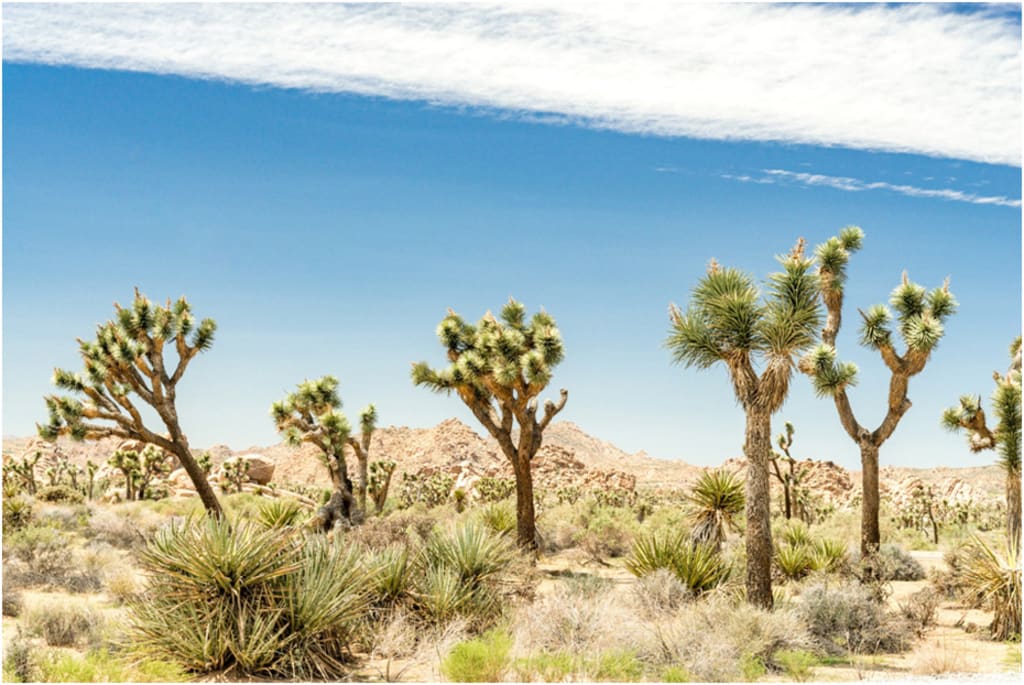
The prickly trees reach toward the sky like praying hands into the heavens. The Mormons saw these trees, and it reminded them of Joshua. The branches of the trees point their way westward like Joshua in an appeal for a safe journey to the promised land. Yucca brevifolia has a small range limited to the boundaries of the Mojave Desert. The magnificent examples of hardiness can live for hundreds of years; some manage the extremes of the arid landscape for a thousand years.
The best place to see the Joshua Tree is in, of all places, Joshua Tree National Park. An easily accessible drive near Palm Springs, California. Joshua Tree, CA, the small town, sports a few tattoo parlors, an authentic western saloon cafe, and a couple of Mexican restaurants. The Park is reached by The 10 in the south or Highway 62 on the northern periphery.
The latter route takes you to Twenty-Nine Palms, popularized in a song, "The Lady from 29 Palms", written by Allie Wrubel in 1947 and recorded by such artists as Frank Sinatra, Freddy Martin, Tony Pastor, and
The Andrews Sisters– It's a fun listen, especially on the drive out.
Aside from the trees, this area of the state is renowned for its wide-open expansive skies, which, during good weather, offer stunning shades of blue and wispy cloud formations. As in any desert environment, those skies can turn dark and ominous in a short time.
The landscape of Joshua Tree National Park is stark and arid, with boulders and rocky outcroppings dotting the terrain. It is these features, along with the Joshua Trees, that make this a photographer's paradise.
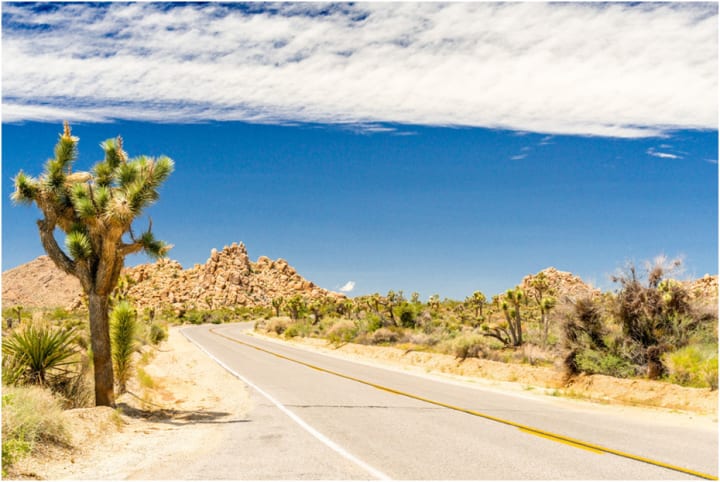
Here's where a wide-angle lens will earn its keep. Those blue skies, while impressive during the day, make for glorious sunsets and unforgettable starry nights. A sturdy tripod is needed as the sun goes down and the light dims. An excellent sunset photo requires a good foreground subject, and the trees do their duty like soldiers at attention.
A haven for astrophotographers
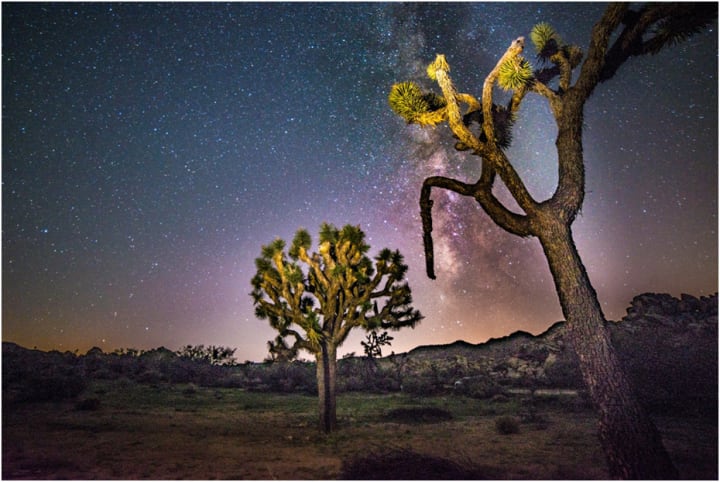
Because of the dark skies at Joshua Tree National Park, it is a haven for astrophotographers looking to capture the stars in all their glory. Most often, it is the Milky Way they chase. The images are always impressive but in-reach for even amateur photographers if you know the secret formula. So, I’ll relate it here:
1. Set your camera to manual mode.
2. Set your ISO to 3200
3. Set your shutter speed to 30 seconds
4. Best results are obtained with a wide fast lens, e.g., 14mm at f/2.8
That's all there is to it.
A small flashlight can be used to light-paint the foreground. It only takes a little bit; a one-second sweep during the 30-second exposure does the trick.
Per the National Park Service website
What to know before you go
• Cell service
• There is no cell service available in the park.
• Services
• There are no food or grocery services in the park.
• Staying overnight
• During the spring season, campgrounds are full nearly every night. Plan ahead and make reservations.
• Bus routes
• Confirm your route with the bus driver.
• Bus stops
• Buses will only drop off and pick up at designated stops.
• Accessibility
• All buses are equipped with wheelchair lifts.
• Pets
• Pets in crates are allowed on shuttle buses if they fit on the rider's lap. They are not permitted on the floor or in the aisle. Learn more about having your pet in the park.
• Bicycles
• Each bus can carry two bicycles.
What to bring
• Water
• There is no water available in the park. Bring at least one gallon per person, per day, especially if you will be hiking or climbing in the park.
• Sunscreen and protective clothing
• There is little to no shade in most places. Protect your skin from the elements and your body from dehydration. Sunglasses, a long-sleeved shirt and pants, and a wide-brimmed hat are a must in the desert.
• Food
• There is no food available in the park. Bring salty snacks and food for an entire day.
• Layers
• Temperatures change drastically in the park over the course of a day. Bring layers of clothing for the chilly mornings and late evenings.
• Camera
• Boulders, Joshua trees, cactus, and more!
• Map
• You won't have cell service in the park, so be sure to pick up a free map and newspaper at a park visitor center before boarding the bus.
About the Creator
Jim DeLillo
Jim DeLillo writes about tech, science, and travel. He is also an adventure photographer specializing in transporting imagery and descriptive narrative.
Keep reading
More stories from Jim DeLillo and writers in Photography and other communities.
Monsters at Borrego Springs
The Serpent and the Stars A warm wind blows across me, but I still feel a chill run down my back. I'm alone in the desert. I’m at one of the darkest places on earth according to my map. It's a little scary, especially while visions of coyotes, scorpions, and roving gangs of desert hares dance in my head. I'm here to photograph monsters. It isn't my imagination. I saw them as I drove in during the day. Standing as tall as two stories, I could make out their rust-colored silhouettes against the arid sand.
By Jim DeLillo4 years ago in Photography
Leavie Scott
ORDER HERE Chicago – A Radiant Urban Masterpiece by Leavie Scott Arts & Culture Review – Feature Story In his striking new work Chicago, photographer Leavie Scott captures the soul of the Windy City with a level of vibrancy and emotional resonance that is impossible to ignore. The image immerses viewers in a dazzling skyline bathed in mesmerizing tones of purple, pink, and gold—a palette rarely seen in traditional urban photography and one that instantly distinguishes Scott’s artistic voice.
By Organic Products 7 days ago in Photography
Curious Photography Tips Every Beginner Should Try
Have you ever wondered why two people using the same camera can produce completely different photos? The answer often lies in how well the photographer understands the camera itself. For beginners, cameras can seem filled with confusing buttons, dials, and settings. But what if those settings are actually the key to better photos?
By Craig Spiesman5 days ago in Photography
The BAFTA Awards
By now, in a stunning departure from recent years, most of the world is aware of what happened at the BAFTA film awards. Social Media Headlines will tell you the bare bones: that John Davidson, a Tourette's Syndrome advocate, shouted a racial slur at two Actors of Colour, Michael B Jordan and Delroy Lindo.
By Natasja Rose6 days ago in Psyche


Comments
There are no comments for this story
Be the first to respond and start the conversation.