Latest Stories
Most recently published stories in Photography.
Lomography
Lomography or the art of colourful, throwaway, lo-fi photography celebrates its 21 birthday during the year, 2013. This International photographic movement started humbly by a handful of young students living in Vienna in 1992 and grew into an international phenomenon and a global commercial enterprise. The concept came about when the small group of friends discovered the joy of using a small soviet camera, the Lomo LC-A, manufactured at the Lomo factory in St. Petersburg, Russia. The students fell in love with the unexpected colour pallet and vignetted look that the cheaply manufactured lenses produced. As the word spread through friends in Vienna, demand grew for the cameras and the Lomographic Society was formed. The entry fee was the price of a Lomo camera and with the camera came life membership and a commitment to the ethics of the Society. The society developed the concept of producing immediate, almost throw away images with the credo 'Don’t think, just shoot.' Rejecting the strict disciplines of regular photography, this movement was the equivalent of the punk rock attitude of the late 70s. Learn three chords and form a band. The lomography philosophy was; here's a camera, here's some film now go take pictures, you are a photographer. Assuming a stance like that of the Dogme 95 film movement which came along a few years later, they believed in stripping the art right back to basics. To help with this concept the Lomographic Society also came up with their own ten golden rules:
By Anthony Laverty7 years ago in Photography
Life Through a Lens
Like many things in my life, I tend to easily fall out of love with certain things I used to be passionate about or have such a huge desire for. For some odd reason I've never had something I've fallen deeply for and thought to myself THIS is what I want to do for the rest of my life. Maybe some people can relate, I don't know. There probably is. When I first started school, I always thought I was heading in a direction where I knew I was going to be successful and I knew which path I was going to take. Once I got nearer to the end of school, I felt more lost than I had ever been. It's a weird thing growing up. You feel like you have to change your mind every day because you can't decide what you want to do. It feels like you're stuck in this cycle society portrays rather than what you actually want to do—the normality of finishing school, going to college, heading off to uni, and then being stuck in a 9-5 job for the rest of your life. It scared me. But deep down, I knew I had to start somewhere... right? Anyways, I was at a point in my life where I felt lost and had no desire to even do anything. All the things in my life that I used to love just didn't satisfy me as they used to when I was younger and I didn't know why. One thing I did learn, however, is deep down there is always something that a person loves more than anything. Sometimes we just don't know it yet.
By Jiddl Islam7 years ago in Photography
Top 5 Fashion Photographers on Instagram
If you're a photographer, then you know all about finding inspiration online or in print. Personally, I love buying fashion magazines like Dazed and Flaunt in those awesome corners stores of New York City to find new content. Likewise, Instagram is a great place for fresh ideas and I would love to share my Top 5 contributors with you! Below you will find work from people with hundreds of followers to hundreds of thousands but at the end of the day their work is too good to pass up.
By Audrey O'Donnell7 years ago in Photography
Antoine D’Agata: Photography as an Affective Vessel
French photographer Antoine D’Agata is universally recognized for his “taboo” predilections. Drawn to the Other, D’Agata seeks out subjects in dark corners of the world that First World society would likely deem inhabitable. Frequently compared to his mentors Nan Goldin and Larry Clark who adhere to similar mantras as D’Agata, he manages to stick out like a sore thumb in the mix of those he’s often likened to. This is heavily due to the transcendent nature of his work, which he asserts is typically driven by pure accidents and done with as little intention and direction as possible. Focusing on the depiction of the daily practices of the Other, may it be drug use, prostitution, sadomasochism, and so on, D’Agata uses photography as a direct engagement with the world, where the hierarchy between photographer/photographed is blurred, commonly throwing himself into the action. Through his insertion of himself in his works, he shatters the boundary that separates Artist from the Other.
By Christian Schnapp7 years ago in Photography
Most Iconic Photos Ever Taken
Any number of a hundred or more iconic and influential images could fill this list, but I've narrowed down 10 photographs that I consider to be among the absolute most iconic photos ever taken. Some depict great heroism or great tragedy. Some depict death. Some of these photographs are iconic because they depict pinnacle moments in world history or because their subjects have become a symbol for various cultural movements. Whether candid or posed, well-framed or haphazardly captured, these photos have withstood the test of time, exist as tangible examples as to how to become a famous photographer, and have been characterized as some of the most iconic photographs in world history.
By Joseph D. N. Kendrick7 years ago in Photography
Art and Photography Essay
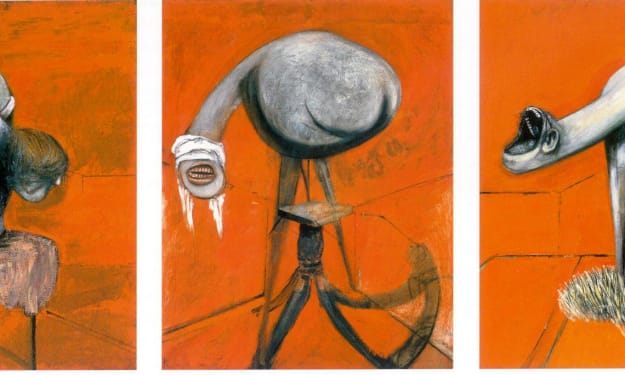
Contemporary and Modern Art, as I soon discovered through my theme of ‘distortion’ and ‘fragmentation,' are closely linked in both the concept and technique. They also both portray emotion such as agony, emptiness, and desperation. In the art world, a distortion is any change made by an artist to the size, shape, or visual character to a form, to express an idea, convey a feeling or enhance visual impact. I have always been fascinated by a style based on exaggerating elements of the human form. My aim was to differentiate between artistic exaggeration of elements and turn this concept into an artwork. If art is what is to be seen, rather than what is seen, then any amount of distortion should be acceptable. My intent was to create purpose in the use of distortion; to use distorted bodies and contorted faces to advance the composition and make a creative statement. A large source of inspiration was my visits to galleries, such as MOMA, Metropolitan Museum of Art in New York, V1 Gallery and NY Carlsberg Glyptotek in Copenhagen, with memories of the lengthening of fingers and necks in the work of John Singer Sargent and the shocking grotesque forms of Francis Bacon. I, therefore, decided to focus on and contrast the work of a contemporary artist and a modern artist of the twentieth century, choosing the work of Jesse Draxler and Francis Bacon, that both use distortion to enhance an emotional portrayal in their work.
By Natalie G.7 years ago in Photography
Photography Project Ideas: Car Window. Top Story - October 2018.
In This Article Photographers who inspired this idea Equipment you’ll need Best type of location to take your photos Optimum camera settings Composition of your image Editing your pictures using Lightroom and Photoshop Examples of my photos
By Becky Street7 years ago in Photography
Best Concert Photographers on Instagram to Follow
Concerts are always exciting. There’s the roar of the music, the ability to see your musical idol in action, and the incredible light shows that just add amazing depth to each second of the show. That’s why people pay hundreds of dollars for concert tickets, and why everyone sees them as a major event.
By Skunk Uzeki7 years ago in Photography
Most Famous Photographers of All Time
A full account of the most talented and most famous photographers of all time would be truly a massive tome. Multiple photographers have been embedded in our world's history through their photographs, if not always by their own names. Here is just a small sampling of some of the most notable photographers from the past hundred years or so, along with some thoughts on what brought them to such levels of notoriety.
By Joseph D. N. Kendrick7 years ago in Photography
Storytelling from Behind the Lens
Currently, the phrase "lifestyle" is all over; practically every place you look; much like the term "vintage" but aside with that. In reference to Wikipedia, Lifestyle photography/videography is a style that primarily aims to capture people in situations, real-life events or milestones in an artistic manner. We began offering Lifestyle Sessions as a way to preserve these real-life moments. Our sole focus is to tell the stories about your life and celebrate them. We have provided a few tips and examples to help us tell your story better.
By Ginny Dorsey7 years ago in Photography
10 Amateur Photography Mistakes Everyone Makes
What makes a photograph look professional? Is it using one of the best DSLR cameras? Is it using the best 20mm film? Of course not! You can take amazing photos with an iPhone that would be worthy of sharing on Instagram.
By Ossiana Tepfenhart7 years ago in Photography
Best Astrophotographers on Instagram to Follow. Top Story - September 2018.
There are Instagram accounts for photographers and artists of all types, from design- and architecture-focused photography to portraits of people and pets. One of the deepest wells in this field is astrophotography, which is pretty much anything to do with outer space: meteor showers, planets, stars, the moon, sunsets, sunrises, and more. There are probably hundreds of astrophotographers on Instagram, but here are some of the best and most prolific for you to follow right now.
By Joseph D. N. Kendrick7 years ago in Photography