

Leroy Harris hailed from the quiet confines of West Feliciana Parish, where he spent his formative years in a small town, attending school until the age of 15. Like many young men of the 1950s, he made the bold decision to leave school behind and enlist in the army. From the very first moment he arrived at Fort Sam Houston, Leroy dedicated himself wholeheartedly to his military duties. Standing tall and lean, he sported a perpetual five o'clock shadow that seemed to defy his best efforts to tame it. With a wry smile, he often quipped, “The hardest enemy to capture was my razor,” lamenting, “It was never where I left it last!” His infectious humor endeared him to his fellow soldiers, and whenever the opportunity arose, he would join them for a game of baseball, showcasing a powerful southpaw swing that earned him the reputation of “owning the bat.”
In 1951, Leroy's unit was deployed to a location just a stone's throw from the Naktong River in southeastern Korea, amidst the chaos of the "Pusan Perimeter." The fighting was fierce, and the two years that followed were grueling. When the conflict finally came to an end, Leroy chose to reenlist, finding himself once again in the thick of battle during the Vietnam War. The toll of these harrowing experiences weighed heavily on the soldiers, transforming them into mere shadows of their former selves. Leroy was no exception; in 1965, he suffered a devastating injury, losing a leg to mortar fire. Discharged and sent back to Louisiana, he returned to find his childhood home in disarray, compounded by the loss of both his parents during his service. With a meager pension of just $62 a month, he sought assistance from the government, only to face daunting lines at the VA offices, where veterans often camped out overnight, only to be turned away by city police.
Leroy's existence was a relentless battle. He was little more than skin and bones, barely managing to eat, as his meager pension barely covered his needs. Working just 20 hours a week at the Mobil Station, he spent the rest of his days scouring the streets for any job he could find. Gaining access to the VA for assistance was nearly impossible. The country owed him a debt, but he would never voice that sentiment. A humble man, he felt it was his obligation to endure, yet life was a struggle with only one leg, and things took a turn for the worse when his stump became infected. He endured weeks of fever, shuttling in and out of the VA Hospital. Each time he seemed to improve, they would send him home, only for the infection to flare up again. The amputation had been done poorly, leaving him vulnerable to relentless infections. The government had a strict policy: veterans could only stay in the hospital for three days unless they were running a fever.
Leroy had no family to speak of, just a small plot of land where his family’s homestead stood. In June of 1966, Leroy passed away in his home. It took a week for anyone to discover him; the mailman, noticing he hadn’t seen Leroy in some time, decided to check in and found the lifeless body. “The pain must have become too much for him,” the mailman recounted to the police, “he had a bullet wound in his head and a pistol lying nearby.”
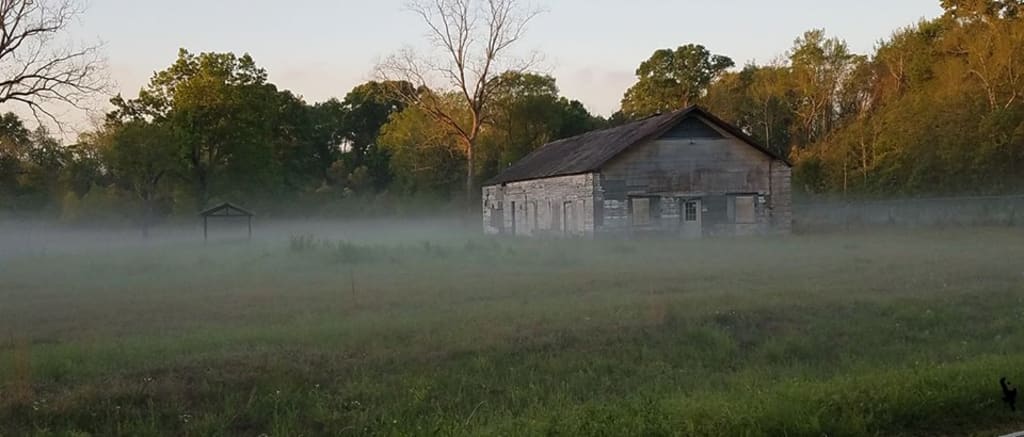
To this day, no one has taken up residence in Leroy Harris's homestead, which stands as a stark reminder of the nation’s failure to care for those who served it faithfully. Some claim to see a flickering candle in the window. If Leroy's spirit lingers there, lets hope it retains the same gentle and unassuming nature he always embodied.
____________________________________________________
Authors note: According to available data, approximately 2.7 million Americans served in the Vietnam War, with over 58,000 losing their lives during the conflict; the average age of those killed was 23.1 years old, and 61% were under 21 years old; a significant portion of Vietnam veterans continue to face physical and mental health challenges like loss of limbs, and PTSD due to their service, and many experienced difficulties readjusting to civilian life after the war. Among all Vietnam War–era veterans after 1 year of follow-up, the suicide CR was 26.4 per 100 000 persons, increasing to 33.5 after 40 years of follow-up. This is truly a sad testament to our government's treatment of our nations dedicated service men.
About the Creator
ᔕᗩᗰ ᕼᗩᖇTY
Sam Harty is a poet of raw truth and quiet rebellion. Author of Lost Love Volumes I & II and The Lost Little Series, her work confronts heartbreak, trauma, and survival with fierce honesty and lyrical depth. Where to find me
Keep reading
More stories from ᔕᗩᗰ ᕼᗩᖇTY and writers in Photography and other communities.
My Year, in Prattling and Photos
It's been a year since... last year. Ironically, it seems I've found myself a new tradition of getting sick during the New Year holidays. At least, this year (that is, this inter-year period remarkable for its shiny decorations in the streets and houses, and closed supermarkets and pretty much everything), I'm doubtlessly doing better: I've managed to come visit my friends in Germany for Christmas (which I failed to do last year) and—after having some good quality time eating machanka, playing Munchkin and swinging machetes (the last one obviously crept into this checklist only for the sake of the phonological form)—I came back home via proverbial Deutche Bahn and probably less known Schweizerische Bundesbahnen, my body hosting a family of viruses, virions and who knows what other tiny critters somewhere inside my chest.
By Andrei Z.18 days ago in Photography
How, Too
Many people wonder how, too. You are not alone, and I am an expert. I will teach you how, too! First, you need to remit a small application fee and fill out an application describing the nature of your financial situation and how often payments will be made, as this will have great bearing on how well I teach you how, too.
By Harper Lewis3 days ago in Fiction



Comments (3)
My own son fought on the front lines of Desert Storm and he came home with a severe case of PTSD. He even threw away the metals that he was awarded during the war, - he said they had blood on them. People do not know and are not aware of the suffering and damage that are done to our young soldiers during war. I know first hand because I witnessed it in my own child. Great Article Sam and an important one to write.
What a tale of dedication to country and selflessness. It is a pity that countries do not recognize those who sacrificed all for their country. Sacrificed for wars they did not start and probably wanted no part of. I always think that when I watch the Rambo series.
It's horrible how our Vets have been treated