
Exploring the Technology Behind AI Face Swapping
The technology behind AI face swapping is explored, generative adversarial networks included, as well as its applications and ethical implications.

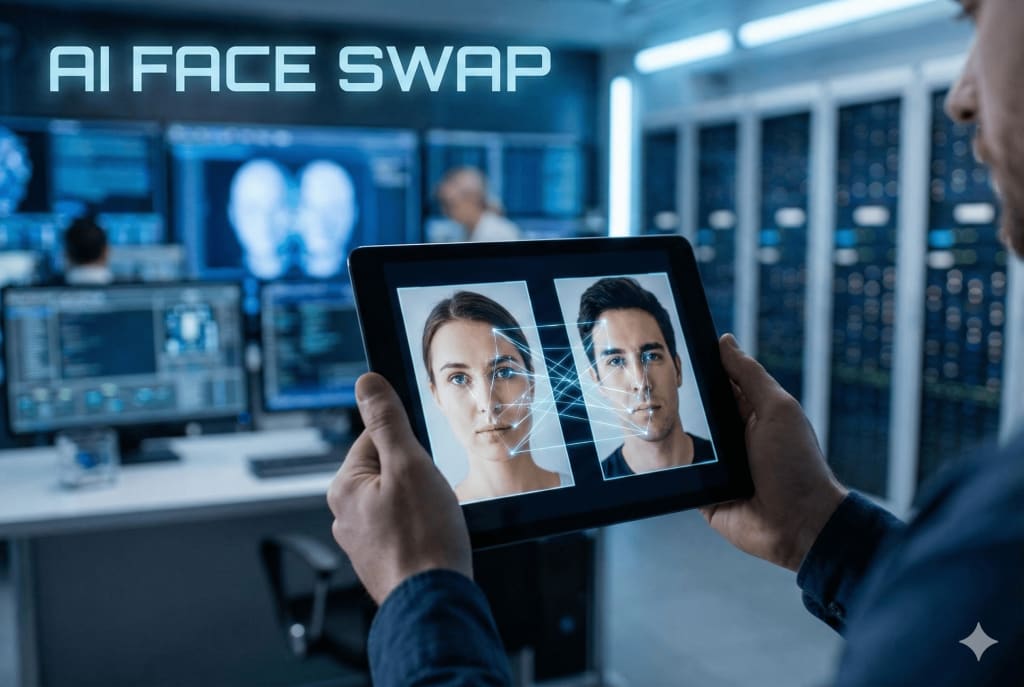
Among all the artificial intelligence (AI) innovations that reached out to the public and the field in general, AI face swapping has caught the most attention and has become the subject of many discussions regarding its ethical use despite the fact that it barely survives through the magical ban. One of the magic tricks that AI managed to do is transforming one person's face into another's. Here, we will take an in-depth look at the technology behind it, its uses, and the powerful tool's possible ramifications.
The Foundations of AI Face Swapping
Deep within the operations of AI face swapping lies a particular method of AI which is known as generative adversarial networks (GANs). GANs comprise of two neural networks, the generator and the discriminator, which collaborate to produce extremely lifelike pictures.
• Generator: The generator produces new images based on the learning of patterns and features from a given dataset (like thousands of faces).
• Discriminator: The discriminator judges how realistic these produced images are, separating between real and fake images.
The generator and the discriminator are in a kind of "game," where the generator is constantly refining its output to mislead the discriminator into thinking the generated image is real. Eventually, the generator becomes fantastic in making photorealistic images, among them being the face swaps. Face swap AI technology applies cutting-edge machine learning algorithms to flawlessly change faces in pictures and videos.
How Does AI Face Swapping Work?
1. Data Collection: For swapping faces, the AI requires an enormous amount of images of faces as its dataset. These images can either be taken from public domains or made from custom datasets. The more images that the AI is trained on, the more it will develop the ability to differentiate and recognize the subtleties of face features and emotions.
2. Facial Recognition and Mapping: The first thing AI does is to use the modern vision algorithms to find the faces in the images. This process includes recognizing the facial landmarks like eyes, nose, mouth, and making a digital representation of these features. After that, the AI basically knows thface's places and proportions.
3. Face Synthesis: Based on this map, the AI performs the swapping of landmarks between pictures. Mixing skin tones might be one of the steps, but also adjusting the light to the source image, and fine-tuning the texture to ensure smoothness of the final product.
4. Refinement and Output: The last operation is the enhancement of the changed face's look, which is done to see whether it can be recognized as a part of the same image. The machine learning-based AI subsequently corrects the inconsistencies like different lighting or misaligned facial features to ensure a polished, realistic face swap result.
Applications of AI Face Swapping
AI face swapping technology has a wide range of applications, some of which are undeniably useful, while others raise significant ethical questions.
1. Entertainment: In movie and TV production, AI face swapping is a significantly facilitating method of creating and manipulating the characters. It can, among others, give the director the power to resuscitate the dead actors, to reverse their age, or simply use the face of another actor for uglifying the existing one or overlays for artistic reasons.
2. Virtual Try-Ons: In the field of beauty and fashion, AI face swapping is among the leading technologies that are widely adopted by the companies to provide their customers the service of being able to visualize how different makeup or glasses would look on their faces without actually trying them on.
3. Personalized Content Creation: Social media users frequently resort to face-swapping apps for the purpose of producing amusing and fun content. The swapping of faces in videos or photos is made possible by these platforms that open up the world of creativity with no limits.
4. Training Data for AI Models: Artificial intelligence face swaps could also be employed in the training of facial recognition technologies, thus providing a wide variety of sources that will enhance the reliability of these technologies in real-world scenarios.
Ethical Considerations and Risks
While AI face swapping presents exciting opportunities, it also raises several ethical concerns:
1. Deepfakes: AI-powered face-swapping technology has advanced to such a degree that the term "deepfakes" is now being used to refer to them—these are videos or pictures that present the face of one person on top of another's, usually in an extremely believable way and often with alterations. The benevolent side of this tech is, of course, the usage in entertainment or parody, but the dark side is there too, leading along the path of deception, fake news, and imposition on personalities.
2. Privacy Issues: The use of AI for face swapping has opened up a whole can of privacy and consent issues. With the high-quality face swaps possible even from people's public images, there are nearly no safety measures employed to make sure that nobody's facial likeness is used without their consent for malicious purposes.
3. Manipulation and Trust: With the fast-paced progression of AI technologies, it will soon become almost impossible to differentiate between AI-generated face swaps and real-life images, and this will again make it difficult for the audience to believe in the authenticity of the pictures. The giving away of trust can cause harm, particularly in cases like journalism where visual proof sometimes is regarded as the mainstay of truth.
4. Security Risks: A group of experts is concerned that the same innovation responsible for AI face swapping may be a source of fraud, identity theft, and even cyber-attacks, if it happens. For instance, deepfake technology might be one of the tools used to impersonate a person's voice or face with the ultimate aim of getting access to clandestine information or systems. The use of faceswap AI makes it possible for users to easily change faces in pictures and videos, creating realistic and fun content.
The Future of AI Face Swapping
The technology of AI face swapping is continuously advancing, and gradually its applications and ethical issues will be the same. Scientists are enhancing the accuracy of the technology, and they are working on deep learning models to produce more and more realistic outcomes. On the other hand, there are also initiatives to invent AI apps that can recognize face swapping which will be one of the ways to counteract the dangers of deepfakes.
AI face swapping will probably always be under the influence of creativity and the need for technological innovation but it is still a matter of ethical debate whether the usage of this technology can be justified. Just like with any other powerful instrument, it is very important to differentiate the good side of the innovation from the bad side of the exploitation, thus, making sure that the advantages of AI face swapping over its possible harms are much greater. The new-age of an AI face swap video is capable of swapping the faces in the video clips effortlessly and producing very life-like and dynamic content with high degree of realism.
Conclusion
AI face swapping has unveiled a great deal about the intersection of machine learning computer vision, and image manipulation. No matter if it is for fun, social networking, or doing business, this technology has already manifested its strength and adaptability. Alas, the dilemma of its rising use is that it is still fraught with moral and societal issues of a very complex nature that require being very careful with the handling. Hence, the more we get to play with this tech the greater the necessity of keeping an eye on the manner of its use and the potential drawbacks from it.
About the Creator
Keep reading
More stories from CEO A&S Developers and writers in Photography and other communities.
Crossed Eyes in Children: How Vision Therapy Can Help
Crossed eyes, medically known as strabismus, is a condition where a child’s eyes do not align properly. One or both eyes may turn inward, outward, upward, or downward, often leading to a misalignment that can affect vision and depth perception. This condition can develop in early childhood and, if left untreated, can have long-term effects on a child’s ability to see clearly and interact with their surroundings. A kids eye examination is crucial for identifying vision issues that could affect their learning and overall development at an early age.
By CEO A&S Developers3 months ago in Longevity
Top 10 Product Photo Editing Companies to Maximize ROI (2026)
In eCommerce, professionally edited product images are a critical factor in driving customer engagement and optimizing online sales. High-quality, consistent visuals foster trust and improve the overall shopping experience. Without proper editing, businesses risk poor representation, increased returns, and lost sales opportunities.
By Nathan Neal23 days ago in Photography
Veil of Subconscious Awakening
Images slide behind my eyelids like film cadres, bursting with meanings. In one moment, I’m speeding down the highway, making the speedometer swing wildly like a frantic pendulum. The next moment, I’m plunging from a falling plane, slowly crashing earthward. At home, I meet black cat’s green, googly eyes staring at me from the cavernous hollowness of the kitchen. When I turn for a moment, it disappears, and all I can see is a pair of blue suede shoes set up against the wall. I pick them up and put them on. When I glimpse at them again, they’ve become black as night, making me blink and flinch.
By Moon Desert7 days ago in Fiction




Comments
There are no comments for this story
Be the first to respond and start the conversation.