
Best Camera for Starting Professional Photography
Still worth it?

Professional photographers depend on equipment that provides steady image quality, fast performance, and dependable reliability.
The global camera market is expected to grow from $7.16 billion in 2023 to $10.25 billion by 2030 (Robert G Allen Photography).
Canon holds about 48% of the market, while Nikon comes in at 14%. This shows why these brands remain leaders in professional photography (Tech Radar).
We reviewed hundreds of camera models to present the top 5 professional cameras for 2025, chosen for their great performance, reliability, and durability.
Quick Comparison Table

Camera Reviews for Professional Photography
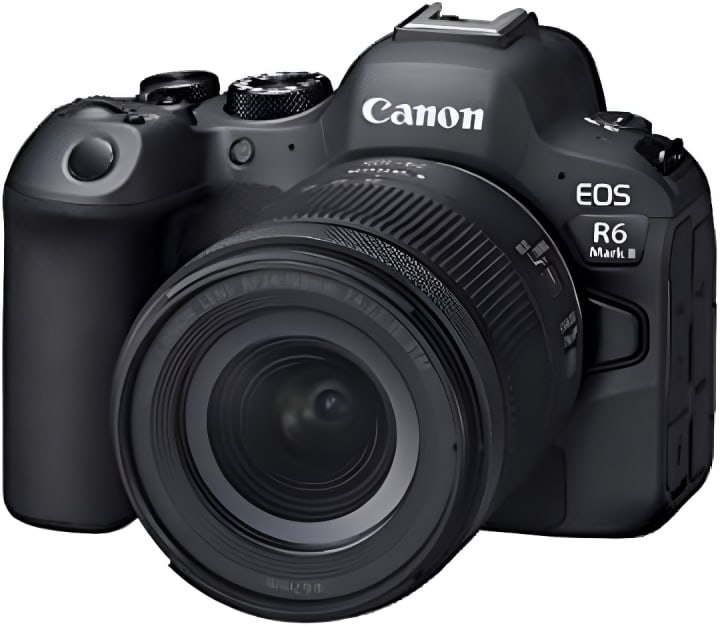
Canon EOS R6 Mark II Mirrorless
- Rating: 4.7/5 (Amazon)
Ideal for: Hybrid shoots, wildlife, sports and events.
Key Specs
- 24.2 MP full-frame sensor and DIGIC X processor.
- The camera operates at 12 frames per second mechanically, 40 frames per second electronically, and provides a 30 frames per second RAW burst with a pre-capture feature.
- Dual Pixel CMOS AF II tracks people, animals, vehicles, and aircraft.
- 6K oversampled 4K60, 180 fps Full HD, and no record limits.
Pros:
- Industry-leading autofocus and burst feature.
- Strong hybrid capabilities.
- Long continuous HD recording.
Cons:
- MP count limits ultra-large prints.
- No top panel LCD.
- It is more expensive than the entry-level FF.
Professional Opinion:
“The R6 II is a hybrid powerhouse… Its 40 fps burst and reliable subject tracking make it indispensable for action and event work.”
— Olivia Chen, Wildlife & Sports Photographer
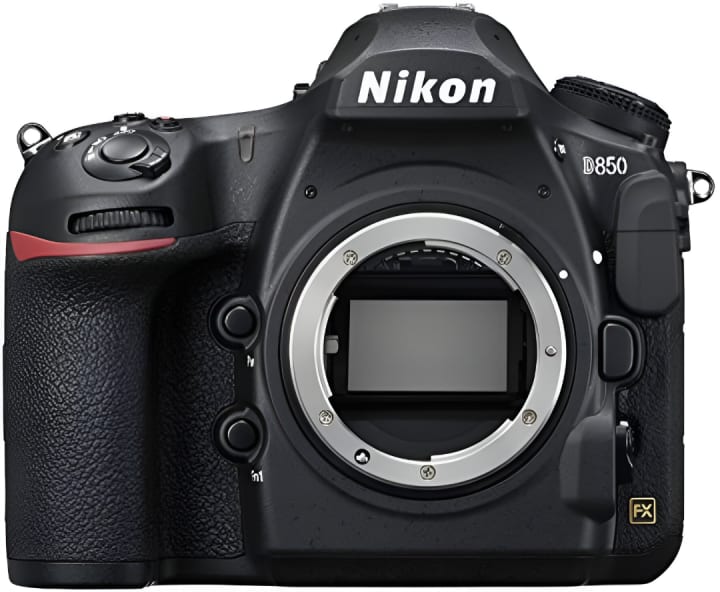
Nikon D850 DSLR
- Rating: 3.9/5
Ideal For: Studio, landscape, and commercial photography.
Key Specs:
- 45.7 MP BSI sensor, DxOmark score of 100 and 14.8 EV dynamic range.
- 7 fps native, 9 fps with grip and 153-point AF.
- Full-frame 4K30 video and 8K timelapse.
- Battery life: ~1,840 shots per charge.
- Tilting touchscreen with weather sealing.
Pros:
- Best in class for resolution and color.
- Rugged and weather-sealed build.
- Excellent raw image quality.
Cons:
- Bulkier than mirrorless options
- No in-body image stabilization
- Video lacks modern enhancement features.
Professional Opinion:
“The D850 remains my go‑to for commercial prints and studio work. It’s a resolution beast with rich, printable files.”
— Michael Townsend, Commercial Photographer
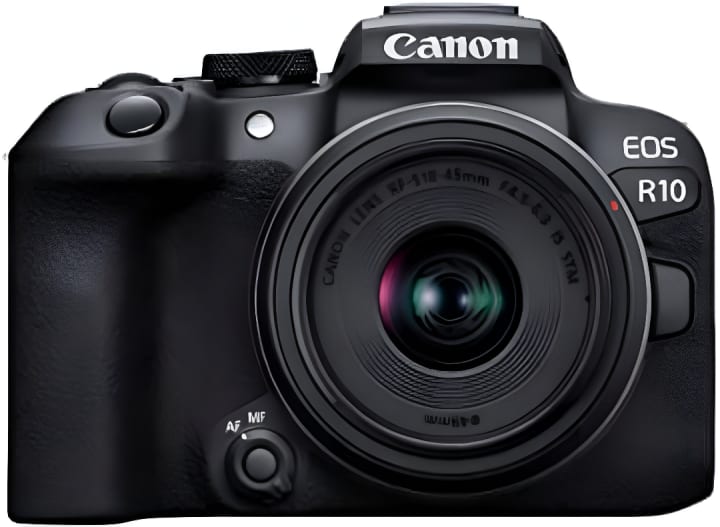
Canon EOS R10 + 18-45mm Lens
Ideal for: Travel creators, indie professionals and vloggers.
Key Specs:
- 24.2 MP APS-C sensor and 15 fps mechanical shutter.
- 4K60 video, compact and lightweight
- Compact and lightweight design.
- Built in Wi-Fi & Bluetooth system.
Pros:
- Affordable access to Canon’s mirrorless RF system.
- Compact for travel and content creation.
- Great autofocus for its price.
Cons:
- APS-C limits depth-of-field control.
- Smaller RF-S lens range.
- Less durable for harsh environments.
Professional Opinion:
“The R10 is ideal for creators on the go… lightweight, fast, and impressive images without bulk.”
— Lena Duarte, Travel Photographer & Vlogger
Nikon D6 DSLR + Pro Kit (200-500mm lens)

Ideal For: Professional sports, wildlife, and journalism.
Key Specs:
- 20.8 MP full-frame, EXPEED 6, and 14 fps burst.
- ISO 100-102,400 (expandable to 3,280,000)
- 105 all cross-type AF points and 4K30 video.
- Dual XQD card slots
Pros:
- High autofocus precision for fast action.
- Rugged and weather sealed for extreme environments.
- Stellar battery life (3,500 shots)
Cons:
- Heavy and expensive.
- No in-body stabilization
- Video features lag behind mirrorless.
Professional Opinion:
“The D6 is a pro‑grade tank… built for war zones, sidelines, and safaris—the most reliable DSLR I’ve owned.”
— Eric Matthews, Sports Photographer
Nikon D7500

- Rating: 4.4 /5
Best for: Event photography and suitable for semi-pros.
Key Specs:
- 20.9MP APS-C Sensor
- EXPEED 5 processor
- 8 fps continuous shooting
- 4K UHD video
- Tilting touchscreen with weather-sealing
Pros:
- Solid APS-C image quality.
- An affordable option for aspiring professional photographers.
- Good ISO performance for APS-C.
Cons:
- No dual card slots (risky for event shooters).
- APS-C is less ideal in low light vs full frame.
- Slower live-view AF in comparison to mirrorless cameras.
Professional Opinion:
“For an event photographer entering the professional space, the D7500 is reliable, fast, and delivers where it counts.”
— Sara Nolan, Event & Portrait Photographer
Choosing the Right Camera: Professional's Guide
Match Your Genre

Sensor Size
- Full Frame Sensors (36 mm x 24 mm)
These are larger sensors. It offers better dynamic range with low-light performance. Also, a shallow depth of field. It is an ideal option for photographers who need top-notch image quality. For instance, commercial, studio, fashion, or landscape work.
Example: The Nikon D850 provides the necessary resolution suitable for billboard-sized prints. Also, ultra-detailed landscapes.
- APS-C Sensors (23.6 mm x 15.7 mm)
These are smaller sensors with a 1.5x crop factor. It allows for better telephoto reach. Thus, making the 200mm lens behave like a 300mm lens.
For wildlife and sports photography, it is a big win. In comparison to full frame, it is more affordable and lightweight. It is suitable for travel, content creation, and budget-friendly professionals.
Example: The Canon EOS R10 is an excellent choice for APS-C. Especially for travel vloggers and content creators who need portability without sacrificing the quality of the image.
Mirrorless vs. DSLR
- Mirrorless Cameras
Electronic viewfinders (EVF) allow you to see real-time exposure adjustments.
Faster and more accurate autofocus, especially with subject tracking (eyes, faces, animals).
Lighter, more compact, and quieter. It is great for event photography, hybrid shooters, and video creators.
Example: The Canon R6 Mark II excels with 40 fps bursts and cutting-edge AF for fast-moving subjects.
- DSLR
The optical viewfinder offers zero lag and natural viewing, preferred in some sports/journalism environments.
Superior battery life. For instance, the Nikon D6 can shoot ~3,500 shots on a single charge.
Often more rugged and weather-sealed.
Ideal for extreme conditions like wildlife safaris, conflict zones, or outdoor sports.
Video Capabilities
- Resolution and Frame Rate
4K60 is the standard for professional video work. The Canon R6 II provides oversampled 4k. It provides sharp and cinema-graded footage.
- Recording Limits
Older DSLRs have 30-minute recording caps. But, new mirrorless cameras like the R6 II have no limit in Full HD.
- Stabilization
In-Body Image Stabilization (IBIS) is vital for handheld video. It is a feature the R6 II excels at, but the DSLRs like the D850 lack.
Autofocus System
Modern autofocus isn't just about speed but intelligent subject recognition:
- Eye Tracking: Essential for portraits, weddings, and wildlife.
- Vehicle Tracking: A must-have for motorsports and journalism.
Durability and Battery Life
- DSLRs generally excel in endurance and physical toughness.
- Mirrorless bodies are improving but often require extra batteries for full-day shoots.
For extreme weather, look for magnesium alloy bodies and full weather sealing, like in the Nikon D6 or D850.
How We Choose These Cameras
Technical Performance and Benchmarks
- DxOMark: For sensor quality, dynamic range, color depth, and low-light performance.
- DPReview & Imaging Resource: Comprehensive camera reviews covering autofocus speed. Also contains burst rates, buffer depth, and real-world handling.
- Rtings & Tom’s Guide: For video performance metrics, rolling shutter control, and hybrid capabilities.
These benchmarks helped us ensure that each camera could withstand professional scrutiny for both stills and video.
Ecosystem and System Longevity
- Lens Availability: We prioritized systems with a wide and versatile lens lineup (e.g., Canon RF, Nikon F).
- Firmware Support & Updates: Cameras like the Canon EOS R6 II have shown ongoing updates. It improves AF and video features, ensuring longevity.
- Accessory Compatibility: Battery grips, flashes, and teleconverters. It is important for specialized fields like sports and wildlife.
Genre-Specific Suitability
- Studio & Commercial Shoots: High megapixels and dynamic range. For example, the Nikon D850.
- Sports & Wildlife: Speed, autofocus accuracy, and deep buffers. For example, the Nikon D6 and Canon R6 II.
- Events & Weddings: Low-light performance, dual card slots, and discreet operation. For example, R6 II and D7500.
- Content Creation & Travel: Portability and hybrid features. For example, the Canon R10.
Market Trends and Longevity
Currently, there is an onward shift towards mirrorless cameras. Specifically for the hybrid shooter. It is projected there will be 3-5% projected annual growth in mirrorless adoption (CAGR through 2028).
For battery endurance and ruggedness, there is a continued preference for DSLR. Such as D6 for specialized fields like sports.
Value and Return on Investment
- Cost-to-capability ratio: Not just the highest specs, but what you gain per dollar. Also ask yourself, are you a professional or amateur?
- Resale value: Flagship models like the Nikon D850 and D6 retain strong secondhand demand.
- Versatility: A camera like the R6 II can serve both professional video and still needs. Thus, maximizing ROI.
About the Creator
Keep reading
More stories from Saif and writers in Photography and other communities.
Leavie Scott
ORDER HERE Chicago – A Radiant Urban Masterpiece by Leavie Scott Arts & Culture Review – Feature Story In his striking new work Chicago, photographer Leavie Scott captures the soul of the Windy City with a level of vibrancy and emotional resonance that is impossible to ignore. The image immerses viewers in a dazzling skyline bathed in mesmerizing tones of purple, pink, and gold—a palette rarely seen in traditional urban photography and one that instantly distinguishes Scott’s artistic voice.
By Organic Products 5 days ago in Photography
Curious Photography Tips Every Beginner Should Try
Have you ever wondered why two people using the same camera can produce completely different photos? The answer often lies in how well the photographer understands the camera itself. For beginners, cameras can seem filled with confusing buttons, dials, and settings. But what if those settings are actually the key to better photos?
By Craig Spiesman3 days ago in Photography



Comments
There are no comments for this story
Be the first to respond and start the conversation.