

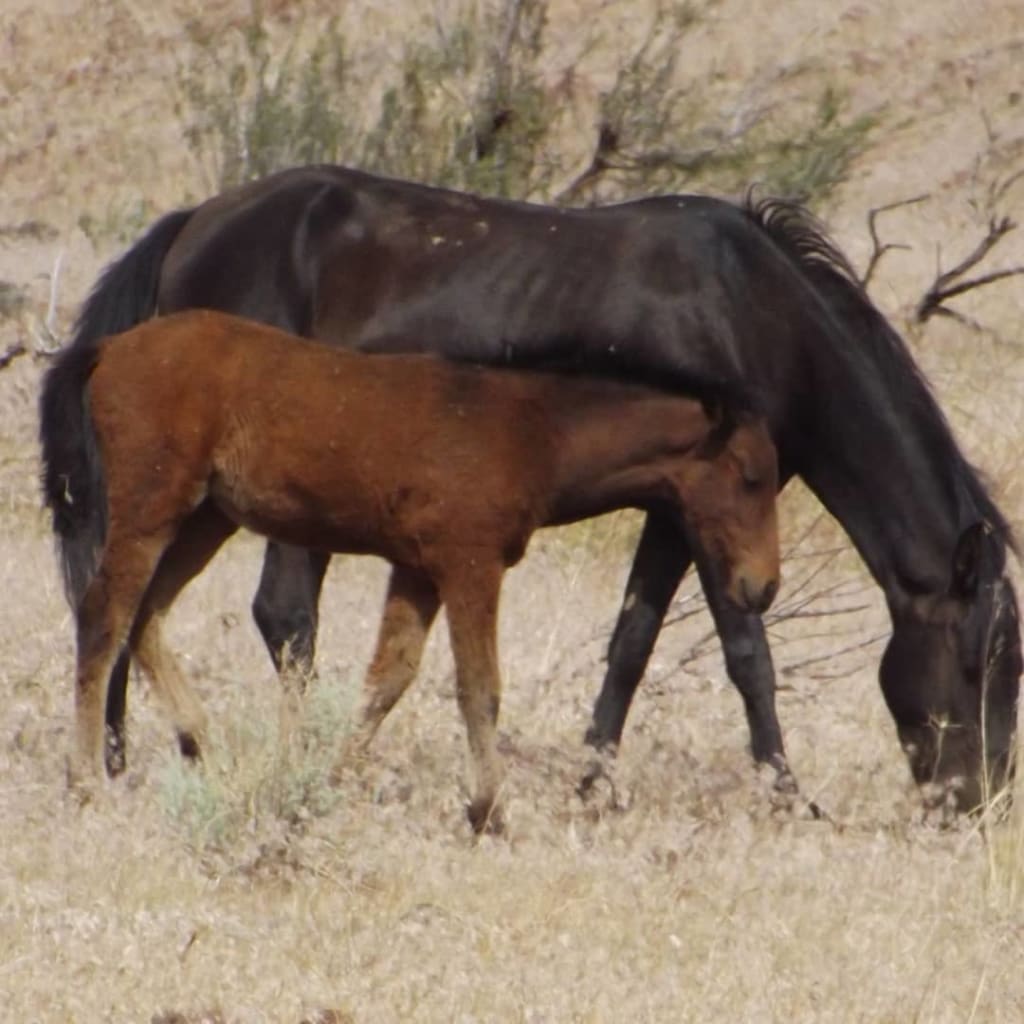
My son went to college in Ellensburg, Wa. On the way to visit my son at college you would come across miles and miles of fields, hills, and streams somewhere before Yakima. If you were lucky enough you would spot the wild Mustang horses. Sometimes you would see specks of them up in the hills. Other times you would get lucky enough to see them right down by the road. On those days I would pull over and get my camera out and take as many pictures as I could. It is not something you see very often anymore. Some would be off by themselves enjoying their peace and quiet. Others would be in families down by the streams drinking and eating, resting in the shade. They are so majestic and beautiful. There are an estimated 20,000 wild horses running all through the Indian Country. Foals raise the population by 20 percent a year. Wild horses have lived and roamed the Yakima Valley since the 1700s. Many people think these horses are fenced in. They see a few fences along the road and think they are owned horses and kept in by fences. These horses are not fenced in. Covering thousands of acres of land, there are no homes or ranch buildings, no feeding stations, few two-track roads, and no additional fencing. These horses don’t belong to any one person. They’re wild. There are at least 20 different packs of horses roaming the land day and night. They are giant and amazing. For the Yakama Nation, the wild horses are a big part of their history and culture.. Unfortunately, the horses are overgrazing their land and finding it hard to find food. Along with the harsh, cold winters and the issues of finding food, many horses are found dead, skeletons laying on the bare ground. The horses are devastating the land and destroying the terrain. There are way too many horses for the amount of land they live on without any kind of management from the Yakama people or the government. The land can support fewer than 3,000 of the animals. The current population, which was between 12,000 and 14,000, is now estimated to be near 5,000 due to starvation, according to Washines. The property the horses live on is about the size of Rhode Island. Soil is getting eroded and the ecosystem is getting destroyed. Also many plants and vegetation the Yakama tribe find spiritual are disappearing. Other animals are being driven out of the land because of the lack of food due to the Mustangs. Sacred deer, an animal important to the Yakama people, have left the area instead of competing with the larger animals. Deer meat is an important part of Yakama Nation ceremonies, and now that is almost impossible to find due to the immense number of Mustangs in the area. Due to the Horse Protection Act which makes it illegal to slaughter the horses and due to animal activists, it is harder and harder to deal with the Mustangs on the tribal land. The tribes have actually tried using birth control on the female horses to help the population from growing, but it is said the horses are not easy to catch. Just within the last year, the horse mortality rate has been 50 percent. There are hopes that since the population has gone down so much, that the vegetation and land might have a chance to regrow and that the deer and other animals will hopefully come home again. I, myself, love seeing the horses and love photographing them. I am very sad about the deaths and mortality rate of these beautiful creatures.
About the Creator
Keep reading
More stories from Stephanie Day and writers in Petlife and other communities.
Single Mother
My mom has taught me many lessons. I can't even count the amount of times she has helped me in my life. She has taught me that I am strong enough, brave enough, and smart enough to raise my two boys on my own. Being a single mother herself, I do not ever remember her giving up or giving in to anything or anyone. She is the strongest woman I know and I can only hope that I am as strong and as brave as she is. She was a police officer before retirement and worked many hours to support my sisters and I. Because of her I have learned to work hard to make sure my kids have a strong and stable life. I could not have done it without her. She is definitely my hero. The grandkids consider her like a superhero. They talk to their friends about how their grandma hunts, fishes, rides motorcycles, and does all of these household projects on her own. Their friends say that their Grandmas sew and bake cookies. She is an amazing woman and I strive to be like her everyday. My parents divorced when my sisters and I were quite young. My parents did not have a wonderful relationship. There was fighting, my dad drank a lot, and anger filled the house. Unfortunately when I grew up I married a man who was a bipolar alcoholic and an abuser. Having 2 small children at the time, I was having a very hard time dealing. I could see the pain my kids were going through and I knew I had to get out of the situation. I thought back often to my parents' relationship and how strong my mom was being able to leave the marriage raising three children on her own. It gave me strength to do the same. After retirement she went straight into the Red Cross. She travelled all over the country helping people in need because of disaster. Loved the work even though it was very hard and took her away from family, including young grandchildren. But she knew she wasn't ready to stop working quite yet. She was in the red cross for almost 10 years before she finally decided it was time to retire and relax. Of course she spends a lot of time helping my sisters and I with our kids so I guess she hasn't quite stopped working yet. As I was a young single mother, it was the most amazing thing to have the support and help from her. She bought a duplex so my sister and I could live there with our children. My sister was also a single mom. If i couldn't pay rent, i didn't have to worry about being put out on the street. I could concentrate on my kids and their needs. She would come over and be grandma, but she would also come over and be the landlord and fix the sink or help clean up the yard. Anything we needed I knew she would be there to help out with. She would and still does help me out with money when I need it. She makes sure she writes down everything I owe her, which is fine with me. It makes me more considerate and more thankful for the help. Not feeling like I am just freeloading from her. I honestly feel like i would not be on this earth anymore without her help and her words keeping me calm on my bad days. I have gone through a lot in my life and she is always there to bring sense to what i am going through and helps me find ways to fix the issues and not just give up. I am literally here because of my mother, in more way than one.
By Stephanie Day5 years ago in Families
Wisteria Woo RIP
Wisteria Woo Silver~Rhodesian Ridgeback Cane Corso mix~ 7.19.15-3.2.26 My service dog, Wisteria, had been slowing down, having mysterious health symptoms like severe hives and unexplained injury. She went to the vet last month, but unfortunately, not all tests detect all problems. When we returned to the vet yesterday, upon much more concerning symptoms suddenly appearing, we learned she had a very large mass (10inx10in) likely the very aggressive hemangiosarcoma, and that we would only be buying a few months if we went through with treatment.
By K.B. Silver 6 days ago in Petlife
A More Human Vocal
When we launched Vocal nearly a decade ago, the world was a very different place. LLMs did not exist, and stories were created one at a time by people sitting down to write, revise, and share something personal. Many of our assumptions about publishing, trust, and participation were built for a world where effort and output were inseparable.
By Justin @ Vocal5 days ago in Resources



Comments
There are no comments for this story
Be the first to respond and start the conversation.