
What Does an ESA Letter Look Like
A Clear Guide to the Appearance and Format of a Real Emotional Support Animal Letter

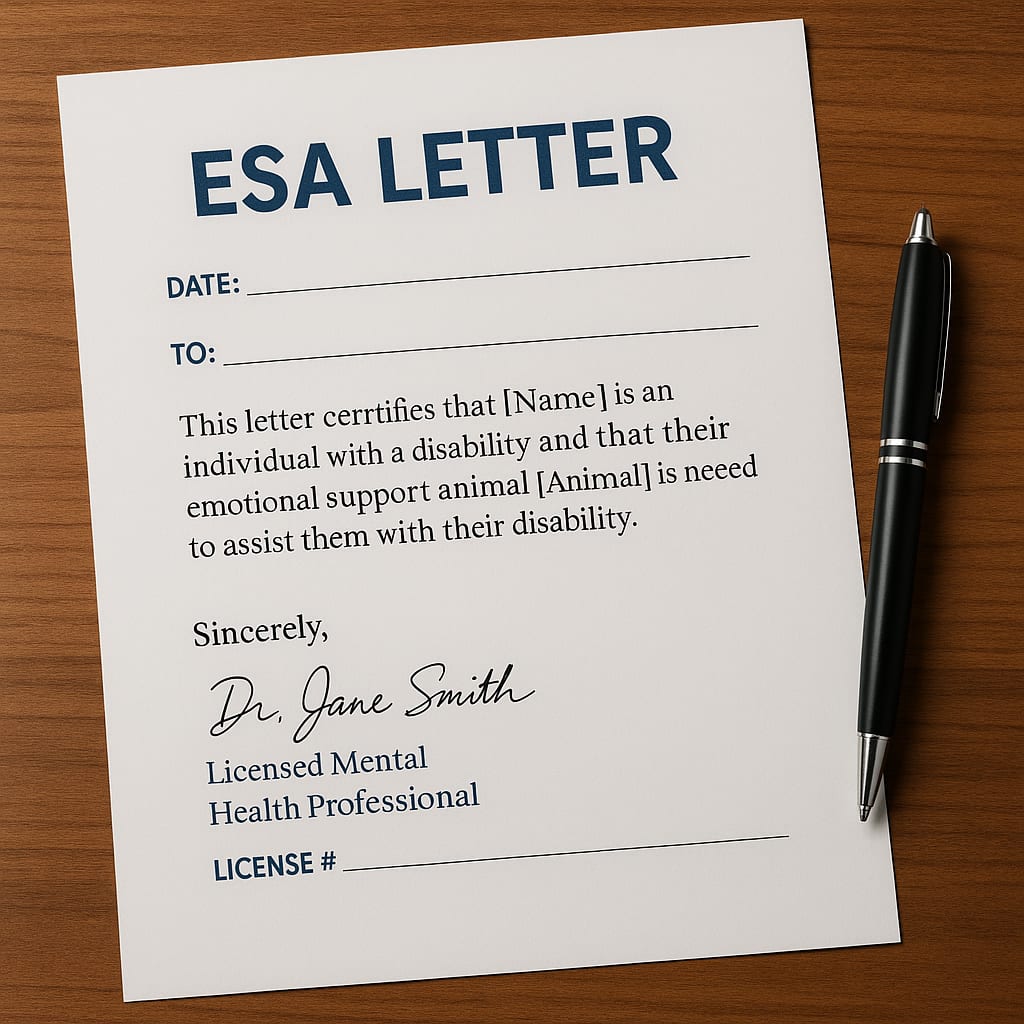
An online esa letter looks like a simple, formal letter. It is written on a licensed professional’s official letterhead. The letterhead usually has the professional’s name, clinic name, address, phone number, email, and sometimes a logo at the top. This makes the letter look official and professional.
The letter itself is plain. It is written in a formal tone, using clear and simple language. No fancy designs, images, or decorations are used. It looks like a document meant for official use, like a doctor’s note. Some ESA letters may be printed on paper with a watermark or a clinic stamp, but this is not necessary.
Overall, the letter appears as a formal, one-page document. Its main purpose is to state clearly that you need an emotional support animal to help you manage your mental health condition.
Details Included in the Letter
The ESA letter must include several key details to make it valid and official. These details are simple but important:
Your Full Name: The letter will mention your legal name, as per your ID or documents.
Your Address: This can be your permanent or current residential address.
Statement of Disability: The therapist will confirm that you are under their care for a mental or emotional disability. The specific condition does not need to be mentioned.
Need for an ESA: The letter must state that having an emotional support animal is necessary for your emotional or mental health. It should explain that the animal helps you manage your condition or provides emotional support.
Therapist’s Details: The letter must include the name, license number, license type (like LMFT, LPC, psychologist, psychiatrist), and the state where the professional is licensed.
Contact Information: The professional’s phone number, email, or clinic address is also mentioned.
Date of Issue: The date when the letter was issued must be clear.
Signature: The therapist’s signature, either digital or handwritten, should be on the letter.
These basic details are necessary to make the ESA letter valid and acceptable under laws like the Fair Housing Act.
Professional Appearance and Format
The letter looks professional. It does not have images, borders, or colors. The font used is usually something simple like Times New Roman or Arial. The text is black on a white background, formatted like any official document. Margins are standard. The letter is aligned neatly, with proper spacing between paragraphs.
The official letterhead at the top gives the letter a formal appearance. At the bottom, the therapist’s signature adds authenticity. Some clinics also include a digital signature if the letter is sent electronically.
In some cases, a clinic seal or watermark is added to the printed version, but this is optional.
Everything in the letter focuses on presenting the needed information clearly and professionally. It is not supposed to look like a certificate or a license.
Length and Style of the Letter
An ESA letter is typically one page long. Sometimes, it may extend to two pages if extra legal references are added, but generally, one page is enough. The style is short and clear.
The letter does not explain your personal history or mental health details. It simply mentions that you have a condition that qualifies for an ESA. Privacy is respected. The therapist only shares the necessary details, without revealing personal health records.
The writing style is formal and respectful. The letter does not sound emotional or personal. It uses official language to state facts in a clear, professional way.
Digital or Printed Versions
ESA letters can be issued as digital or printed documents.
Digital Version: Many therapists send ESA letters by email as a PDF file. This version is valid and acceptable if it includes the therapist’s signature, license number, and official letterhead. Digital signatures are allowed.
Printed Version: Some people prefer a printed copy. This version may be given in person or mailed to you. Printed letters may include clinic stamps, embossed seals, or watermarks, but these are not required.
Both versions are equally valid as long as all the important details are present.
Simple Language in the Letter
The language used in the ESA letter is simple, formal, and professional. Complex terms are avoided. The letter clearly explains that the person needs an emotional support animal due to a mental or emotional disability. It may mention that the animal helps manage daily activities or provides comfort.
Therapists do not include unnecessary medical terms. The letter is short and to the point. It is written in a way that housing providers or airlines can easily understand.
Here’s an example of the kind of sentence often used in ESA letters:
“This letter serves as confirmation that [Client Name] is under my care for a mental health condition. I have determined that the presence of an emotional support animal is necessary for their emotional well-being.”
This simple style makes the letter easy to read and understand.
Legal Reference in the Letter
Sometimes, ESA letters include a mention of laws like the Fair Housing Act (FHA) or the Air Carrier Access Act (ACAA). These laws protect your rights to live with your emotional support animal or, in some cases, travel with it.
A short statement may be included in the letter, such as:
“Under the Fair Housing Act, [Client Name] qualifies for reasonable accommodation to live with their emotional support animal.”
This mention of legal protection adds strength to the letter but is not always required. Some professionals choose to include it; others focus only on confirming the need for an ESA.
No Fancy Design, Only Professional Format
ESA letters are not designed like certificates, ID cards, or decorative documents. They are official, formal letters. They look like a doctor’s note, using plain paper and simple fonts.
Many fake services on the internet offer fancy-looking certificates or colorful cards. These are not valid ESA letters. A real ESA letter is simply a formal letter from a licensed mental health professional.
It does not include your pet’s photo or ID number. It may not even mention the animal’s name or type unless your therapist chooses to include that information. The focus of the letter is on your need for an ESA, not on the animal itself.
Example Layout of an ESA Letter
Below is an example layout of how an ESA letter usually looks. This is not a real letter, just a sample format to help you understand its appearance:
[Official Letterhead at Top]
[Clinic Name or Therapist’s Name]
[Address]
[Phone Number]
[Email Address]
Date of Issue: [Month Day, Year]
To Whom It May Concern:
This letter is to confirm that [Full Name] is a current patient under my care. I am a licensed [Professional Title, e.g., Licensed Clinical Psychologist] operating in the state of [State Name]. Due to [Client Name]’s emotional and/or mental health condition, I have determined that the presence of an emotional support animal is necessary for their ongoing treatment and well-being.
As a licensed mental health professional, I recommend that [Client Name] be allowed to live with their emotional support animal, which provides comfort and support in managing their condition.
If you have any questions regarding this recommendation, please contact me at the information provided above.
Sincerely,
[Signature]
[Full Name of Therapist]
[License Number]
[License Type]
[State of License]
This example shows how simple and professional a real ESA letter looks. It focuses only on the necessary details.
Conclusion
An ESA letter looks like a formal, professional letter written by a licensed mental health professional. It includes your name, address, a statement about your condition, confirmation that you need an emotional support animal, and the professional’s contact details, license number, and signature.
There are no designs, colors, or decorative elements in a real ESA letter. It is a plain document created for official use, meant to help you live with your emotional support animal legally and without problems.
Whether printed or digital, the letter must include the official letterhead, clear language, and therapist’s signature. Its simple and professional look is what makes it valid and acceptable.
Now that you know what an ESA letter looks like, you can recognize a real one easily and avoid fake documents that might cause problems in the future.
About the Creator
Keep reading
More stories from Robert Barrett and writers in Petlife and other communities.
Beginner’s Guide to Getting Your ESA Letter Easily
What is an ESA Letter? An Emotional Support Animal letter is an official document provided by a licensed mental health professional (LMHP). This letter states that you need an emotional support animal to help manage your mental or emotional health challenges. Unlike pets, ESAs are recognized under specific laws that grant them certain privileges, especially in housing situations. For instance, with a valid ESA letter, you can live with your pet in apartments or houses that typically have a no-pet policy. This letter acts as proof that your animal is not just a pet but an essential part of your emotional well-being.
By Robert Barrett8 months ago in Petlife
Lion vs. Hyenas
The struggle between lions and hyenas is one of the most fascinating rivalries in the African wilderness. These two powerful predators share the same habitats, hunt similar prey, and constantly compete for food and territory. Their conflict is not just about strength but also about strategy, teamwork, and survival. Observing a confrontation between them reveals much about the balance of nature on the African savannah.
By Abubakar2205 days ago in Petlife
HTMA Hair Test: Understanding Hair Tissue Mineral Analysis and the Role of Interpretation
Hair Tissue Mineral Analysis (HTMA) refers to a laboratory method used to evaluate mineral content and patterns through a small hair sample. The analysis is often associated with identifying longer-term trends in mineral balance rather than short-term fluctuations.
By CEO A&S Developers5 days ago in Petlife
A Knight of the Seven Kingdoms Series Review (Season 1)
As one of the biggest properties in fantasy, A Song of Ice and Fire remains immensely popular with audiences. After reaching far into the past with House of the Dragon, a second spin-off was on the cards. A Knight of the Seven Kingdoms serves up a bite-sized slice of action and drama, but it still claims a spot among the best small-screen titles.
By Robert Cain6 days ago in Geeks


Comments
There are no comments for this story
Be the first to respond and start the conversation.