
Want to keep native fish?
You will raise the Rhodes fish! It's good to keep and not expensive to look at.

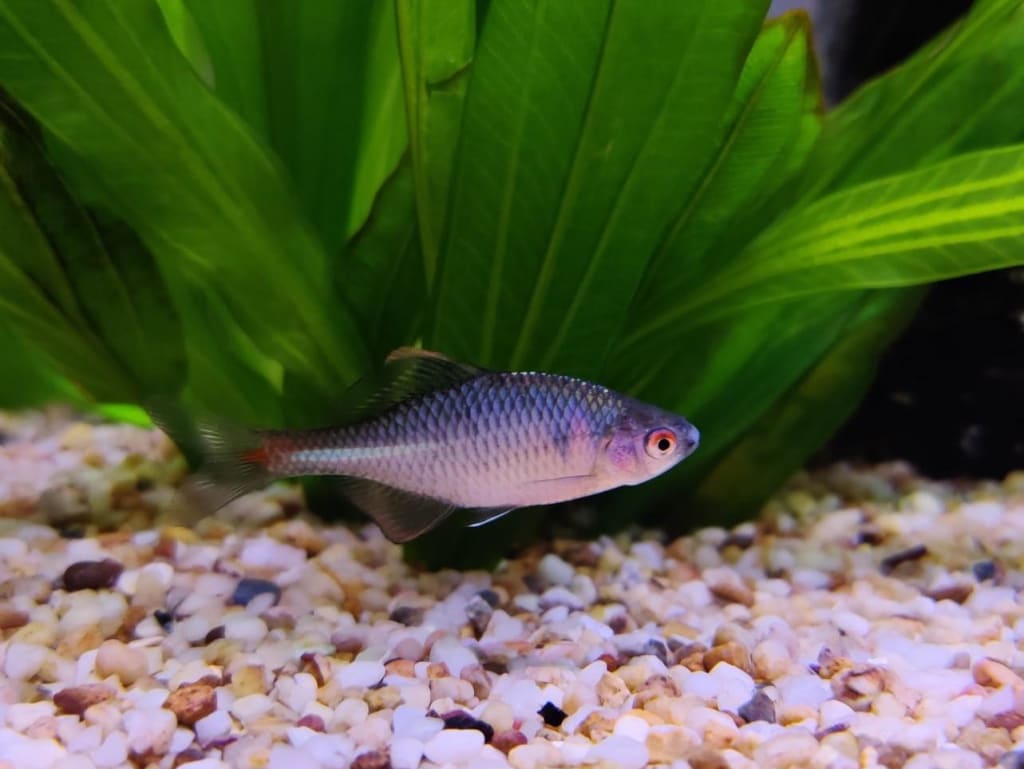
Rhodes, which has many subdivided species, is a native fish. There were many of these fish in the streams and ponds around us when we were children, but now they are rare in the city. Although Rhodes is a common fish in the countryside, it is still ornamental. It is also sold in many markets and is said to have herbal value. Because the price of Rhodes is not expensive, it is loved by many native fish lovers and is commonly kept in stream tanks.
The body of Rhodes is flattened sideways, and the dorsal, caudal and ventral fins are transparent, and the whole body is a cool tone, silvery and light blue, looking very cold, like the fairy that does not enter the mortal world.
There is a blue stripe from the abdomen to the tail of the Rhode Islander, and a little red at the tail is the finishing touch, which gives the Rhode Islander its distinctive charm. Let's talk about how to raise Rhodes step by step!
A. Aquas cape for Raising Rhodes
To keep Rhodes, lay the bottom sand on the bottom of the tank, and plant the water plants, Rhodes likes to have dense vegetation, then get the foreground grass and background. I usually only choose one kind of grass between foreground grass and background grass. However, it is not impossible to give it a luxurious "villa".
Let me give you an example: First of all, plant the foreground grass, you can choose the Paddy Dwarf Pearl, lay a layer of water plant mud, and lay the bottom of the tank flat, not low in the front and high in the back (of course, it depends on you), I like lawn instead of the hillside.
Plant the Paddy Dwarf Pearl at three-centimetre intervals, then slowly put it into the water after the tank is full.
It takes time to wait for the lawn to grow. To raise it quickly, you can add a lot of carbon dioxide to the tank to promote the growth of Paddy Dwarf Pearl. Wait another fifteen days or so, and the grass tank is ready. Note, raising fish is not to buy the fish in the tank on the line, there are a lot of preparations to do.
The water temperature and water quality for raising Rhodes
Again, because Rhodes is a native ornamental fish, it can adapt to a wide range of temperatures, the most suitable temperature for growth is 14 degrees to 28 degrees. The lower limit of low temperature can reach five degrees, and there is no rigid requirement for F value, just use tap water that has been resting for three days. It is important to note that although Rhodes can tolerate low temperatures, it cannot withstand sudden temperature changes.
When picking fish in the aquarium, it is best to ask the owner the temperature of his original tank, and when you get home, also adjust the water temperature to two degrees higher than the original tank temperature, which is good for Rhodes to adapt to the new environment.
Usually, in addition to the organic impurities in the water, we do not need to care about the algae, no matter what kind of algae, as long as it does not affect the living space of Rhodes. Although algae may affect the overall ornamental quality of Rhodes, it has little effect on the health of the fish, after all, the native environment is not that fresh.
Third, the Rhodes fish into the tank over water
You have to prepare a clean tank or a big basin. Rhodes likes to swim in groups, and the ornamental value of swimming in groups is higher, so the quantity you buy is determined by the maximum density according to the size of your tank.
Other ornamental fish cannot be kept in large densities, but Rhodes is different. The greater the feeding density, the faster it can adapt to the new environment, which is also a kind of security establishment, just like us when we are in a foreign country and suddenly see a hometown, we will feel extra affectionate regardless of whether we know each other before.
So the basin of water should be as big as possible to ensure that each one can be immersed in it. After putting the fish and the bag into the basin, put the water into the basin and add it slowly, adding a third or a quarter at a time, staying for ten minutes each time until the water submerges the bag.
It is okay to shade the light to keep them quiet and let them rest well.
Four, the feeding of Rhodes carp
Rhodes is an omnivorous fish, the food is mainly algae, and you can feed some abundant shrimp in moderation during the opening stage.
The grass tank for Rhodes has a lot of vegetation, so you only need to feed some artificial pellets, and there are also feeds that can help the coloration of Rhodes.
Three to four days after entering the tank, observe its mental state every day. Rhodes is most likely to get water mold disease, especially in this period when it is in the new tank, temperature difference is the main cause of water mold disease, observe it, find it early and treat it.
Once you find that the tail of Rhodes is white and cloudy, that is the kind of foggy feeling, with fins together, and the tail is congested with blood, then most likely it is infected with water mold disease.
Rhode Islander's water mold disease early found in time can be saved, the sick fish out of separate isolation, stop feeding, raise the water temperature to thirty degrees, soak with tetracycline, drug bath for ten minutes, three or four hours soak once, a week will be cured.
For some fish lovers in order to prevent fish disease on the body, before the tank water was sprinkled with yellow powder, I experimented wit some, there are effects. But this will affect the color of the water yellowing, and this is only prevention, and can not completely prevent the occurrence of disease.
V. The light requirement of Rhode Islander fish
As I said before, the color of wild Rhodes is bright mainly because the river water is not transparent on all sides, and only the sunlight on the water surface shines down. If you have a lot of water plants and dense aquas capes, you can place the ornamental fish tank in the shade and turn on a light as lighting, which is enough for four or five hours a day.
Six, raising Rhode Islander fish water change
Because Rhodes likes to swim in groups, there are at least twenty to thirty fish in a tank, so it is troublesome to change the water, so it requires a strong filtration system, plus the effect of water circulation, so that it is more suitable for raising Rhodes.
If the filtration system is good, change the water once a week, just a little bit at a time. Remember to change the water slowly and add new water that has been dried, and don't have big temperature fluctuations.

Rhodes can be said to be a kind of fish that native fish players can't get around, almost all fish lovers who like to keep native fish will keep it. There are some differences in the color and appearance of the Rhodes species in our area, but the feeding methods are similar. For example, the breeding of Rhodes is symbiotic. I won't start talking about it here, I will talk about it in the next article.
All in all, Rhodes is a high-value native fish. In terms of feeding difficulty, it is considered low. From the point of view of keeping Rhodes in our home aquarium, it is very beautiful to have a mix of several kinds of Rhodes. For example, the color of high-backed Rhodes is blue, and the color of volcanic Rhodes is red. ...... And then there are some mussel symbiosis, I wonder if it will breed better-looking Rhodes?
About the Creator
Fester Hammer
We soon believe what we desire.
Keep reading
More stories from Fester Hammer and writers in Petlife and other communities.
No Word Comes Near Enough
The English language has its limits. I learned this when I became a student of the Bible and looked up the Greek and Hebrew definitions behind the Scriptures I loved. Some languages have so much more depth and power than the one I use to convey my thoughts. But, even so, I don't think any word could ever come close to describing this void and pain I am journeying through. I don't know how to swim through its murky waters.
By Shirley Belk6 days ago in Poets




Comments
There are no comments for this story
Be the first to respond and start the conversation.