
Things You Will Need To Start Raising Chickens
A Helpful List For Potential Chicken Parents


Raising chickens for eggs is one way to make your home a little more self-sustaining.
In an effort to reduce food costs and perhaps even help contribute financially, I started a little homestead. It was a slow project, and is still ongoing since the things you need for homesteading require a pretty penny.
I started with a garden in tires to grow fresh produce for my family, as that is one of the most expensive things to buy at the grocery store now. Then I began to raise chickens, which has been quite the learning curve. It's not just a matter of getting a few birds and keeping them in your yard for safety. Chickens are delicate little dinosaurs, that die rather easily if you mess.
Once they are older and fully feathered, it gets a little easier.
If you only want enough eggs for yourself, or a small family of two or three, having 3 or 4 chickens is a great idea. If you'd like to try and profit off of having chickens, you'll need about 12 to 14 to start with.
I'm not the most experienced chicken owner, but I figured I'd compile the starting bare necessities for anyone who might be considering starting a little flock of chickens so that you can get a pretty good idea of how much it will cost, how much space you need, and what you will need in order to support your flock, no matter what size.
Habit and Housing
Habitat and housing are pretty much the most important thing for raising chickens. They are sensitive to temperature and vulnerable to predators, and people assume they aren't intelligent. It's hard to drown in 2 inches of water, but a chicken can manage it. So let's make sure we cover the basics.
Water Problems
First and foremost. Try not to have your flock housed where there is natural running water. Chickens are clumsy, and the last thing you need is for a chicken to get swept away after a rainstorm. Avoid large deep sources of water - not only because they tend to drown themselves but also because of diseases that occur more easily in open still-water sources (ponds, or large open containers).
But chickens (and ducks) need a LOT of water. And surprisingly, they eat about their body weight worth of food every day. Simple automatic feeders and waterers work well. I do not like the circular kind that you slide into place to lock and hang from the roof. I have it. But I hate it. I will be going for specifically these lidded and roost resistant automatic waterers and feeders when the ones that I have finally disintegrate from wear and use (as most things do).
I have a few ducks in my flock, so I do have an open source of water. It's a little kiddie pool and I only fill it up halfway (so my chickens can confidently stand up in the water if they fall in). To keep diseases (also the smell and mosquitos) down, I empty it out and refill it with clean fresh water every day. It keeps the ducks happy and the chickens safe.
Safety From Predators
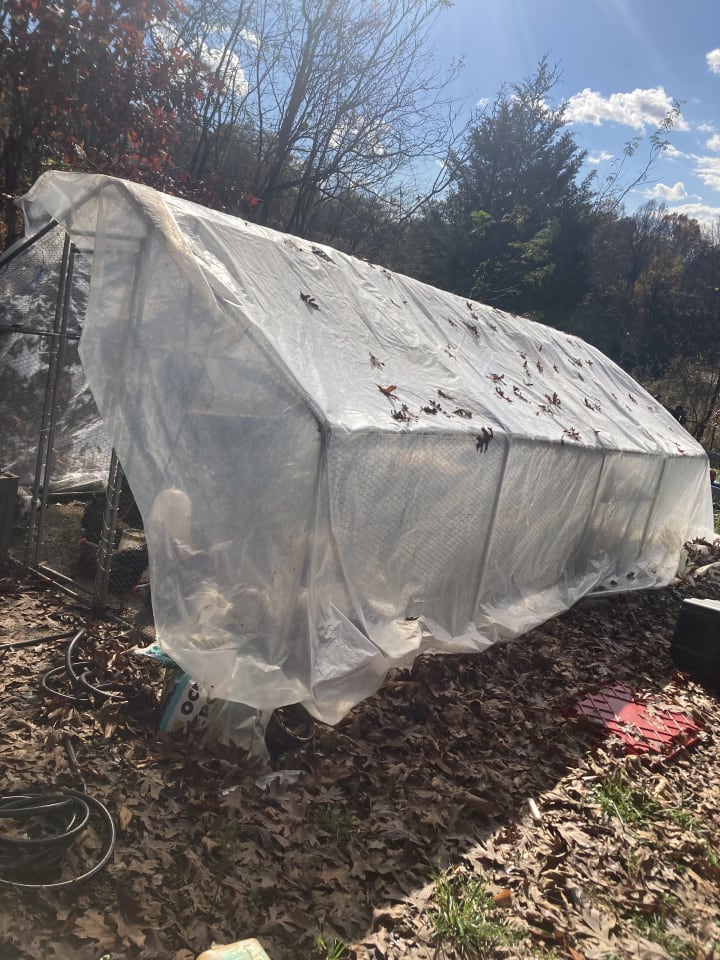
A large enough run or coop for a flock of chickens is important. I live in the forest so I opted to give them a large space that is roofed to protect them from the aerial birds and nocturnal predators. I don't let them out of their coop to run very often, because I have hawks and chicken hawks that have picked off almost whole flocks in my hollow. When I do let them out, I supervise them.
If you do not live in a predator-filled area like I do or have an enclosed fenced area, sometimes "yard birds" are a great way for chickens to exist. A little coop or hutch will do perfectly for them (if you don't have a lot of birds), and even if you don't have enough space to get layer boxes for them (see below), they will most likely lay their eggs in the hutch that is their home.
Layer boxes are a great addition to any habitat you have your hens in. Not only are some of my hens uninterested in the coop, but I have an aggressive rooster problem. I had to designate the big coop house to just him. So I thought, let's try layer boxes! It cuts down on the Easter Egg hunt every day too.
I bought my wooden layer boxes from Temu, but regret my choice. The wooden boxes are hard to clean, and they warp pretty quickly in humidity. I have a nice wonderful shady spot to put them in, to avoid roasting them in the summer. Next time, metal will be the way I go
Of course, your next boxes will need lining. In the winter, I put loose cedar in the boxes so that they have somewhere warm to be, and in the summer I use simple organic natural nest liners.
Entertainment and Comfort
Believe it or not, chickens get bored. Just like any farm animal. And chickens don't like to sleep on the ground. They like to roost up higher off the ground. Happy hens have good egg production. Because I spend a lot of time bonding with my flock, I enjoy providing them with little unnecessary luxuries.
A little playset with swings and a ladder provides perching options and interactive play for them. You can also opt for a much cheaper and simpler roosting ladder.
Chickens and cold aren't a thing. Heating elements in your coop are important during the winter and when your chickens are young. I have a budget set up and I live in the warm south, so I use 3 to 4 regular red heating lamps inside my bundle, and it keeps it very snug and cozy in there. There are also lampless heaters you can use for your birds, depending on the size of the coop. You'll also need to make sure your coop is warm enough that your livestock's water doesn't freeze in the winter. There are also heaters, specifically designed for doghouses and coops to avoid burning the animals and keeping them safe. These bad boys are great for snow days.

Investing In Your Flock
Just as profitable as selling your eggs, maybe even more so, are selling live chicks to other farmers. A large incubator will help you hatch new generations of chicks for you to keep or sell. If you are only raising eggs to make new generations to add to your flock, a smaller one will do.
Of course, if you're raising chicks that means you'll need a brood box to protect them and keep them warm.
The most expensive item you will have to buy for your flock is most likely going to be the housing unit you choose. Be prepared to shell out quite a pretty penny, whether you decide to have a little coop or hutch, or a long run with various coops inside like mine.
Luckily chickens are a livestock animal that has a good return on investment. When your chickens hit the age where they are laying eggs. Some breeds of chickens lay as many as 300 eggs a year.
Whether you're selling eggs, feeding your community, or selling chicks at your local farmers market - chickens are well worth the time and effort.
Time is precious, thank you so much for taking some to read my article. I hope you enjoyed it and it proved useful in some way!
I help supplement my family's income with affiliate links. The links, should you choose to click and purchase, may give me monetary compensation. But you will not be charged extra. Thank you so much for your support.
Find my fictional fantasy book "Memoirs of the In-Between" on Amazon in paperback, eBook, and hardback.
You can also find it in the Apple Store.
Use the code J3F-HK4-I0K for a 20% discount on your purchase of my book on the Campfire Reading app.
And if you like pretty things - check out the author's merch store - where all money goes right back into advertising.
About the Creator
Hope Martin
Find my fantasy book "Memoirs of the In-Between" on Amazon in paperback, eBook, and hardback, in the Apple Store, or on the Campfire Reading app.
Follow the Memoirs Facebook age here!
I am a mother, a homesteader, and an abuse survivor.
Keep reading
More stories from Hope Martin and writers in Petlife and other communities.
Memoirs Of The In-Between: Chapter 6
A few weeks of classes with the children proved useful. By the end of the week, I knew how to turn on the lamps that required energy, the history of Limbo, how CiCi had formed the Spirit Warriors with the help of Malakaii, and more about the Tisin and how souls moved through the cycle that fueled this world as well as many others. Things were much clearer, though there were still many questions to be asked. One day, Leon met me after class, a grin on his face as he looked at me.
By Hope MartinExclusive • about a year ago
A Dart at Dusk
Seconds ago, the sullen sun set on the two of us… my exuberant furry companion and me. A fresh breeze embraces us, delivering welcome relief from the day’s oppressive heat. His typical stumbling and staggering along — apace with a sloth — has turned into trip-trapping, high-stepping, almost skipping along.
By Angie the Archivist 📚🪶about 17 hours ago in Petlife
The Great Cat-Dog Truce: A Battle of Ridiculous Proportions
In the kingdom of our living room, two notorious enemies had ruled the realm for as long as we could remember: Sir Whiskers, the cat, and Barkley, the dog. They weren’t just pets; they were sworn enemies, each vying for dominance over the sofa, the kitchen floor, and even the occasional cardboard box.
By Ahmed aldeabella5 days ago in Petlife



Comments
There are no comments for this story
Be the first to respond and start the conversation.