
The Whispering Alley
In the heart of an old city, where cobblestone streets wound like

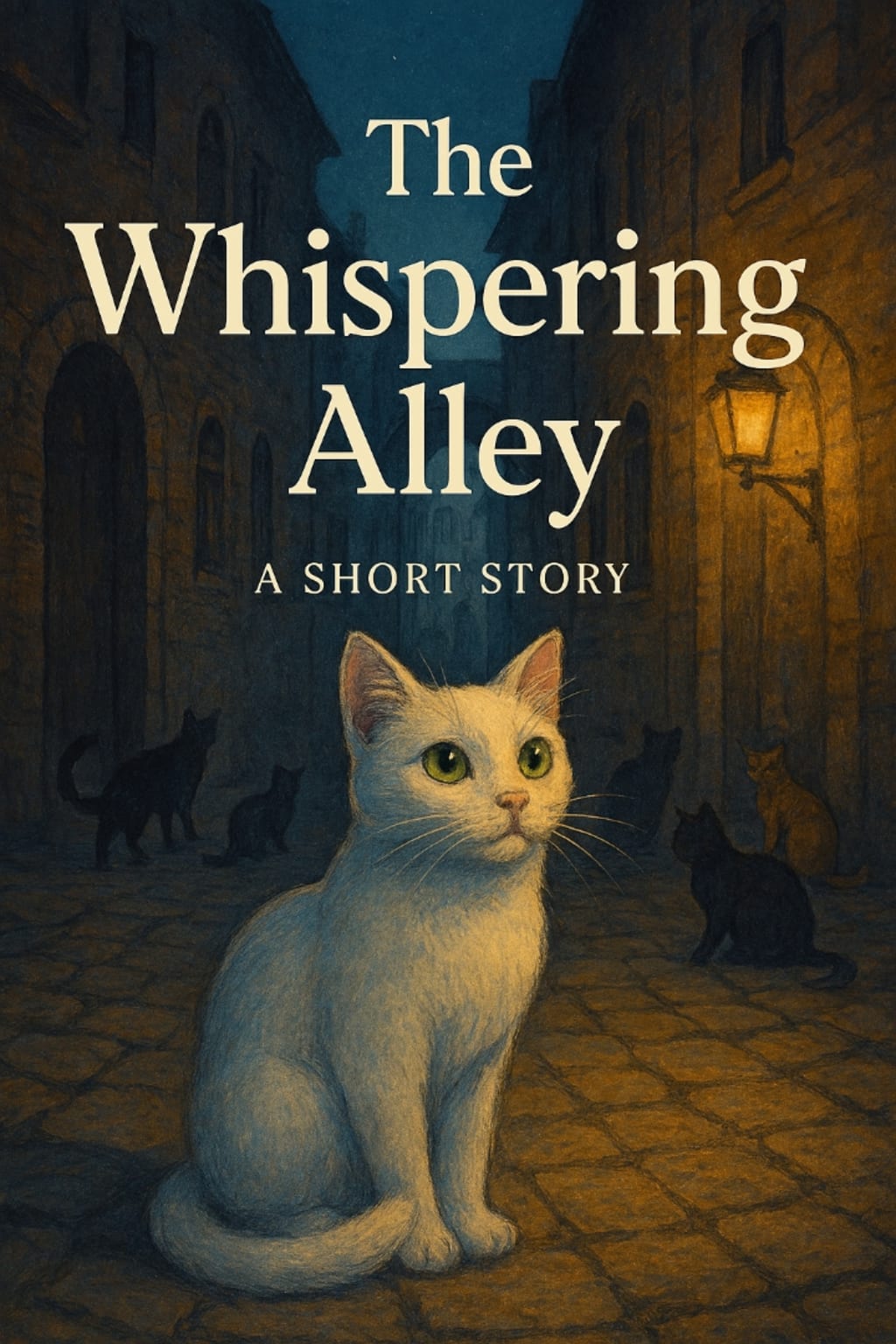
Whispering Alley
In the heart of an old city, where cobblestone streets wound like forgotten veins and lanterns flickered against weathered walls, there was an alley known only to those who listened carefully. Locals called it the Whispering Alley, though few could explain why. To most, it was just a narrow passage between two crumbling buildings. But to the cats of the city, it was a kingdom.
Every evening, when the sun dipped low and shadows stretched long, the alley came alive. Cats of every shape and color gathered there—sleek black hunters, ginger wanderers, silver‑striped dreamers. They moved with quiet grace, their paws soft against the stones, their eyes glowing like tiny lanterns. To the people of the city, they were strays. To themselves, they were storytellers, guardians, and rulers of the night.
Among them was a young cat named Liora. Her fur was white as moonlight, and her eyes carried the green of spring leaves. Unlike the others, she was curious not only about the alley but about the world beyond. She often perched on the highest wall, watching humans hurry past, wondering why they never paused to hear the whispers that filled the night air.
One evening, as the cats gathered, an elder named Marlow began to speak. His voice was not heard in words but felt in silence, carried through the flick of his tail and the gleam in his eyes. He told of a legend: that the alley was once home to a single cat who could understand human speech. This cat, centuries ago, had guided lost travelers, comforted lonely souls, and even warned the city of storms before they arrived. But when the humans stopped listening, the gift faded, leaving only echoes in the alley’s stones.
Liora listened with rapt attention. She believed the gift could return, if only someone tried hard enough. That night, she made a vow: she would learn to bridge the silence between cats and humans.
Her journey began with observation. She followed a baker who left scraps of bread by his door, noting the kindness in his gestures. She watched a child who whispered secrets to her doll, sensing the rhythm of human speech. She even sat near the old librarian, who read aloud to himself in the fading light. Each sound, each tone, became a puzzle piece in her mind.
Weeks passed, and the other cats teased her for her strange fascination. “Humans are deaf to us,” they said. “Why waste your nights chasing impossible dreams?” But Liora remained determined. She believed that silence was not emptiness—it was a language waiting to be understood.
One stormy evening, as rain lashed the city and thunder rolled across the sky, Liora found a girl huddled beneath a broken archway. The girl was crying, her voice trembling with fear. Liora approached, her paws soaked, her fur heavy with water. She sat beside the child and let out a soft, deliberate sound—not a meow, but something deeper, shaped by all the nights she had listened.
The girl froze, then looked into Liora’s eyes. For a moment, the storm seemed to pause. The child whispered, “You understand me.” And though no human words left Liora’s mouth, her gaze carried comfort, her presence spoke louder than language. The girl’s tears slowed, replaced by wonder.
News of the white cat spread quietly through the city. People began leaving bowls of milk, scraps of food, and gentle words in the alley. They did not know why, but they felt drawn to listen. And in return, the cats gathered more boldly, their whispers weaving into the fabric casts
About the Creator
Alhouci boumizzi
Chapter One: The Black Storm
Keep reading
More stories from Alhouci boumizzi and writers in Petlife and other communities.
Elena had always loved libraries. The quiet aislesthe scent of old
Elena had always loved libraries. The quiet aisles, the scent of old paper, the way stories seemed to hum beneath the silence — it was her sanctuary. But the library she stumbled upon that autumn evening was unlike any she had ever seen.
By Alhouci boumizzi5 days ago in BookClub
The Summer I Was Chosen by a Northern Mockingbird
During the long, suspended days of the pandemic, a wild mockingbird began visiting my driveway and chose me, again and again. What started as a strange encounter became a brief, meaningful connection that I still carry with me.
By Erica Roberts 24 days ago in Petlife
The Mini Goldendoodle Who Changed the Quiet House
The house on Cedar Lane had been quiet for a long time. Not the peaceful kind of silence — the heavy kind. The kind that sits in corners and echoes in hallways. After Mr. Rehman retired and his children moved abroad, the rooms became larger, the hours longer, and the evenings longer. Even the sunlight seemed to enter politely and leave early.
By Paw Planet 4 days ago in Petlife
Super Bowl LX Recap: A Team Called Hawks
Sixty. The Super Bowl turned 60! Still amazes me that this was the sixtieth Super Bowl played in NFL history. It seems like yesterday that I watched Super Bowl XXVII, the first SB I ever watched. The QB who won Super Bowl XXVII has since called a few SBs, and will call next year's game, but that's another story. Super Bowl LX took place at Levi's Stadium in Santa Clara, California, the home stadium of the San Francisco 49ers. However, it was one of their division foes who represented the NFC, as the Seattle Seahawks faced off against the New England Patriots.
By Clyde E. Dawkins5 days ago in Unbalanced




Comments
There are no comments for this story
Be the first to respond and start the conversation.