
The Last Watch
A Dog’s Loyalty Beyond the Edge of Time and Loss


By : [Aftab khan]
In the fog-kissed village of Suryanagar, nestled between hills and rice fields, there lived an old man named Hari and his dog, Bhoora. Hari was a widower, long retired from his days as a postman, and Bhoora — a scrappy, mixed-breed with salt-and-pepper fur — was his only companion.
No one knew where Bhoora had come from. One stormy night five years earlier, Hari had heard a whimper outside his door. When he opened it, there stood a soaked, trembling pup with matted fur and sorrowful eyes. Hari, who hadn’t spoken to another soul in two days, had simply opened the door wider and said, “Come in, beta.”
From that moment, they were family.
Their days fell into a gentle rhythm. Hari would wake before the sun, boil tea over a coal stove, and sit on his wooden bench while Bhoora sat beside him, his head resting on the man’s feet. They’d walk through the fields together, Hari humming old tunes, Bhoora occasionally darting into the grass after butterflies or barking at wayward squirrels.
The villagers often smiled when they saw them — the bent old man with a walking stick and the dog that never left his side, even at the temple or the market.
“Bhoora is more loyal than most sons,” the grocer once said, and everyone agreed.
Hari had no family left. His wife had died young, his only son had moved to a city abroad and stopped writing years ago. But he never spoke ill of the boy.
“Time changes people,” he’d say quietly.
But Bhoora never changed. Rain or shine, illness or cheer, he was there. When Hari had a fever, Bhoora didn’t leave his bed for three days. When Hari had no money for meat, Bhoora quietly chewed dry chapatis without complaint.
And Hari, in turn, treated Bhoora like kin. He bathed him with warm water, talked to him like a person, and even tied a red thread around his neck on festival days.
“You’re not a dog,” Hari would say. “You’re my shadow.”
One winter, Hari began to cough. A dry, deep cough that made Bhoora whimper each time it echoed through the house. The doctor in the village came and went, medicines were prescribed, and Hari seemed to get better.
But Bhoora knew better. He followed Hari more closely, slept against his chest at night, and refused to go out without him.
Then, one morning, Hari didn’t wake.
Bhoora nuzzled him, barked softly, licked his hand. But the hand remained still.
The neighbors came running when they heard the howling.
Hari’s body was prepared for cremation the same day. Bhoora paced the courtyard restlessly, not allowing anyone to touch Hari until a village elder gently coaxed him away.
At the riverbank, as the pyre burned and the sun dipped behind the hills, Bhoora sat motionless, staring into the flames. He didn’t bark. He didn’t blink. His tail lay flat, his ears low.
When the fire turned to ash, and the people left, Bhoora stayed.
For days, Bhoora did not return to the house.
Villagers saw him sitting beside Hari’s favorite bench. Or at the riverbank. Or at the temple steps where they used to rest after walks. Some tried to feed him, but he only sniffed the food and walked away.
One evening, a young girl named Asha brought him a wool scarf that Hari had once worn.
“Here, Bhoora,” she said gently. “He would want you to be warm.”
Bhoora sniffed it, whined, and curled up with the scarf tucked under his paws. It became the one object he never left behind.
Seasons changed. Bhoora grew older. Slower. But he never let go of his vigil.
He stopped barking. Stopped chasing birds. But each morning, he’d drag himself to the gate and stare at the horizon — the same path Hari used to take on his rounds as a postman.
Some say Bhoora was waiting for Hari’s spirit to return.
Others believed he was protecting the village in Hari’s memory.
But no one doubted his faith.
The villagers built a small shelter near the banyan tree for him. Painted it blue. Wrote a sign that read: “Bhoora’s Watch.”
He became a symbol — of loyalty in a world that often forgot it.
Then one monsoon, as the rain returned to wash the village clean, Bhoora lay down under the bench where he and Hari had spent countless mornings. He closed his eyes, rested his chin on the old red scarf, and didn’t wake up.
There were no grand ceremonies. But people came.
Asha brought marigolds. The grocer brought warm milk. Children who had once feared dogs sat beside him, tears in their eyes.
He was buried beside the bench, beneath the neem tree.
They placed a stone slab with a simple line:
“Here lies Bhoora — friend, guardian, and son.”
Epilogue
Years later, a writer passing through Suryanagar asked a tea seller about the stone under the neem tree.
The man pointed and said, “That’s where Bhoora rests — the dog who never left. He taught us what love really means.”
The writer sat beside the grave, took out his notebook, and began to write.
Some stories, after all, deserve to be told again and again — not because they are loud, but because they are true.
And Bhoora’s was truer than most.
About the Creator
AFTAB KHAN
SUBSCRIBE ME AND READ STORY
Storyteller at heart, writing to inspire, inform, and spark conversation. Exploring ideas one word at a time.
Writing truths, weaving dreams — one story at a time.
From imagination to reality
Keep reading
More stories from AFTAB KHAN and writers in Petlife and other communities.
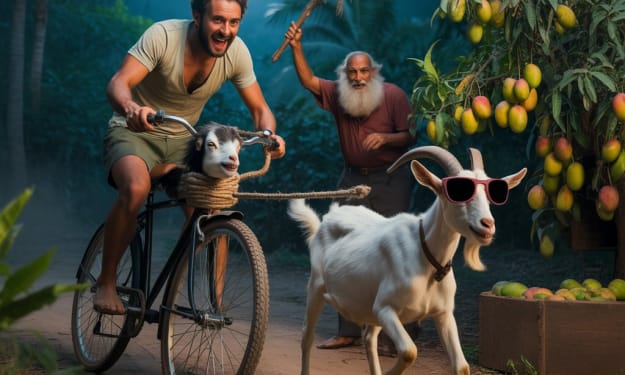
The Great Mango Heist
In the small Indian village of Bhagalpur, known mostly for its stubborn cows and excellent mangoes, nothing ever really happened. And when something did happen, it usually involved someone falling into a well or stealing slippers from the temple porch.
By AFTAB KHAN7 months ago in Petlife
Wisteria Woo RIP
Wisteria Woo Silver~Rhodesian Ridgeback Cane Corso mix~ 7.19.15-3.2.26 My service dog, Wisteria, had been slowing down, having mysterious health symptoms like severe hives and unexplained injury. She went to the vet last month, but unfortunately, not all tests detect all problems. When we returned to the vet yesterday, upon much more concerning symptoms suddenly appearing, we learned she had a very large mass (10inx10in) likely the very aggressive hemangiosarcoma, and that we would only be buying a few months if we went through with treatment.
By K.B. Silver 5 days ago in Petlife
Dogs in the life of composers
If you have a pet, you will surely agree: as soon as we take responsibility for someone – be it a cat, a dog, a ferret, a parrot, a horse, anyone! – these creatures become an important part of our lives, whether we want it or not.
By Ilya Baranovabout 11 hours ago in Petlife
Who is your "Person"?
It's important to recognize that you cannot go through life as easily on your own. My name is Elizabeth and I'm a survivor of child abuse and horrific trauma. Healing from trauma is not a quick fix and recognizing that it will take time, is part of the struggle.
By Elizabeth Woods6 days ago in Psyche


Comments
There are no comments for this story
Be the first to respond and start the conversation.