
The Howl Returns: Dire Wolves Romulus and Remus Rise from the Ashes of Extinction
Meet the new-old wolves
The Howl Returns: Dire Wolves Romulus and Remus Rise from the Ashes of Extinction
The world has just witnessed a scientific feat so profound, so seemingly ripped from the pages of science fiction, that it’s hard to fully grasp its implications. Forget cloning your beloved pet; we’re talking about the resurrection of an entire species. Meet Romulus and Remus, not the mythical founders of Rome, but the very real, breathing, howling embodiment of a creature lost to time: the dire wolf.
After vanishing from the face of the Earth over 10,000 years ago, the legendary dire wolf, a predator that once stalked the icy landscapes alongside mammoths and saber-toothed cats, has officially returned. The groundbreaking achievement comes courtesy of Colossal Biosciences, the ambitious team already making waves with their efforts to bring back the woolly mammoth. Using ancient DNA painstakingly extracted from fossilized remains dating back as far as 72,000 years, they have successfully engineered two modern wolves that echo the might and majesty of their extinct ancestors.
But Romulus and Remus are not simply clones, ghostly replicas of a bygone era. They represent a new frontier in genetic engineering and conservation. Colossal’s team has meticulously crafted these modern wolves with approximately 20 specific genetic edits, carefully selected to imbue them with the key physical traits and even the rumored spirit of the original dire wolf. Think of it not as a carbon copy, but as a carefully curated revival, a modern interpretation built upon the ancient genetic blueprint.
The dire wolf, *Canis dirus*, was a formidable beast, a true icon of the Ice Age. Imagine a wolf, but larger, heavier, with a more robust build and a bite force that could crush bone with terrifying ease. These were pack hunters, apex predators that roamed across North and South America, capable of taking down prey significantly larger than today’s gray wolves. Their disappearance coincided with the end of the last glacial period, a complex event likely driven by a combination of climate change and the extinction of their megafaunal prey. For millennia, their story has lived on in fossil records and in the popular imagination, fueled in no small part by their imposing presence in fiction.
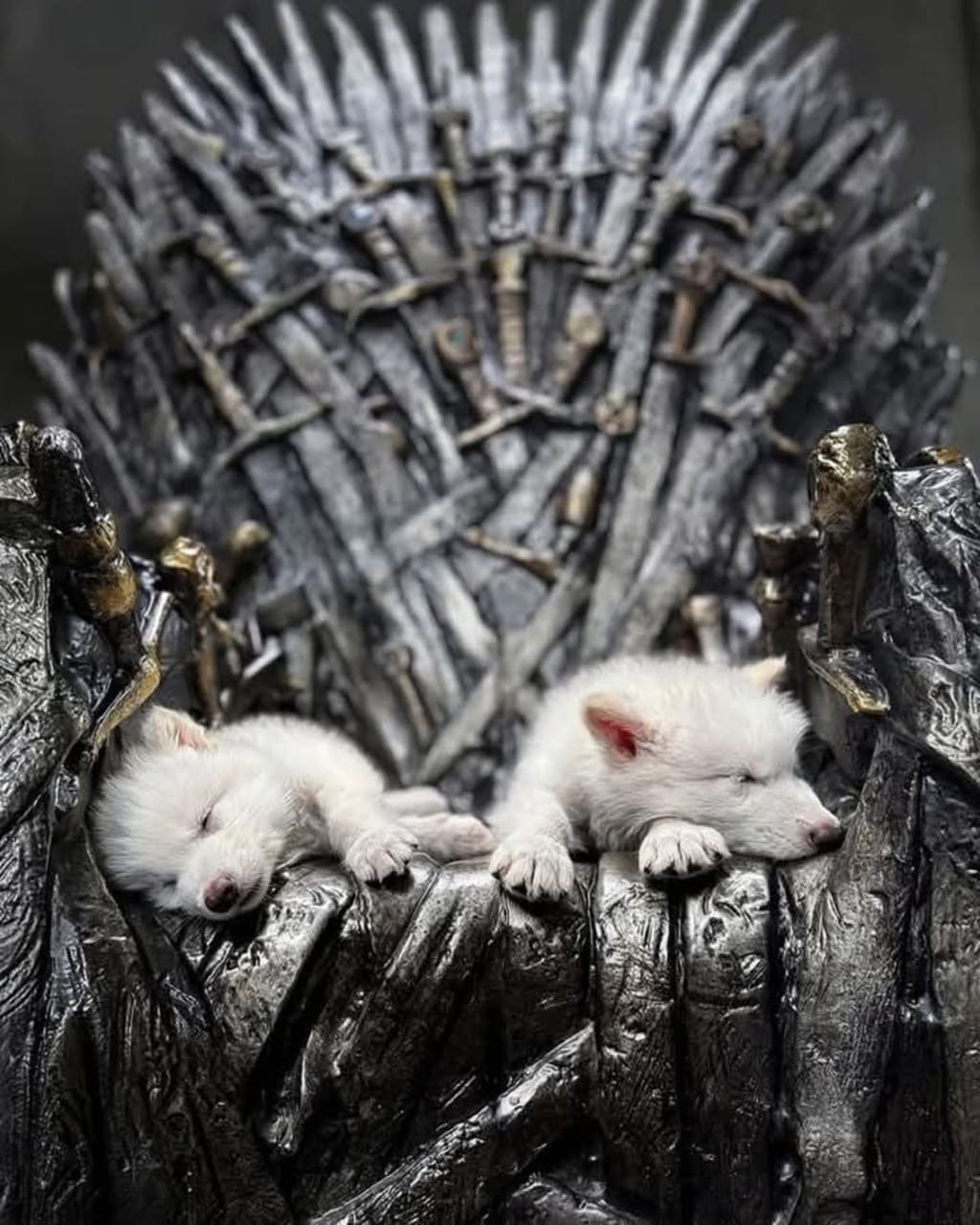
And speaking of fiction, the symbolic weight of this resurrection is amplified by the involvement of none other than George R.R. Martin, the literary mastermind behind the epic "A Song of Ice and Fire" series, where direwolves are not just animals but powerful symbols of loyalty and strength. Martin, a cultural advisor and investor for Colossal Biosciences, understands the profound cultural resonance of these creatures. To celebrate this monumental achievement, he orchestrated a truly unforgettable photoshoot.
Imagine the scene: Romulus and Remus, these newly returned titans of the past, seated atop the iconic Iron Throne. Not just any Iron Throne, but the very prop borrowed from Peter Jackson’s personal collection, a tangible link to another realm of fantasy and epic storytelling. This image, a powerful juxtaposition of ancient reality, modern science, and fictional legend, speaks volumes about the ambition and the cultural impact of this project. It’s a nod to the long history of these magnificent creatures, a celebration of their present revival, and a hopeful glimpse into a future where extinction might not always be the final chapter.
The implications of this breakthrough are far-reaching. While the immediate excitement surrounds the return of such a charismatic megafauna, the scientific and conservation potential is immense. The technology developed by Colossal to achieve this resurrection could have profound applications in preserving endangered species today. By understanding and manipulating ancient DNA, we may gain invaluable insights into the genetic resilience and vulnerabilities of extinct animals, informing our efforts to protect their modern relatives.
Furthermore, the reintroduction of dire wolves, if carefully managed, could potentially have ecological benefits. As apex predators, they could help regulate ecosystems, influencing prey populations and promoting biodiversity. However, this is a complex undertaking that would require extensive research and careful consideration of potential impacts on existing ecosystems and human populations. The ethical considerations surrounding de-extinction are also paramount and will undoubtedly be the subject of ongoing debate.
The return of Romulus and Remus is more than just a scientific curiosity; it’s a powerful symbol of human ingenuity and our growing ability to manipulate the very building blocks of life. It challenges our understanding of extinction and raises profound questions about our role in shaping the future of our planet. While the journey ahead is undoubtedly complex, the first howls of the resurrected dire wolf echo with a message of hope – a testament to the possibility that even what is lost may one day be found again. The Ice Age predator is back, and the world will never be quite the same.
About the Creator
A Dart at Dusk
Seconds ago, the sullen sun set on the two of us… my exuberant furry companion and me. A fresh breeze embraces us, delivering welcome relief from the day’s oppressive heat. His typical stumbling and staggering along — apace with a sloth — has turned into trip-trapping, high-stepping, almost skipping along.
By Angie the Archivist 📚🪶5 days ago in Petlife
Miss Persephone's Manual to a Seemingly Ordinary Life
Miss Persephone was found at the dining table, her blue eyes swollen, her tears arriving and retreating like the tides of the ocean. Earlier that day, her family had visited her in the retirement home where she had lived for eight years. It was her eightieth birthday.
By Imola Tóth3 days ago in Fiction


Comments
There are no comments for this story
Be the first to respond and start the conversation.