
The Fox and the Olive
A tale of adventure and good fortune.
Tucked away among the rolling hills of Siena, a fair way down the track from the bustling streets of Montepulciano, there lives a quiet enclave of traditional Tuscan fruit growers.
Here, the hills are dotted with the remnants of Romanesque architecture; scattered patches of shrubland encircle residential mounds topped with pale brick villetas, barns, and churches. Long, cobbled roads camber between carefully grown rows of Cypress trees, demarking highways once known to honourable generals and their marching armies, and to the enterprising merchants of golden ages long since forgotten. These faithful routes now lay weathered and loose from centuries of rumbling wheels, hooves, and boot-leather.
Following the landscape with the naked eye, these paths can be seen traversing the foothills in every direction. Where a treeline gives way to a hedgerow, precise junctions can be made out at a squint. Here, narrow byways become open roads as they ascend more steeply now, cresting the hills and arching off over the horizon.
Catching this view at first light, when the morning dawns pink, the land appears remarkably still. As the sun slits between pockets of woodland, the deep wingbeats of a Goshawk might be visible, soaring at full stretch above the treetops. Common, too, is the morning call of the Scops Owl, appearing atop a tiled rooftop or church tower to whistle; though remaining a rare sight, even to the most watchful of locals.
By midday, regiments of olive trees clear into view, their dusty green leaves displayed to the sun. Protected beneath the shaded canopy, clusters of firm olive fruit hang from delicate limbs. These will not be ready for harvest until the closing months of the year, when their flesh is dark and ripe to the pit.
From here, they would be collected in baskets and hauled to the olive mill to be rolled, pressed, and kneaded for their precious oils. While much of this was done by hand by the olive presser, the heavy rolling and crushing work was assisted by a resident donkey or two, blindfolded for comfort, and gently guided around a central turning block.
The donkeys would also make for welcomed company during harvest, and happily munch through any broken olives found on the ground, as well as through leaves and branches - although they didn’t find these particularly nourishing - leaving nothing to rot or spoil. They would show little interest in the laying of the parachute, or in the beating and shaking of the trees, except for when the occasional olive bounced and rolled before their curious noses.
Up ahead, the olive presser would be waving and whacking at his olive crop, easily displacing most of the fruit from their stalks. A generations’ old technique, involving cherished family heirloom - a trusty wooden beating stick, fashioned from sturdy hornbeam, with a wound leather strap for grip. The highest bunches were reachable from atop a step, hastily unslung from one of his companions’ saddles. Firm and plump, these were delicately plucked by hand, then lobbed into the woven basket below.
And, every night, the olive presser would return home to the fattoria, and jot the day’s harvest in his little black notebook.
~
For most months of the year, aromatic sacks of pungent garlic and chilli lined the sandy brick walls inside the olive mill, shaded from the searing Mediterranean heat. These goods were hand-crushed and sun-dried - the labour of merchants’ sons - before they were ready for bartering at the end of the growing season. New tastes, imported by the palates of travelling vendors and visitors, had brought new expectations for the olive pressers of Siena, who blended these ingredients into daring new infusions.
Now these bags sat untouched, having not been opened since they were purchased the previous autumn. By now, the working parts of this olive mill had been idle for months.
Consistently poor harvests had followed the harsh, wet winters of recent years. Lingering summer storms, drawn in from the sea, gave breed to swarms of olive fruit flies. Of the crops that endured, ripening was delayed, and yields were poor. Newly laid saplings suffered unseen dead-rot and blight. The little oil that was salvaged was dull and bitter.
With little money left for repair and upkeep, the heavy granite crushers had begun to crumble. The complicated web of pulleys and levers had mostly snapped and frayed. Worn iron tools were left scattered among hay and weasel droppings on the hardstone floor.
~
Resigned to another fruitless day, the olive presser returned home with little to show for his efforts once more.
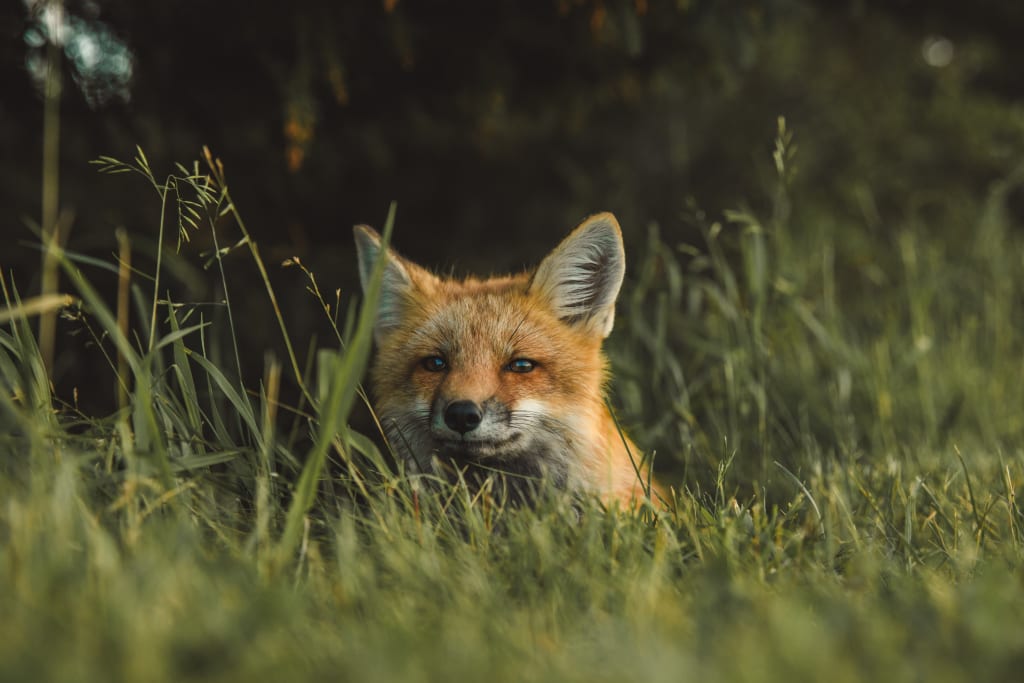
Reaching for his little black notebook, something caught the corner of his eye: a native Red Fox, tall and proud - with thick, healthy fur and ears pricked forward - now stood square in his doorway.
An impressive creature, but one whose presence filled him with concern. Before he could rise to shoo it away, the fox dashed for the corner of the room, scooping up the olive presser’s trusty beating stick in its mouth, and made off out the door! With a jolt, he jumped to his feet, fortunately still dressed, and gave chase into the courtyard.
He followed the creature out the gate and down the track alongside his house. The chase passed down several winding paths, eventually crossing by a nearby garden fête. Amber bunting adorned the pale bricks of the residence, and the sound of folk music and singing competed with the smell of fresh pastries in the air. Quietly, the duo slipped through unnoticed, and onto a dirt trail beyond the garden wall.
Ahead, this path met the glistening freshwater brook running through the village, twisting alongside it before being enveloped by its gentle current.
The fox bounded straight on through, stopping only to glance back when it reached the opposite bank. Downstream, Minnows pooled in the calm shallows, their muddy camouflage broken by the gentle flicks of their tails. A pair of dragonflies took flight from some nearby reeds, tracking one another as they raced along the brook before darting beyond the hedgerow.
The olive presser stopped. Looking down at his worn boots, which were his only pair, and were hardly in good condition anymore, this crossing was terribly inconvenient for him, perhaps even a hazard. Maybe he should turn back now. Assuming this animal was not simply teasing him – baiting, only to disappear into the brush in a heartbeat - could it really be worth all this?
Undeterred, he took his first step forward and placed it firmly into the water. The current ran fresh and cold, immediately pouring through every crack and seam of his boots, filling up over the mouth, and around his ankles. Carefully, he made his way across, lifting silent plumes of silt and debris as he went. Before he could get close, the fox continued along the trail, his impressive tail in full swing.
~
By the time the olive presser stepped up onto the wooden style some distance down the track, his feet had already begun to warm up. Still squelching with every move, he awkwardly lifted one leg over the style, before sidestepping down. The fox, of course, had no such trouble, and crossed the fence through a gap in the panels.
Before he could marvel at the fox up close, it started – alarmed - and fled back through the fence.
Turning around, the olive presser caught a brief glimpse of the Toro that was now charging him, before doubling over with the impact of its defensive strike and being knocked straight out of consciousness.
~
By the time he awoke, it was dark. Panicked and confused, he sat up, realising he was now in a ditch, and took stock of his senses. Surprisingly, he was not in much pain. Perhaps even more to his surprise, the fox had remained with him, still gripping his precious stick.
Slowly he rose, and took up after the fox once more, which trotted happily across the field and onto the track leading to the surrounding hills.
~
Rising steeply, the footpath now traced along a narrow ridge, skirting around the outside of a shallow ravine.
The olive presser knew immediately where he was.
Sure enough, sunken into the clearing below, he could make out the high walls of the region’s only jail. Accompanied only by a dusty, one-way access road to the front, it stood exactly where it had for centuries. Its menacing walls were tucked far away from public view at the base of a shallow, hilltop ravine.
He had never actually been this close before. Nobody liked to venture this way. The fox maintained his direction along the ridge, showing little interest.
That is, until the inmates began to stir.
Sleeveless arms of all shapes and sizes began to appear through the open bars on each window, elbows hooked on metal as they began to bang and clink against their shackles. Backlit by the moonlight, their shadows danced against the blueish cell walls behind them, as the pounding of fists turned to a steady, cadenced drumbeat. The rhythmic stomping of feet soon followed, as a sole voice called from one of the cells.
The rest of the inmates broke out in chant – a song that would surely carry far beyond the hills, above the trees and dipping ponds, and echo into the villages below. A traditional and moving ballad: of hope and of nostalgia, of joy and of courage, still recited by bards and hearthside storytellers of late. Encouraged, the fox and the olive presser passed by with haste.
~
By now, night was giving way to morning, the twilight hue of sunrise slowly beginning to occupy the sky. The olive presser, realising his tiredness, for the first time felt weary and cold, and noted the severity of his bruises.
Suddenly, the fox, stick in mouth, darted into the thickets. Now alone and fearing the worst, the olive presser sat down on a sunken log. Curiously, the fox returned, alongside two cubs and a partner. The skulk of foxes presented him with his stick, and a faded, crumpled piece of paper:
Treasury Bond: 20,000
Shocked, the olive presser reached into his pocket, and with mottled fingers pulled out a small, round olive. He outstretched his palm as close as the fox would allow, displaying the peculiar fruit to his curious companion. Leading with his snout, the fox slowly tipped his head forward, rolling the olive with his nose, before coyly taking it up in his mouth.
The fox clearly thought very little of the olive, for he spat out the repugnant fruit immediately.
Wincing with regret, he swiftly turned and took off up the bank to where his cubs were waiting with mother. Family in tow, the fox embarked up the slope and to the crest of the horizon, his red fur now a dark silhouette against the sky. For a moment, he turned to look back, locking eyes with the man he had led so far from home, before pressing on over the hill and forever into the night.
For a moment, the olive presser watched where the fox had stood. Silence overtook his surroundings. The sun was threatening to rise, and he had not slept, so he began to make his way back up the trail.
To while away the journey, he hummed the upbeat melody from the mid-afternoon fête, and quietly recited the inmates’ hearty song from earlier in the night, occasionally stopping to inspect a set of familiar pawprints running in the opposite direction.
Finally arriving home, everything was exactly how he had left it. By now, the fire was a dim, ashen glow beneath the mantle. Next door, his donkeys purred and snored, blissfully aloof to the fact that their master had been gone all night.
Reclining in bed, he flipped open his little black notebook, as he did every night, this time turning two pages ahead and squaring his pen to the paper:
“The Fox and the Olive…”
About the Creator
Keep reading
More stories from writers in Petlife and other communities.
Off the Leash: The Essential Gear Guide for Adventurous Dogs
There’s something wildly freeing about unclipping the leash and letting your dog move the way they were built to. If you’re hiking in areas that truly allow off-lead exploration, your gear list shifts. No harness. No leash dragging through dust. Instead, it’s about smart, lightweight essentials that keep your dog safe, hydrated, and easy to manage when adventure gets messy. Long walks off lead are less about control and more about preparation.
By Shabbir Ahmad4 days ago in Petlife
Top tipple tricks
Been thinking a lot about drinking, lately. Not least because of a recent episode of over-indulgence and the inevitable after effects. Some readers may recall the earlier articles I wrote about beating the booze. Here I set out an experiment in techniques for cutting down on my alcohol intake. The experiment was successful, the techniques worked, and I have armed myself with an arsenal of weapons in the war against the demon drink. I have yet to fire the first round however. It's all a question of timing (perhaps procrastination).
By Raymond G. Taylor5 days ago in Psyche




Comments
There are no comments for this story
Be the first to respond and start the conversation.