
The Final Walk: What My Dog Taught Me About Letting Go
Some goodbyes aren’t just about loss. They’re about love, memory, and the quiet grace of knowing when it’s time to say thank you

The Beginning of Us
He wasn’t my dog at first.
Rusty came into my life on a rainy November morning twelve years ago. I was twenty-six, barely able to take care of myself, let alone another living being. I’d just moved into a small apartment after a painful breakup, still dragging the weight of depression behind me like a rusted chain.
He showed up on my front porch—a drenched, shivering mess of reddish-brown fur and ribs that showed through his skin. He had no tag, no collar, and eyes that carried the kind of sorrow you don’t see in strays. Not fear—loss. As if he, too, had once belonged to someone who left without a goodbye.
I let him in.
He never left.
Rusty wasn’t the kind of dog who demanded attention. He was quiet, reserved, almost cat-like in his habits. But he followed me from room to room, slept beside my bed, and sat with me on the balcony like an old friend who didn’t need words to make his presence known.
He grew into the kind of dog strangers smiled at. Children adored him. My neighbors learned his name before they learned mine. He had that effect on people—soft eyes, a slow wag of the tail, and a gentleness that disarmed even the grumpiest souls.
During those years, I healed. Got a better job. Fell in love again. Broke my heart again. Moved cities. Lost my mother. Published my first book. And through all of it, Rusty was there—anchoring me with the simple, steadfast truth that no matter what I was going through, he was mine, and I was his.
The first time he stumbled going up the stairs, I brushed it off.
He was just tired. Maybe the floor was slippery. Dogs stumble sometimes.
But then it happened again. And again.
His once-bright eyes began to cloud. He stopped chasing squirrels in the backyard. His ears didn’t perk up at the sound of the doorbell. And worst of all, the tail that once wagged at the speed of joy slowed into a hesitant twitch.
The vet confirmed what I already feared: arthritis, cataracts, and early signs of cognitive decline. He was aging. Faster than I was ready for.
I cried that night—silently, into his fur. He didn’t know why I was crying. But he nuzzled against me like he always did. Because that's what love does. It shows up, even when it doesn't understand the pain.
A year later, he couldn’t climb the stairs anymore.
He had to be carried into the car, into the vet’s office, onto the couch. He was still eating—barely. Still wagging—weakly. Still looking at me with those soft brown eyes, though sometimes they didn’t seem to focus.
He had good days and bad ones. And I clung to the good days like a drowning person clings to driftwood. But deep down, I knew what was coming. I just didn’t want to name it.
Then came the morning when he couldn’t get up.
He tried. I saw him try. His legs shook. He whimpered—something he never did. His body was failing him, and for the first time, he looked at me not with love but with confusion. As if asking: Why can’t I move? What’s happening to me?
And I made the call.
The vet agreed to come to the house. “Thursday,” she said gently. “That gives you time.”
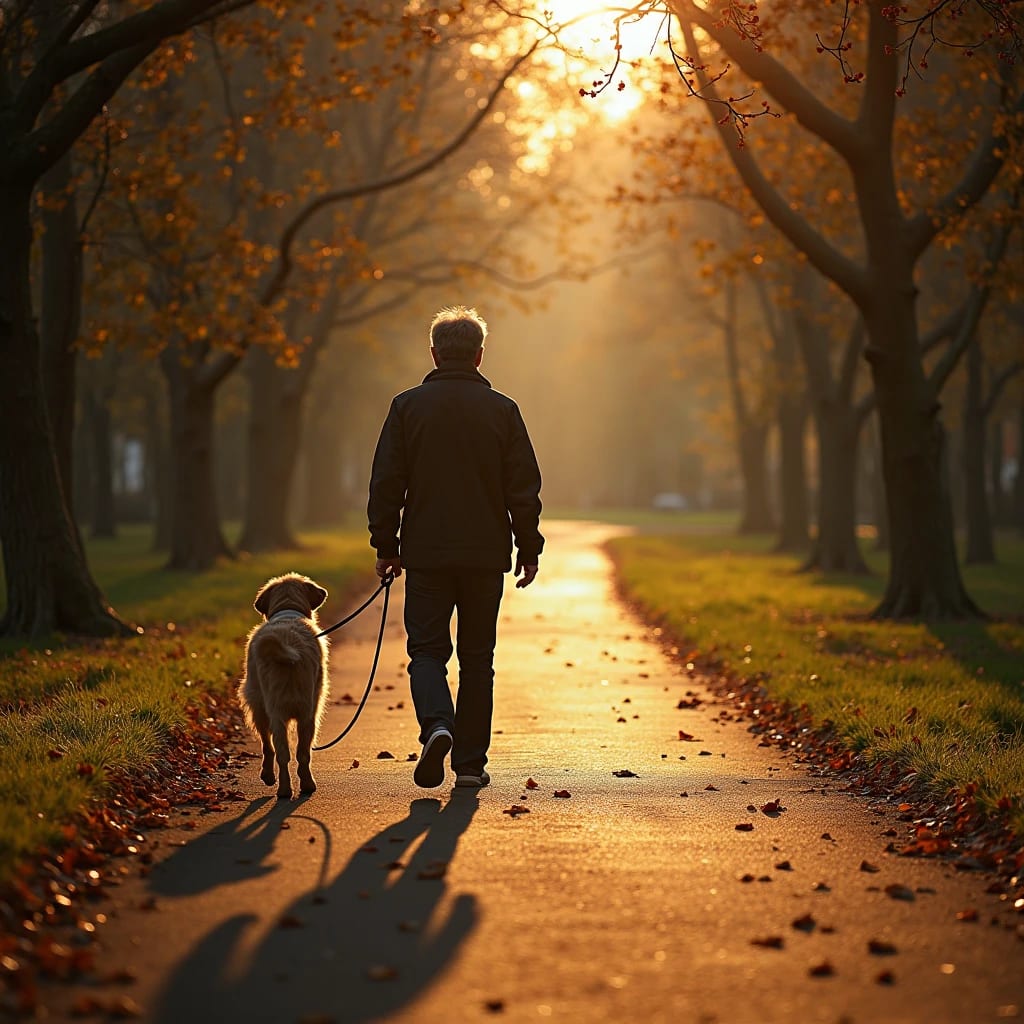
Thursday morning arrived like a quiet drumbeat. The air was still. Rusty hadn’t moved from his bed in the living room. But when I knelt beside him and whispered, “Wanna go for a walk?”—something changed.
He lifted his head.
Struggled onto his legs.
And for the first time in days, he stood. Just barely. But he stood.
I grabbed his leash—not because I needed it, but because it felt like the right thing to do. Rituals matter, even at the end. Especially at the end.
We walked.
Well—moved.
Each step was slow, deliberate. His legs shook. I supported him with one hand beneath his belly, the leash loose in my other. We walked down the block, past the school where the kids used to call his name, past the park where he once chased butterflies, past the corner where he once stood tall and barked at a bulldog three times his size.
Now he moved with dignity, even in fragility. A soldier returning to familiar ground one last time.
And I talked to him. Not because he understood, but because I needed to say the things I hadn’t.
I told him he was the best thing that ever happened to me. That he had saved my life more than once. That his love was the only constant in a world that had been anything but steady.
And then I whispered:
“It’s okay to go. I’ll be okay. I promise.”
He paused. Looked up at me.
And I swear—his tail wagged.
The vet arrived later that afternoon.
I sat with Rusty in my lap, cradling him the way you’d hold a newborn. The vet explained what would happen. I nodded. But my ears were buzzing. My throat felt like sandpaper.
He looked up at me once more before she administered the injection.
And I said the only words that mattered:
“Thank you.”
Within seconds, his body relaxed. His breathing slowed. Then stopped.
The room was silent.
But it wasn’t empty.
Because the space between us—me and Rusty—was filled with something that death couldn’t erase.
Love.
The house felt like an echo chamber for weeks after.
Every sound reminded me of him. The jingle of keys (he’d always come running). The thud of the mail slot. The rustle of his bed, which I couldn’t bring myself to remove for days.
Grief has a strange rhythm. It doesn’t scream. It whispers. You hear it in the absence of nails on the floor. In the way you still pour a second bowl of food by instinct. In the silence of a morning walk that no longer has a companion.
But slowly, the pain dulled. And the love remained.
Rusty taught me a lot about life. About trust. About routine. About joy in the simple things—like sunshine on a rug or the thrill of a tossed tennis ball.
But in the end, what he taught me most was about letting go.
We talk a lot about love being holding on. But sometimes, the purest love is in releasing. In giving someone the permission to leave, and the promise that you'll carry their memory—not their burden.
Rusty gave me that.
And on our final walk, I gave it back.
About the Creator
Muhammad Sabeel
I write not for silence, but for the echo—where mystery lingers, hearts awaken, and every story dares to leave a mark
Keep reading
More stories from Muhammad Sabeel and writers in Petlife and other communities.
The Cat Who Knows My Secrets
I adopted Miso on a rainy Thursday when the world outside felt like it had lost all color. My therapist had said, “Try something alive. A plant, a pet. Something that depends on you.” I was skeptical. But there he was — curled up in a too-small basket at the animal shelter, half-asleep and wholly unimpressed by the world.
By Muhammad Sabeel6 months ago in Petlife
A Dart at Dusk
Seconds ago, the sullen sun set on the two of us… my exuberant furry companion and me. A fresh breeze embraces us, delivering welcome relief from the day’s oppressive heat. His typical stumbling and staggering along — apace with a sloth — has turned into trip-trapping, high-stepping, almost skipping along.
By Angie the Archivist 📚🪶5 days ago in Petlife
Frozen Clash: Wolf vs Bear
The morning light broke gently over the snow-covered wilderness, turning the frost into a blanket of sparkling diamonds. The forest was silent except for the soft whisper of wind moving through the icy branches. Every tree was coated in white, and the frozen ground glistened under the soft sunlight. In this serene landscape, life thrived in quiet ways, even in the harshest winter conditions.
By Bilal Mohammadi7 days ago in Petlife


Comments
There are no comments for this story
Be the first to respond and start the conversation.