
The Cat Who Raised the Puppy
An Unlikely Mother’s Love
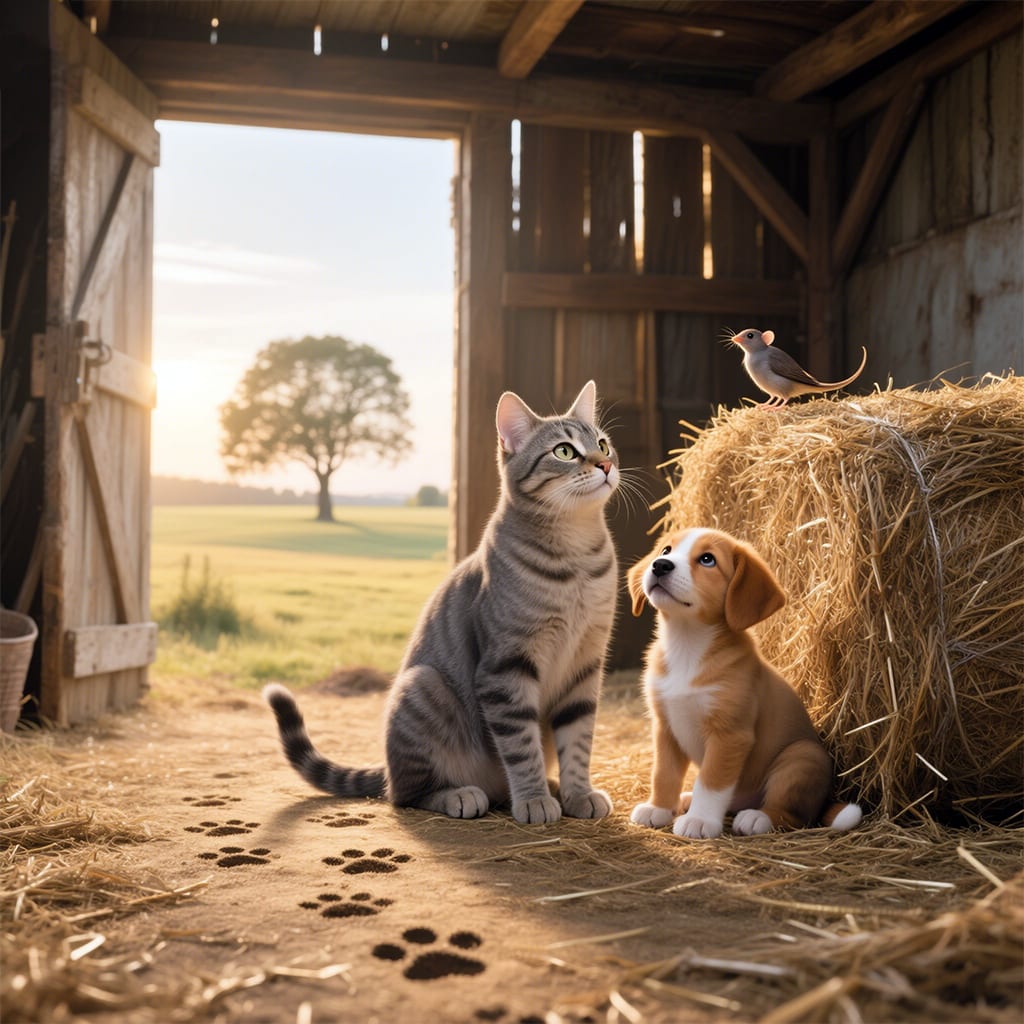
In a quiet corner of Meadowbrook, a village where life moved slow and sunbeams stretched lazily across cobblestone paths, lived a gray tabby cat named Mistletoe. She was no ordinary feline. Known to the villagers as “Missy,” she held the unspoken title of Queen of the Barn, ruling over the hayloft of old Farmer Duncan’s land.
Missy had lived a full and fearless life—chasing off foxes twice her size, raising four litters of kittens, and once dragging a rattlesnake out of the barn with the fury of a tiger. Now in her elder years, with a stiff gait and a streak of silver in her fur, Missy had settled into peaceful days of sunbathing and dignified silence. That was until the day the humans brought in a small, trembling creature wrapped in a flannel shirt.
A puppy. Barely weaned. Ears too large for his head, tail curled tight in fear. His name, they said, was Rusty—a name far too bold for something so soft and whimpering.
Missy watched from atop a bale of hay, her amber eyes narrowing. She had no patience for foolishness or noise, and puppies were known for both. Yet something in the pup’s eyes—a kind of raw loneliness—froze her mid-glare. It was a look she recognized, the same gaze one of her kittens had the day it was separated from its litter by a hawk and brought back, traumatized and cold.
That night, when the barn grew quiet and Rusty began to cry, Missy leapt down from her perch. She padded slowly across the wooden floor, tail flicking, and curled herself beside him. The pup startled at first, his cries catching in his throat, but Missy gave a single, decisive lick across his snout and settled in.
From that moment on, the barn had a new rule.
Rusty followed Missy everywhere. He watched how she leapt onto the windowsill to catch the morning sun, how she groomed herself with slow precision, how she narrowed her eyes and froze when she sensed a rodent nearby. And Missy, despite her initial reluctance, began to teach him.
She taught Rusty how to stalk quietly, how to be patient. She taught him to listen—not just hear, but listen—to the wind, the rustling of leaves, the vibrations in the ground. When he barked too loudly or chased his own tail, Missy would swat him across the nose—not out of anger, but guidance.
In time, Rusty grew. His legs lengthened, his bark deepened, and his clumsiness faded into agile grace. But the most surprising thing was how cat-like he became. He didn’t chase chickens or bark at cows. He moved with a kind of quiet respect, often seen perched beside Missy on the roof of the barn, the two of them surveying their kingdom like twin sentinels.
The villagers found it odd, of course.
“Never seen a dog act like that before,” old Farmer Duncan would say with a chuckle. “He doesn’t fetch. Doesn’t dig. Just stares at you like he’s judging your life choices.”
Children visiting the farm would giggle at the sight—Rusty stretched across a haybale, grooming his paw awkwardly, then rubbing it across his face just like Missy had taught him.
But for all his feline quirks, Rusty was loyal. Fiercely so. One autumn evening, when a wild coyote slipped through the fence and crept toward the henhouse, it was Rusty who stood in its path. Missy arched her back, hissing from the roof, but Rusty met the predator head-on. He growled low, baring his teeth—not wildly, not with reckless energy, but with cold, controlled resolve. The kind Missy had always shown.
The coyote backed down.
From then on, no one questioned his place.
As seasons passed, Missy’s steps grew slower. Her once bright eyes dulled with age, and she spent most days curled in the sun, watching Rusty patrol the barnyard with a silent pride. He still came to her side at dusk, curling his much larger frame around her fragile one, and she would rest her chin on his back.
Then one winter morning, Missy did not wake.
Rusty stayed beside her, refusing food or water, until the farmer gently lifted her body and buried her under the great oak tree near the barn. Rusty lay there for hours, unmoving, even as snow began to fall.
But he rose.
The next morning, Rusty climbed to the top of the hayloft where Missy once sat, and watched the sunrise. And when a new litter of barn kittens was born that spring—motherless and mewling—he padded over and curled around them, letting their tiny bodies press against his warmth.
He licked their heads awkwardly, softly.
He remembered.
Rusty the dog, raised by a cat, had become something more than either species was meant to be. In him lived the courage of a guardian and the quiet wisdom of a queen. And in the heart of Meadowbrook, stories would be told for generations—of the cat who raised the puppy, and the puppy who never forgot.
About the Creator
Only true
Storyteller | Explorer of ideas | Sharing thoughts, tales, and truths—one post at a time. Join me on Vocal as we dive into creativity, curiosity, and conversation.
Off the Leash: The Essential Gear Guide for Adventurous Dogs
There’s something wildly freeing about unclipping the leash and letting your dog move the way they were built to. If you’re hiking in areas that truly allow off-lead exploration, your gear list shifts. No harness. No leash dragging through dust. Instead, it’s about smart, lightweight essentials that keep your dog safe, hydrated, and easy to manage when adventure gets messy. Long walks off lead are less about control and more about preparation.
By Shabbir Ahmad3 days ago in Petlife


Comments
There are no comments for this story
Be the first to respond and start the conversation.