

When quarantine started in March 2020, it was bitter cold in Toronto and it seemed for a long time like it wouldn't end. But, after one last snowfall in early-mid May (I'm not kidding) Spring did eventually come.
Luckily, it didn't hold back. Within about a week of that snowfall things were green again, and it was amazing. With my sources of indoor entertainment exhausted, I could finally stroll around the neighbourhood under the sun, breathing in the warm, Springy-Summery air.
Perhaps they were always there and I just never bothered to slow down and look. When I went on walks with my boyfriend I noticed so many critters and birds in our neighbourhood park and trail that we'd rarely or never seen before. Blue jays, cardinals, woodpeckers, blue herons, field mice, carp, turtles, an evasive little thing that resembled a mink, and so many other creatures were everywhere. We began to walk outside more frequently, sometimes twice a day, just to get a better look at these amazing animals. I'd always hoped to catch a sight of something interesting every day, but I never expected to be caught in such an interesting, lucky, amazing situation.
***
On the morning of June 19, I was, like any other day, taking a walk around the neighbourhood with my boyfriend, Rui. We crossed the bridge over the little creek behind the baseball diamond and went up the path, but there was something very unusual about the sight before us. There was a large, roundish thing on the side of the path hovering over a small pit in the dirt.
I couldn't believe my eyes. "Is that a...turtle?"
We'd seen small, aquatic turtles in the neighbourhood before, but nothing like this. It was a female snapping turtle, laying her eggs in a pit she had dug in the ground. We stayed at a distance and watched, absolutely fascinated. The eggs plopped out one by one, looking and sounding like little ping-pong balls as they landed in the put. The turtle didn't seem to care that we were watching; she took her time laying her eggs, roughly plowed some dirt over them, and disappeared into the grass.

We were really excited, but also extremely worried. During the whole laying process, only one other family besides us had come by, so not many people knew about the eggs. However, this path was used very often by dog walkers, and dogs could most certainly catch the scent of the eggs. Not to mention, the neighbourhood also had racoons, minks, and perhaps even foxes. The turtle, unfortunately, had picked a pretty terrible spot to lay her eggs.
We contacted a friend who lived in the neighbourhood and who was much more familiar with reptile care and told him about the eggs. We didn't know what to do; a sign by the fence would only draw unnecessary attention to the eggs, and there was no way to put a covering over the eggs that would protect the turtles from predators but also not block vital things like sunlight and rainwater. We didn't want to disturb the eggs unless absolutely necessary.
In the end we decided that the best course of action would simply be to keep a close watch on the eggs. This was in the middle of quarantine, so none of the local wildlife organizations were open or picking up the phone. The one that did pick up was in the neighbouring city and couldn't operate outside of their jurisdiction. It looked like we were on our own.
***
The next morning, while Rui and I were out running errands, we got a call from our friend. He was visiting the egg location.
"I have bad news," he said. "It must have been a dog or something. The eggs have been dug up, and some of them are crushed."
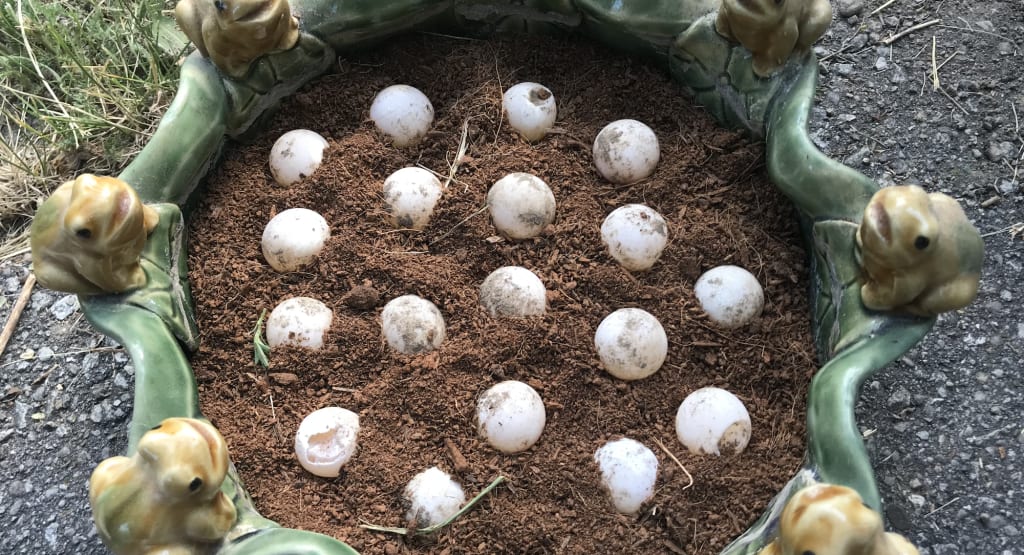
Our hearts sank; we felt responsible. When we came home, we did some research and then rushed to the spot with some containers. Our friend came with a bag of special substrate for reptiles. Eggs were scattered around the area, yolks leaking out, but many of the ones at the bottom were still okay. And so, under the unforgiving heat of the afternoon June sun, we each took home half of the eggs, nestled in a comfortable layer of reptile substrate.
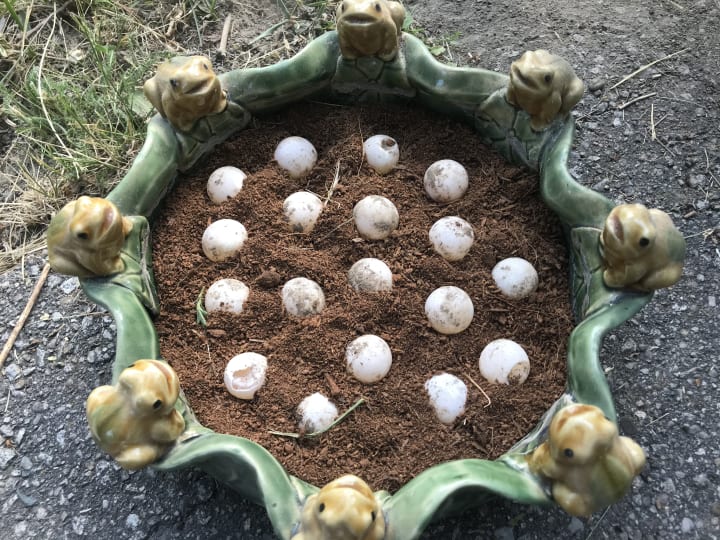
We knew from our research and prior knowledge that turtle eggs are extremely sensitive to disturbance. For example, if you flip the egg's orientation (top to bottom) while the fetus is developing, that can end up killing the turtle. This is because turtle egg yolks will bind to a particular side of the egg, and are not free-floating like the eggs that we're used to seeing (chicken, quail, etc.)
However, that's usually when the fetuses have already been developing for a while. We had no idea if it applied to turtle eggs that weren't really developed (after all, they were only laid a day ago). There was no way of knowing if any of the turtles were going to survive, and since turtle eggs need at least about 3 months to hatch, it was going to a real waiting game to see if any of them were going to make it.
We took some of the eggs home (pictured above), slow and steady so as to not shake them too hard. I was carrying something very precious in my hands. At home, we set the eggs on a ledge in front of a window, where it would get lots of sunlight and warmth. Every once in a while I would spray the top with water to help maintain moisture levels, since we read that the eggs shouldn't stay too dry. Rui and I kept this up diligently for three months, all the way until September.
While there is a method to check for life in the eggs, it involved digging them up and holding them over a phone flashlight. Since we didn't want to risk killing the (possible) fetus by disturbing it, we opted to just not know. And so, there was nothing to do but wait.
***
What the heck?
It was September 1, 2020. I was doing one of my compulsory egg checks (which I'd been doing multiple times every day basically since the eggs entered my house), and something seemed a little different. I never touched the substrate over the eggs, except except for when one of them got exposed from my water spraying. Today, though, there seemed to be a...bump...in the soil.
It's probably nothing, I shrugged and thought to myself as I brushed my finger over it lightly to smooth out the soil. As my index finger swept across the bump, my heart skipped a beat. Something moved. My mind went into absolute jitters; it was really happening. After all the months of waiting in the dark, we now had an actual sign that, at the very least, one of the turtles had survived.
I watched the bump religiously, but it didn't move for a long, long time. It turns out that hatching is a slow and tedious process that can often take many, many hours (or even days). I reluctantly peeled myself away from the eggs, heart pounding.
After several hours, I came back to an amazing sight. There are absolutely no words to describe how I felt in that moment when, peering into the container, I saw a little tiny face looking up at me from the soil. If there's anything I can be proud of myself for in my life, I'm proud that I remembered to capture this moment.
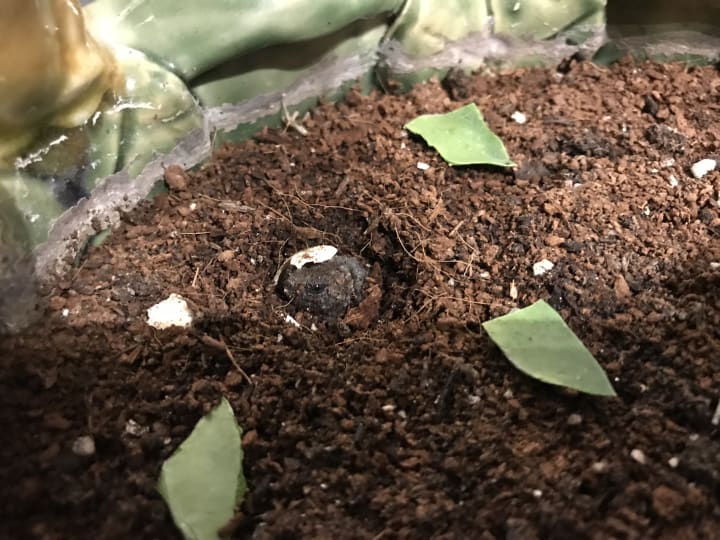
The turtle stayed like that for the next half of the day. Perhaps it was waiting for its siblings and didn't want to leave the soil alone. After all, safety in numbers, right? I had to go out that evening for some plans I'd made a while back, so I put the entire container in a sink so that if the turtle suddenly got tired of waiting and decided to crawl out, it wouldn't fall from the window ledge. When I got home that night, there it was, in the sink. Don't worry, the container wasn't very high and I wasn't gone very long. The little turtle was active and well, and I immediately put him in a small tub of water.
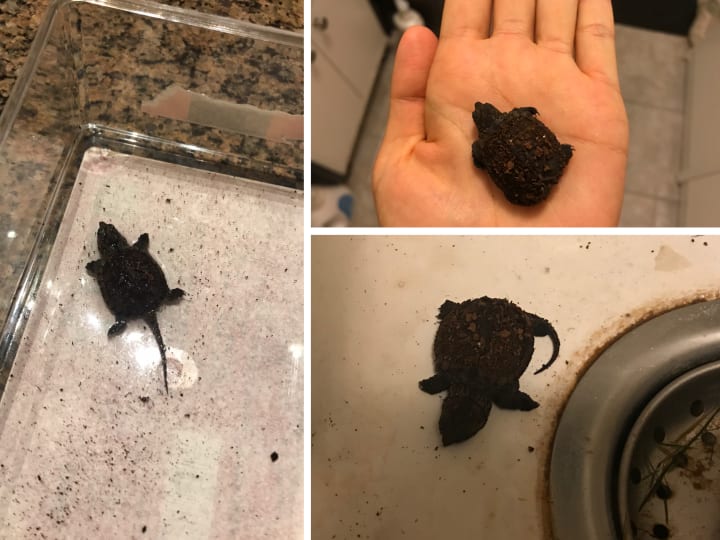
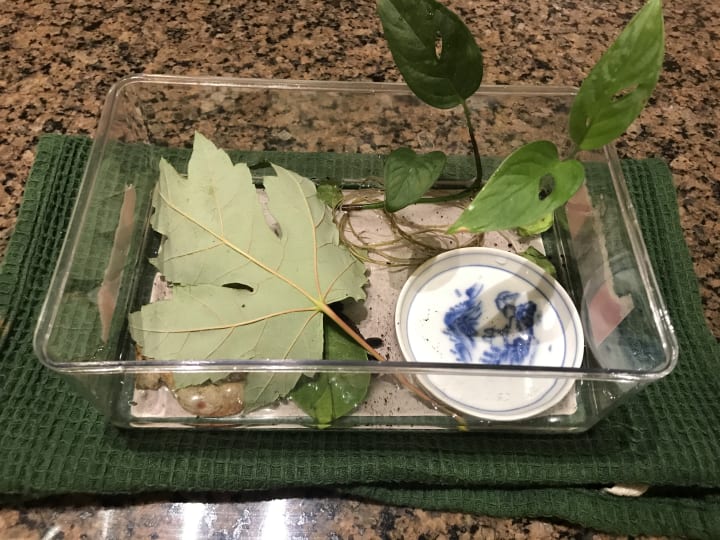
I jazzed up the container with some leaves and other things that might make it more comfortable for Jeb, and I went to bed that day happier than I'd been for a long, long time.
Note: It’s pretty much impossible to tell the sex of turtles at this age, so we actually have no idea if the turtles are male or female.
***
It all happened very quickly. The next day, within the span of a couple of hours, not one, but two eggs began to hatch! As I was watching them hatch, it became apparent that even little hatchlings like these have their distinct personalities.
The first one that hatched, named Zipporah (Zippy, we called it), was very rambunctious. It was extremely eager to come out, and was the most active of all the turtles throughout the entire time that it was in our care. It was a very chunky (thicc) turtle and came out with its egg sac still attached, and it unfortunately it had never developed a tail. The following is a video of some parts of Zippy’s hatching process.
Zippy quickly joined Jeb in the little tank while we waited for the third turtle to finish hatching.

The next hatchling was very different. Even after it came out of the egg, it burrowed himself into the soil and refused to come out. When we tried to coax it out, it only attempted to burrow deeper into the substrate. Eventually, though, we were able to coax it out, and it joined its siblings. We named it Ezekiel (Zeke for short).
That night, we borrowed a bigger tank from our friend and set up a more comfortable home for the hatchlings. In retrospect we did put too much water for the little babies, but given the platform they had and the plants they could grip on, they were still fairly comfortable.

The next morning, they seemed to have really settled in!

The third day, Ishmael (Mel) and Jezebel (Belle) hatched almost at the same time, and by noon they also joined the rest of their siblings in the bigger tank. Overall, out of the 20 or so eggs we had taken we got five adorable little hatchlings! Even though we were concerned about the mutations, we were so happy that they had survived. They were all energetic.

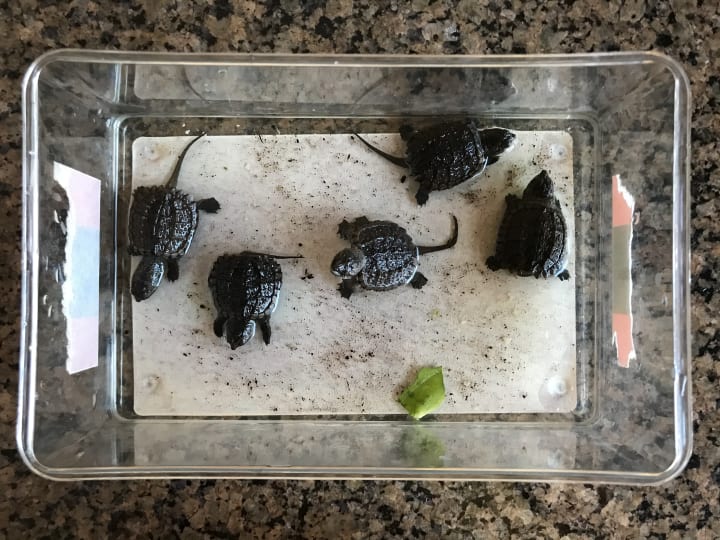
Mel was looking strong and healthy, but Belle had a deformed tail. It was smaller than usual, stuck pointing to one side, and unable to be controlled by Belle—essentially unable to serve any real purpose as a tail. While we cannot be absolutely 100% sure these disfigurations (in Zippy, Zeke, and Belle) didn’t have anything to do with being disturbed as eggs early on, unfortunately in nature snapping turtles also tend to have a high mutation rate. Out of the five hatchlings, only two (Jeb and Mel) were visibly “normal”.
The other turtles, despite their mutations, exhibited fairly normal behaviour and seemed healthy, Zeke, as it turned out, had more issues than we originally thought. While the most obvious sign was its crooked tail, upon closer inspection it had two other major issues. The more minor of the two was that it had a pretty severe underbite. Most turtles, if you have noticed, have an overbite, and it helps them to bite their food. Zeke’s underbite, therefore, inhibited its ability to bite and eat properly.
The biggest problem, however, was that it didn’t have eyes. It took us a day to notice, because the hatchlings had very small eyes in general, but Zeke simply didn’t have them. It wasn’t that they just hadn’t opened; Zeke didn’t have little “bumps” where its eye sockets should have been, causing his head shape to be distinctly different than that of its siblings.
Zeke wasn’t like its siblings. While the others liked to bury under shells and leaves, Zeke spent most of its day trying to get somewhere as high as possible—whether that be on the platform on on the plant. While everyone else hung out mostly in the water, Zeke didn’t like being in water and preferred dry land.
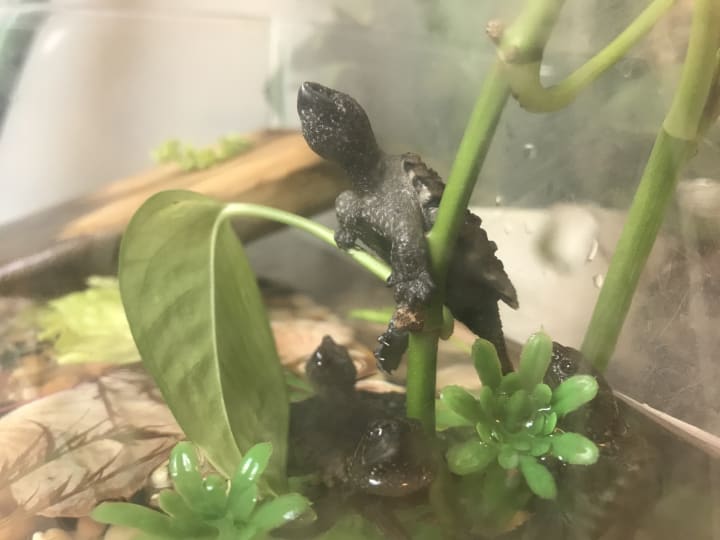
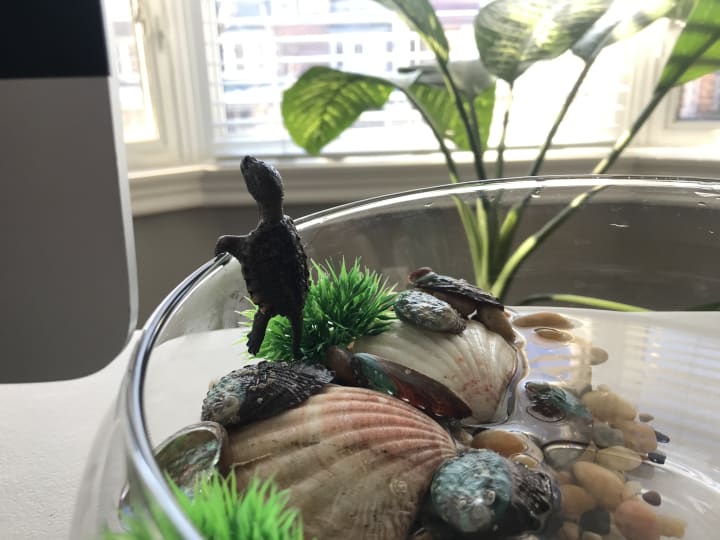
The others ate the bloodworms and crickets we fed them readily and hungrily, but Zeke wouldn’t eat for the first two or three weeks (which really had us worried). Zeke also had to be specially and patiently fed with food skewered on the point of a toothpick, and the food had to be placed right in front of its nose for it to sense it. The others fattened up and grew stronger; Zeke lost weight. The others stayed low to the ground; Zeke often stood up on his two hind legs (yes, like a person).
We ended up keeping the turtles for approximately one month, and we released four of the turtles around the time of Canadian Thanksgiving. We took them to the little creek by the spot where their mom had laid the eggs and we let them go. It was incredibly heartbreaking watching them swim off on their own, but we had taken care of them long enough and they were strong and healthy. Zippy, despite having no tail, was clearly the toughest and most rambunctious, and had actually gained quite a bit of weight during its time with us. While Belle also had a disfigured tail, it was energetic and loved to move around. Jeb and Mel were more sensible, and were cautious but strong. We had a lot of faith in all of them.

For several days afterwards I would keep coming back to the spot to see if I could see any of them again, but they had all left to lead their independent lives. I wish them all the best on their journey!
…Now, earlier I did mention that we only released four turtles. Yes, it’s true, we kept Zeke. Please don’t come at me with lectures on how it’s important to release wild animals back into their habitat—I know. I believe that in the vast majority of situations, releasing them is the best and right thing to do. However, with the immense number of issues Zeke experiences and the care that it needs, it isn’t very clear how long Zeke’s lifespan will be. We honestly figured it might be better for us to just take care of Zeke.
So we prepared a little home for Zeke (we tend to call Zeke a "he", but that may change when we know Zeke's real sex). He has its own little tank where he has a safe, dry space to be, as well as water. We feed him once every day or so. Snapping turtles are independent animals, but even if Zeke is lonely it has Rui and I here with him. Zeke is over half a year old now, and while he has struggled to grow bigger, he’s made a little bit of progress. He still stands up on two legs from time to time, almost like he’s trying to sense just how far the world reaches. Needless to say, we’ll be caring for Zeke for as long as he lives.

This has been (and continues to be) my amazing journey with hatching snapping turtles through a very unexpected sequence of events. While I of course am not happy that they had to be moved from their original location, the whole experience with them has brought me so much joy. It was my privilege to be their caretaker, and it is my privilege to be Zeke’s caretaker. I hope that one day, tomorrow or ten years from now, I can meet those four little turtles once again.
About the Creator
Understanding the Causes, Symptoms, and Treatment Options for Colitis in Dogs
Colitis in dogs is a common gastrointestinal condition that affects the large intestine (colon). When the colon becomes inflamed, it can lead to uncomfortable and sometimes alarming symptoms for your pet.
By Dominion Valley Animal Hospital7 days ago in Petlife
📢 Raise Your Voice Thread: 03/05/2026
Our “Raise Your Voice Threads” are hosted most alternating Thursdays at 12PM ET to offer creators more avenues to uncover exceptional stories on Vocal. As we are continuously searching for fresh creators and inspiring stories, this thread provides an opportunity to exchange and discuss the stories that have moved and motivated us on Vocal.
By Raise Your Voice by Vocalabout 7 hours ago in Resources

Comments
There are no comments for this story
Be the first to respond and start the conversation.