
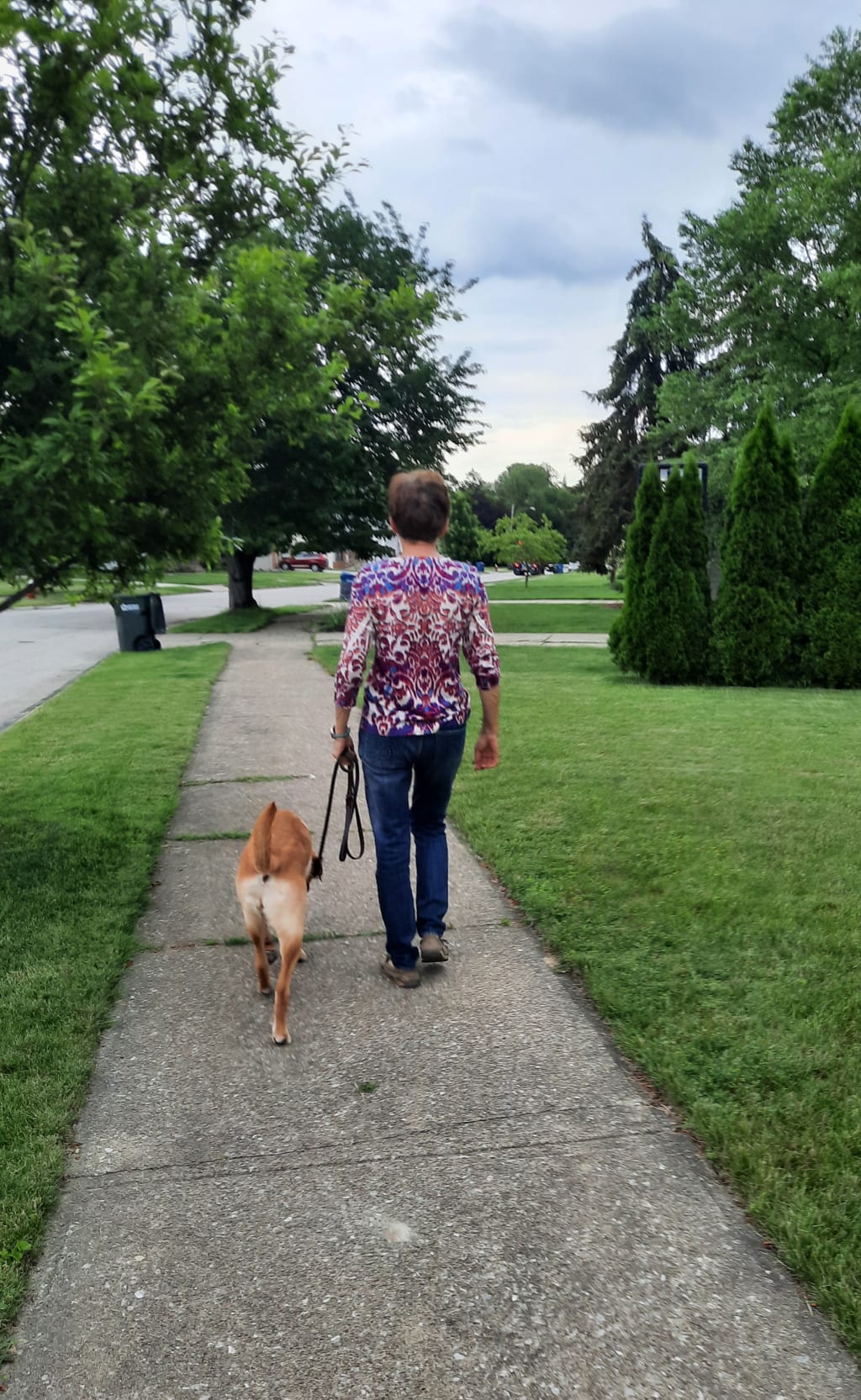
When Stella grows up, she will be a therapy dog. But, we have a lot of work to do to get there. Stella is a sweet and good natured dog. She loves everything and everyone. She is full of excitement and ready for new adventures at the drop of a hat (which is in fact true - she loves a dropped hat or sock or glove. Best game ever! ) Shakespeare’s words ring true for her: “O brave new world that has such people (creatures/experiences) in it!”
But her youthful curiosity and joyful exuberance can become unrestrained energy and unruly power at the turn of a switch - a squirrel scurrying up a tree, cotton tree fuzz floating in the air, chipmunks, rabbits, a leaf blowing in the wind, all can instantly elicit an impulsive lunge and a determined pull on the leash.
“She is still a puppy,” I am reassured by the other dog owners at the neighborhood play group when she leaps into the air to give them jubilant doggy kisses. But at 8 months old and 55 pounds, that is a generous and forgiving explanation, indeed! I think they are starting to reconsider that view because I noticed recently a collective willingness to correct her when she tries to jump. Much to my relief, she is showing improved awareness and the ability to check her impulse. I guess it takes a village to raise an exuberant dog!
One of the prerequisite steps to become a therapy dog is to earn a Canine Good Citizen certificate, a nationally recognized certification that sets standards for dog training and behavior. Ten areas of behavior are assessed on the test, such as sitting politely to be petted, walking on a loose leash, sitting and down on command, coming when called, staying calm during distractions, and so on. In truth, these are basic requirements for any dog, but a therapy dog is required to do all of them, not just sometimes, but all the time, reliably and consistently.
So I thought, ok, let’s pick one out of the hat and see how she fares.
Loose leash walking it is!
According to the American Kennel Club, this item examines the handler’s ability to control the dog during a walking demonstration that incorporates a right turn, a left turn, a stop, and an about turn. The dog’s job is to pay attention to the handler’s actions and be able to respond to movements and changes of direction without pulling or resisting.
So how does Stella do with loose leash walking? It has been the best of times, it has been the worst of times, to paraphrase Charles Dickens.
In the last month, we have done walks where she has been spot on perfect: her head in line with my leg, looking up attentively and expectantly for signs and directions; sitting politely at crosswalks until released to cross; walking tall with head held high. Practically ready for testing!
But then there are times when walking a Tasmanian devil would be easier! Case in point: A few days ago we were in the park, meeting her very best friend, Rosie, on the way to the river to play. From the moment we arrived, Stella was a hellion, nay, more of a wild beast! She pulled, she leaped into the air, she barked with excitement, she tried to run around me to get to Rosie in the distance. The shortened leash was not enough leverage; the treats were of no use; my commands had no effect. I could imagine the shaking heads of people in the park, judging and thinking “that dog needs some obedience training!” But I could not concern myself with imagined opinions. I had to get control of the situation. After all, as my trainer Kerry says, my job is to pilot Stella and answer her questions: “Can I run amok?” “No, you may not.” In retrospect, I should have put her back in the car and driven far enough to reduce the stimulation; and then approach slowly and gradually, only as far as she could handle, with the goal always being success as she responds to my instructions.
A high point and a low point. Most of the walks these days are somewhere in the middle, unless there are distractions. Then, back to the drawing board to reestablish calmness and control. So, loose leash walking needs more work. Stella has some of the foundational pieces in place, and as her puppy excitability diminishes, mature walking skills will be the norm. But for now we keep working diligently on the basics so that when she grows up, Stella can become a therapy dog.
About the Creator
Keep reading
More stories from Dana Watts and writers in Petlife and other communities.
Growing up Stella
Stella is 7 months old, and when she grows up, she will become a therapy dog. She will comfort those in need, she will sit politely to be petted. She will give gentle doggy kisses to hospitalized children who reach out to pet her. She will rest her head quietly on the lap of nursing home residents, scratching her wistfully behind her ears as they think of bygone days and dogs they too had once owned. She will listen quietly to people telling their stories, good memories, sad memories, old longings that they recall as they look into her soft brown eyes.
By Dana Watts5 years ago in Petlife
The Summer I Was Chosen by a Northern Mockingbird
During the long, suspended days of the pandemic, a wild mockingbird began visiting my driveway and chose me, again and again. What started as a strange encounter became a brief, meaningful connection that I still carry with me.
By Erica Roberts 4 days ago in Petlife
📢 Raise Your Voice Thread: 01/22/2026
Our “Raise Your Voice Threads” are hosted most alternating Thursdays at 12PM ET to offer creators more avenues to uncover exceptional stories on Vocal. As we are continuously searching for fresh creators and inspiring stories, this thread provides an opportunity to exchange and discuss the stories that have moved and motivated us on Vocal.
By Raise Your Voice by Vocal2 days ago in Resources



Comments
There are no comments for this story
Be the first to respond and start the conversation.