
Is a pigeon eye that shakes good?
Talking about the quality of the pigeon from the dynamic type of the eye

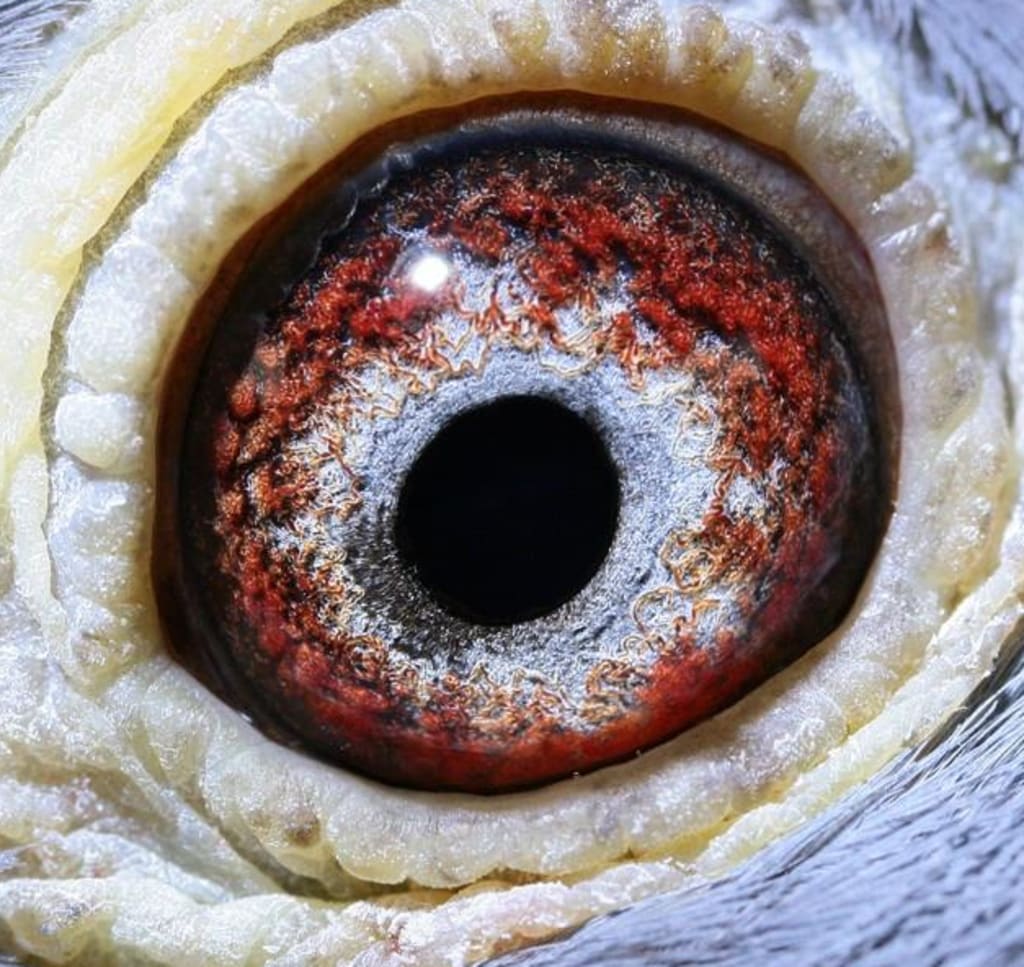
The dynamics of the pigeon's eyes reflect more or less the personality of the pigeon, mainly in four aspects: eye twitching, pupil dilatation, target pursuit, gaze, etc., which are divided as follows.
Eye twitching.
When we catch the pigeon in our hands and observe its eyes, we will find that some pigeons' eyes will shake one after another, while others' eyes rarely shake. For this situation, some domestic experts have made a study, and the author also made a test, the test results show that the pigeons with constantly shaking eyes are sensitive and anxious, with timid temperament. On the contrary, the pigeons whose eyes rarely shake are mild and quiet, and bold.

During the short-distance training, the pigeons with fast twitching eyes fly fast, but due to their timidity, they sometimes wander outside the loft and hesitate, which affects the reporting time. So let them do more training flights before participating in the race, gradually eliminating the nervousness and impatience. In the final, it is better to let it be hot, or in the hatching of eggs, to prompt it to return to the shed quickly and win the honor of the owner, but most of them will fail if they take such acute pigeons to the long-distance race.
In the long-distance race or the very long-distance race, the pigeons with slow eye twitching perform better than the ones with fast twitching, because they are stable and not impatient. When the weather is bad, they won't move forward blindly, take shelter from the rain and wind, or take a break from the food; they will continue to move forward when the weather is good.
In this way they develop a hard-working spirit and, over time, pass on this character to their children and grandchildren. These pigeons are not fast enough to grab a place in the close race, but in the long-distance race, they determine the direction while flying, and once they fly in the wrong direction, they will not be irreversible, they often "turn back to the shore" and fly back to the same place. If deviations occur on the way back, they will keep correcting them and will not fly too far in a hurry.
Some pigeon owners are reckless when they find individual "tractors" and eliminate them during close training flights. Not to mention the blindness of the pigeon, but in terms of character, this kind of pigeon should be put to the further test at a distance to prove its true quality.
Pupil dilation
The pupil dilation is linked to eye twitching, most pigeons have constant eye twitching. The pupil dilation is fast and the opposite is slow. We hold the pigeon and move the head, one moment in the sun and the other in the shadow, we can see that the pupil of the pigeon shrinks with the light and expands with the darkness, this is the pigeon's eye adjusting the focus to see the sight in different brightness, this is similar to the principle of the lens of a camera, all pigeons with normal eyes have this kind of physiological movement.
But some pigeons show it more prominently. For example, if you look at its eyes in the shade of a tree or under a roof, not under direct sunlight, even without changing the direction of its eyes, you can see that its pupils sometimes open wide to look at the swing of leaves in the near distance, and sometimes narrow to look at birds in the sky, frequently opening and closing.
This means that the pigeon is trying to identify the sighted object, which means that it is very likely to navigate by vision, and a pigeon that navigates by the visual system is suitable for short and medium-distance races. However, some pigeons have slow pupil dilatation, even for a long time, and some pigeon fanciers say that the eyes of such pigeons are like the eyes of dead fish, which they do not like very much.
I have been raising pigeons for several years, and at the beginning, I was like that, but as I observed more and more long-distance pigeons, I gradually changed my opinion, some long-distance and ultra-long-distance returning pigeons' eyes are not very dilated and twitching, for example, most of the ultra-long-distance pigeons returning from Shanghai to Hami do not have very twitching eyes, and I think that the navigation of such pigeons does not depend on the pigeon's eyes.
It is impossible to see your loft with your eyes above a thousand kilometers, so their navigation system must be more effective than their eyes. If the eyes of a long-distance winning pigeon are fast, it must be a good breeder; because it is not enough to navigate from a long distance with the eyes alone, it must have more than two effective navigation systems, and these pigeons must fly faster in short and medium range racing.
Some pigeon fanciers think that the pigeon whose eyes are not very dilated and shaking is because its eyes function very well, it doesn't need to shake to adjust the curvature of the muscles, just like a pilot with good eyesight, he can see everything near and far, while those who suffer from myopia or presbyopia need to wear glasses to adjust the focus.
This is also quite reasonable. If the pigeon's eyes are functioning well, it is not necessary to move the eye muscles frequently to see the object, so the eyes are not easily fatigued, on the contrary, if they are constantly shaking and contracting, the muscles will soon be fatigued and will not be able to support them in the long-distance race and fall behind.
We often see long-distance homing pigeons with black or purple color blocks in their eyes, commonly known as "hanging color". This is because the fatigue of the eye muscles is excessive and causes the rupture of capillaries, which is not a good phenomenon as some pigeon fanciers say. If the eyes of a long-distance returning pigeon are still the same as before the race or have not changed much, then its potential is self-evident.
Because its long-distance return is either not navigated by the eyes or even if it depends on the eyes, the eyes can afford it without signs of exhaustion, so its potential is great.
Pursuit of the target.
When we hold a pigeon to look at the eye during the day, we usually make the pigeon's eye look towards the light sky, if something is moving in the sky, such as a bird or an airplane, the pigeon's eye will follow the movement, this is a normal performance, but some pigeons will have a special performance, they will repeatedly scan the position of the moving sighting, even though the moving sighting does not reappear in that position.
This means that the pigeon is alert and it is good to escape from the falcon. In short and medium-range races it is good to remember the geography of the surroundings and will be faster and faster.
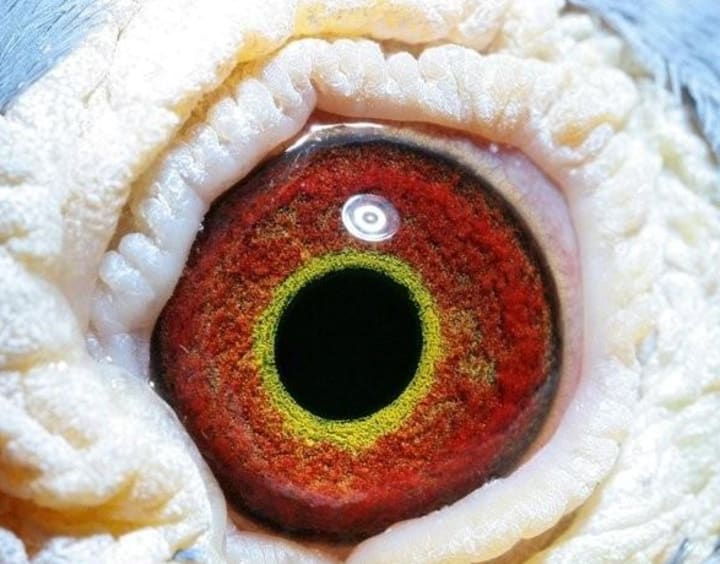
Gaze.
Some pigeons have their eyes fixed on you when you hold them, others are fixed on an immobile target. Therefore, you don't see a lot of flaring. In fact, except for those who are demented due to old age or illness, it is not that they do not follow moving targets or that their pupils do not dilate, but the reason why they do not react that way is mostly due to their personality.
This kind of pigeon is mild, calm, and bold. They do not struggle and do not resist when they are in their hands. It gives people a feeling of affinity and sophistication. These pigeons have a strong attachment to the nest and they have a good performance in competitions.
Some of them have developed this character due to many competitions. The pigeon's eyes also show whether the pigeon is healthy or not. A healthy pigeon has high transparency of the cornea and you can see the color of the eye shape behind the membrane, etc.
Healthy pigeons are in good spirits, so their eyes look solid and alive. The corneas of sick pigeons seem to have a thin layer of suspended fluid, sometimes you can see bubbles of tears, so that the eye shape after the membrane, the color appears blurred, and the pigment of the sand bottom sand grains becomes lighter. The spirit is poor, so the eyes appear airy and weak.
When introducing the winning pigeon, the fanciers often describe it with the eyes as "dry, old, shiny, and shiny", which only means that the winning pigeon is healthy, it does not indicate other qualities than health there are many pigeons that are similar to the winning pigeon or more "dry, old, shiny, and shiny". Many pigeons are almost the same as the winning pigeon or are more "dry, old, shiny, and shiny" and can't return.
Of course, there is nothing wrong with that presentation of the winning pigeon's eye, but here I tell the fanciers that any pigeon with poor health should not be sent to the race, even if it has a good pedigree, even if it has taken a place in the same race, if it is still sent to the race, it is not a victory in hand, but a defeat in sight.
About the Creator
Fester Hammer
We soon believe what we desire.
Keep reading
More stories from Fester Hammer and writers in Petlife and other communities.
A Dart at Dusk
Seconds ago, the sullen sun set on the two of us… my exuberant furry companion and me. A fresh breeze embraces us, delivering welcome relief from the day’s oppressive heat. His typical stumbling and staggering along — apace with a sloth — has turned into trip-trapping, high-stepping, almost skipping along.
By Angie the Archivist 📚🪶3 days ago in Petlife



Comments
There are no comments for this story
Be the first to respond and start the conversation.