
How to Train Your Puppy: Basic Commands
Read this article to learn more
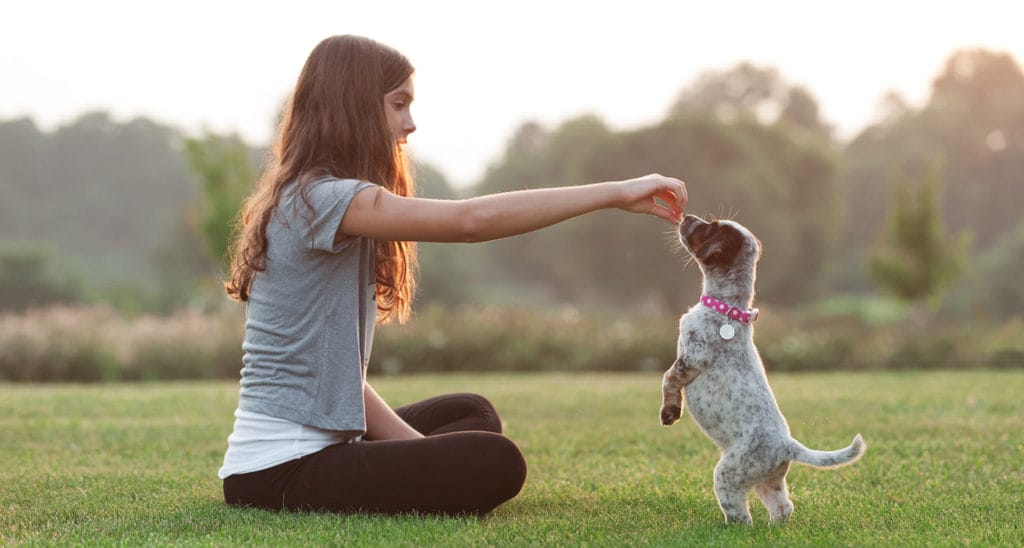
Training your puppy with basic commands is an essential part of its early development. It not only helps to ensure good behavior but also strengthens the bond between you and your furry friend. By following the steps outlined below, you can teach your puppy the basic commands and set them on the path to success.
Start with the basics:
To begin with, you need to teach your puppy some basic commands like "sit," "stay," "come," and "heel." These commands will help your puppy understand your expectations and build a foundation for more advanced training later on. It is best to use short, clear commands and reward your puppy with treats or toys to encourage positive behavior.
When you teach a command, make sure you demonstrate it first, and then give your puppy the opportunity to try it themselves. For example, to teach "sit," hold a treat above your puppy's nose and move it back towards their tail. As their head moves up, their bottom should go down. Once they are in a sitting position, give them the treat and plenty of praise.
Be consistent:
Consistency is the key to success when it comes to training your puppy. Use the same commands and training methods every time you train your puppy. This way, they will understand what you expect from them and learn more quickly.
For example, if you use the command "sit" to get your puppy to sit down, use the same command every time you want them to sit. If you use different words, your puppy may become confused and take longer to learn the command.
Use positive reinforcement:
Positive reinforcement is one of the most effective ways to train your puppy. Praise your puppy when they follow your commands correctly, and reward them with treats or toys. This will encourage them to repeat the behavior in the future.
However, it's important to remember that rewards should be given immediately after the desired behavior is displayed. This will help your puppy to associate the behavior with the reward.
Keep training sessions short:
Puppies have a short attention span, so it's important to keep training sessions brief, preferably between 5-10 minutes. Repeat the sessions several times throughout the day.
It's also important to end each session on a positive note. If your puppy is struggling with a command, try to end the session with a command they are comfortable with and reward them for their good behavior.
Practice in different environments:
Once your puppy has mastered a command in one location, try practicing in different environments, such as at the park or on a walk. This will help your puppy to generalize the behavior and understand that the command applies in different situations.
It's important to remember that practicing in new environments can be overwhelming for your puppy. Start with easy environments and gradually increase the difficulty. This will help your puppy to feel comfortable and confident.
Be patient:
Remember that every puppy learns at its own pace. Some puppies may learn a command quickly, while others may take longer. Be patient and consistent with your training, and your puppy will eventually master the basic commands.
It's also important to remember that training your puppy is a continuous process. Once your puppy has mastered the basic commands, you can move on to more advanced training. Consistency and positive reinforcement are key to ensuring your puppy's success.
In conclusion, training your puppy with basic commands is an essential part of its early development. By following the steps outlined above, you can teach your puppy the basic commands and set them on the path to success. Remember to be patient, consistent, and use positive reinforcement, and your puppy will soon become a well-behaved and obedient companion.
f you want to learn my #1 way to master the puppy training, click here now.
About the Creator
Keep reading
More stories from writers in Petlife and other communities.
A Dart at Dusk
Seconds ago, the sullen sun set on the two of us… my exuberant furry companion and me. A fresh breeze embraces us, delivering welcome relief from the day’s oppressive heat. His typical stumbling and staggering along — apace with a sloth — has turned into trip-trapping, high-stepping, almost skipping along.
By Angie the Archivist 📚🪶4 days ago in Petlife
Why Puppies Get Attached So Quickly
The Fascinating Science Behind Puppy Bonding—and How Their Fast Attachment Shapes Lifelong Relationships --- You walk through the door after a long day. Before you even take off your coat, a tiny, wiggling puppy comes running, tail wagging, eyes shining, and jumps into your arms as if you’ve been gone for a year.
By Ahmed aldeabella2 days ago in Petlife
The Devil's Cut
“Comrade, finally you’re awake.” The voice was smooth, sensual. A flickering incandescent bar was all that lit the white, sterile room. All Vladimir remembered was everything going black. He tried to move his arms and found them strapped to the gurney.
By Matthew J. Fromm4 days ago in Fiction




Comments
There are no comments for this story
Be the first to respond and start the conversation.