
How to Train a Puppy to Sit and Stay - Step by Step
Basic Command Are Life Savior for Dog Owners

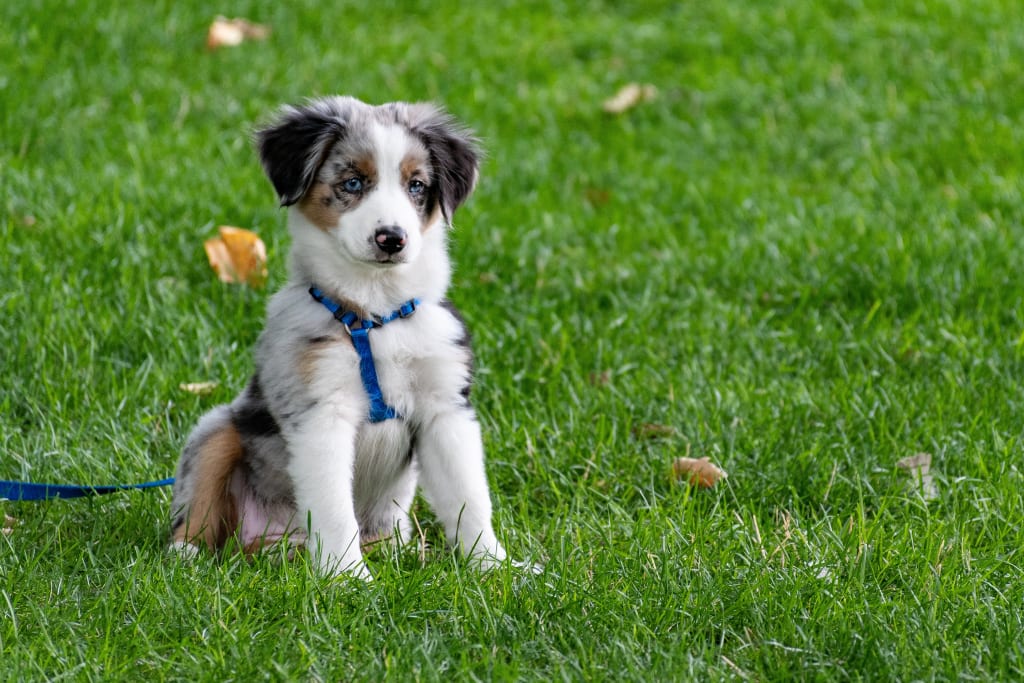
How to train a puppy to sit and stay?
Sit and stay are basic commands, and these are vital for socialization and ensuring that the canine grows up to be a well-mannered canine.
You want him to learn how to behave around people so that he can be introduced from an early age, and you also want him to know what it means to sit and remain still when there are other dogs around. With the right training, your puppy will learn all of these things in no time.
Sit and stay commands serve as a foundation for puppy training. These can be used to teach your dog other skills that begin with a sitting position, such as down and stay.
It also aids in the prevention of jumping, chasing, dominance, and excessive barking; a sitting dog cannot assume a dominant or aggressive/alert posture.
To help your pup learn these essential commands, use the following steps.
How to Teach A Puppy to Sit
Preparation Phase
Train in a place with as few distractions as possible.
Check that your puppy hasn’t just eaten a meal and isn’t starving for treats.
Arrange high-value treats that your dog enjoys and that he only gets during training.
Rubber toys or stuffed toys also help you in puppy training.
— — — — — — — — — — — — — — —
Dog Lovers: Get an AWESOME custom-made gift for your dog. Click Here
— — — — — — — — — — — — — — —
Training Phase
Step 1. Put a treat in front of your puppy or hold it close to his nose and have him smell it.
Step 2. Move the treat forward and backward over his head. You’ll see that his head naturally follows the treat and the bottom lowers to the ground.
Step 3. At this point, say “sit” in an authoritative tone and with action.
Step 4. The moment the puppy sits, say “good boy” and offer him a treat.
Step 5. Repeat the process many times so the pup learns the association between the desired action (sitting) and treats.
Step 6. Once you identify that the association is established, show him the treat, but don’t wave it near his nose. Start using hand motion with the command ‘sit’. Keep on offering treats and praise for good sit.
Step 7. When the puppy is following the command well, only give the treats intermittently.
Step 8. Keep on doing this until he learns to sit on his own without the treat.
Step 9. Say ‘Ok, Now go’ to release the dog.
Step 10. If at any point, the puppy doesn’t follow the “sit-stay” command, turn your back to the puppy and stop treats, compelling him to follow order.
How to Teach A Puppy to Stay?
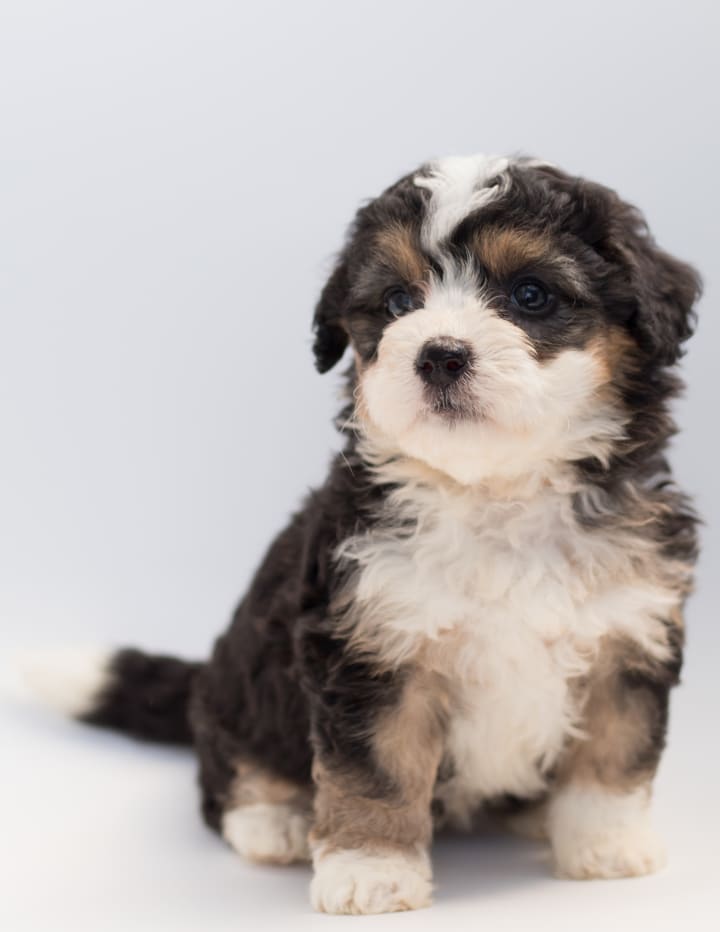
Sit and Stay commands go side by side. Stay means that you want your puppy to hold their posture as it is.
Step 1. Once your puppy is sitting, extend your hand in front of them (giving them a physical cue) and say “stay” loudly and clearly.
Step 2. Take a step back and wait for a few seconds. If your puppy stays in place, give them a treat and lots of praise.
Step 3. Gradually increase the length of time and distance to stay, and reward it with treats to show appreciation.
Step 4. If your puppy gets up before you release them, gently guide them back to the starting position and repeat the process.
Step 5. Repeat this exercise several times, then extend the stay by 2 to 5 seconds.
Step 6. When the puppy follows ‘sit and stay’ command for 15 to 20 seconds, then offer treats less frequently.
Step 7. Turn your back to the puppy and stop giving treats when the puppy doesn’t follow the “sit-stay” command or before you give the release words ‘Ok, Now Go’. Turn your back for at least five to ten seconds so that they lose any hope of treats.
Your puppy will quickly learn that holding the “sit-stay” command results in more delicious treats and that any movement vanishes the yummy treats.
When extended ‘sit-stay’ is achieved, you can use the command to prevent a wide range of potential behavioral issues. The command can be used while you give him food on the floor or to keep your dog from bolting and jumping on visitors.
Training Puppy Precautions
Be Positive
Speak in a friendly tone with a smile on your face. Your puppy will pick up on your mood. If you are angry or frustrated, your puppy will pick up on this too and will become fearful of you.
Keep Sessions Short
Remember to keep training sessions short.
Be Patient
It may take a week or more of daily practice with ‘sit-stay’ to progress for 1 to 2 minutes. With a few months' drill, the “stay” can be extended to 15 minutes or more. When your puppy is exposed to this much practice, then you are in a position to leave the room while the puppy “stay” in its position.
Be Consistent
When it comes to training your dog, consistency is key. If you are consistent, then you will see results.
Conclusion
If you are not putting in the work, then you are not going to get the desired results. This is especially true when it comes to training your dog.
You need to train your dog from an early age so that he can learn what is expected of him. The sooner you start, the better.
You need to use treats and praise whenever possible when training your puppy, and you also need to make sure that he feels your emotions as well.
If you follow the steps above, then your puppy will be trained in no time.
Get Instant Access to Awesome Gift
About the Creator
Lisa Green
💕 Ready for Adventure With Your Dog? 🐶 Have Fun & Inspire Visitros. 🐕💕 Enjoy This Free Giveaway 😍 Visit: https://l.linklyhq.com/l/1tqHs
Keep reading
More stories from writers in Petlife and other communities.
A Dart at Dusk
Seconds ago, the sullen sun set on the two of us… my exuberant furry companion and me. A fresh breeze embraces us, delivering welcome relief from the day’s oppressive heat. His typical stumbling and staggering along — apace with a sloth — has turned into trip-trapping, high-stepping, almost skipping along.
By Angie the Archivist 📚🪶3 days ago in Petlife
Japan Pet Food Market Size and Forecast, 2026–2034
Market Snapshot The Japan Pet Food Market is projected to expand significantly, growing from US$ 6.72 billion in 2025 to US$ 14.68 billion by 2034, registering a robust CAGR of 9.07% during the period 2026–2034. This growth is being driven by rising pet ownership, increasing pet humanization, strong demand for premium and functional nutrition, and growing awareness around pet health, aging, and preventive care.
By Aaina Oberoi2 days ago in Petlife



Comments
There are no comments for this story
Be the first to respond and start the conversation.