
How the reputation of pit bulls emerged
Are Pitbulls really dangerous?

The first dog to provoke a public uproar in America was The Spits, a breed that we would most likely now refer to as Pomeranians. America has a long history of condemning particular canines. They gained a reputation as women's dogs because a doctor basically declared that women should bear the repercussions of owning dogs rather than children. While pit bulls were originally regarded as wonderful family dogs and were compared to the Honda Civic of dogs, articles on these dogs described them as lethal and vicious creatures. For more than seven years, Bronwin Dicki studied and wrote a book about pit bulls. A cute sidekick of "The Little Rascals," pitbulls were even included in military advertisements to promote patriotism.
The 1960s and 1970s saw a significant change in the nation's cultural landscape as well as an increase in crime, particularly in the biggest cities in the United States. According to a 1971 New York Times story, Bronx residents adopted guard dogs to take care of themselves because the city wasn't providing it for them. The 1980s also saw the rise of rap music, which addressed the decline of inner cities head-on and made frequent references to pit bulls. As these dogs came to represent racism and urban poverty, they also became stand-ins for human prejudice; new accounts link them to drug dealers and criminals. The media had created a stereotype of pit bulls, turning them from family pets to national enemies.
What is a Pitbull?
The terms "hound" and "pitbull" are somewhat similar. There are four pure breeds in that category: the American Pitbull Terrier, American Staffordshire Terrier, American Bully, and Staffordshire Bull Terrier. It's a breed group, a generalized shape, not a single breed. Many people refer to them as pit bull-shaped dogs because they were descended from English Bulldogs through the British Bull and Terrier breeds. Because of their notoriety, pitbulls are now covered by breed-specific laws, or BSL, in over 700 US communities. Pitbull opponents frequently point to judicial decisions—such as the Maryland court of appeals' 2012 decision that pit bulls are naturally dangerous—to defend BSL. The 2012 case's dissenting judge emphasized that dog bite statistics are erroneous and that there is insufficient evidence to sustain the label of being inherently harmful.
Because of reporting biases, we don't have solid statistics on which dogs bite most frequently. For example, when smaller dogs or other dogs bite, it's not reported in the same manner as when a pitbull bites. Similar to shark attacks, which don't result in many deaths annually but are nonetheless reported on the media when they do, pitbull attacks also make for exciting news. It can be very challenging to even identify the breed of a dog; most dogs are mixed breeds, with some being a mixture of several different kinds. People tend to assume that a large dog is a pitbull automatically, unless it is a breed that they can easily recognize.
Many dogs that may appear to be pitbull mixes actually don't have any pitbull in them; a study found that nearly 90% of dogs and shelters that were labeled as a particular breed were misidentified and dogs were labeled as pitbull-type dogs almost half the time, even without DNA evidence. In addition, because they are among the most well-liked dogs in our country, their population simply means that there will always be more reports of attacks from popular breeds than from less well-liked canines. For all of these reasons, among others, the American Veterinary Medical Association issued a warning in 2001 saying that statistics on dog bites are not reliable indicators of the prevalence of dog bites. The bottom line is that BSL is ineffective because bites and attacks have continued to occur even in areas where these laws are in place. Denver's pitbull prohibition was enforced for thirty years, costing $5.8 million, although it had no discernible effect on public safety. Similar to this, Denmark saw no appreciable decrease in dog bites after pit bulls were outlawed in 2010.
If your dog is deemed a pit bull, there are a lot of rental homes where you cannot dwell. There was a restriction on the weight of the canines; either way, if they accepted huge dogs, they stated that pitbulls were not allowed. People often look for a simple solution to stop dog attacks, believing that it can be achieved by concentrating on a certain fighting breed. However, the true solution is to examine how we handle dogs and whether their needs are being met, and the response is that we're not always talking about dogs that are left outside unattended for extended periods of time without socialization or training; in those cases, the dogs' needs aren't being met, and their lives aren't fulfilling. By giving people the tools they need to assist such dogs, we can stop bites and attacks from occurring.
About the Creator
Eunice Fasoranti
I am a passionate writer who crafts compelling stories that explore the depths of human emotion and creates narratives that linger in the reader's mind long after the last word.
Keep reading
More stories from Eunice Fasoranti and writers in Petlife and other communities.
The Egyptian Discovery That Terrified Scientists
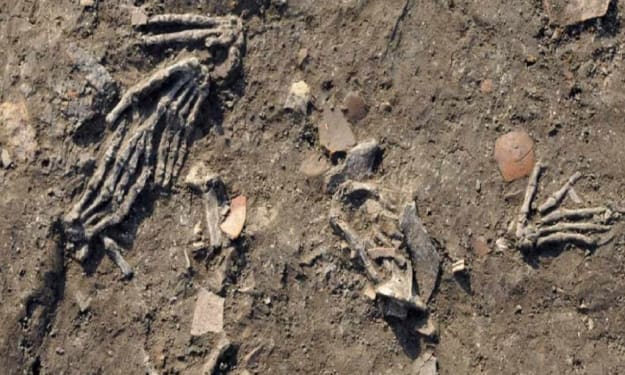
Years ago, a gruesome discovery was made in Egypt that startled scientists. 16 human hands, all right hands, carefully buried in four eerie pits. These hands were abnormally large, making them look less human at first, but they were indeed human hands. Curiously, no left hands were found. This discovery points to an ancient dark ritual, as depicted in old Egyptian art and tales. It was believed that warriors would present the right hand of their defeated adversaries as proof of victory in exchange for gold. The Egyptians believed in the afterlife, so cutting off someone's hand was thought to cut off their power forever, ensuring a complete and eternal defeat for their enemies. This practice is thought to have occurred during battles between the Egyptians and the Hyksos, who lived in what was once known as Canaan.
By Eunice Fasorantiabout a year ago in History
A Dart at Dusk
Seconds ago, the sullen sun set on the two of us… my exuberant furry companion and me. A fresh breeze embraces us, delivering welcome relief from the day’s oppressive heat. His typical stumbling and staggering along — apace with a sloth — has turned into trip-trapping, high-stepping, almost skipping along.
By Angie the Archivist 📚🪶9 days ago in Petlife



Comments (2)
Oh, interesting. I didn’t know that pitbulls that are mixed breeds don’t tend to have pitbull in them 🤔
Excellent written