
Hi, I'm a Writing Tutor
and this is my dog, Oscar. He has Canine Autism.

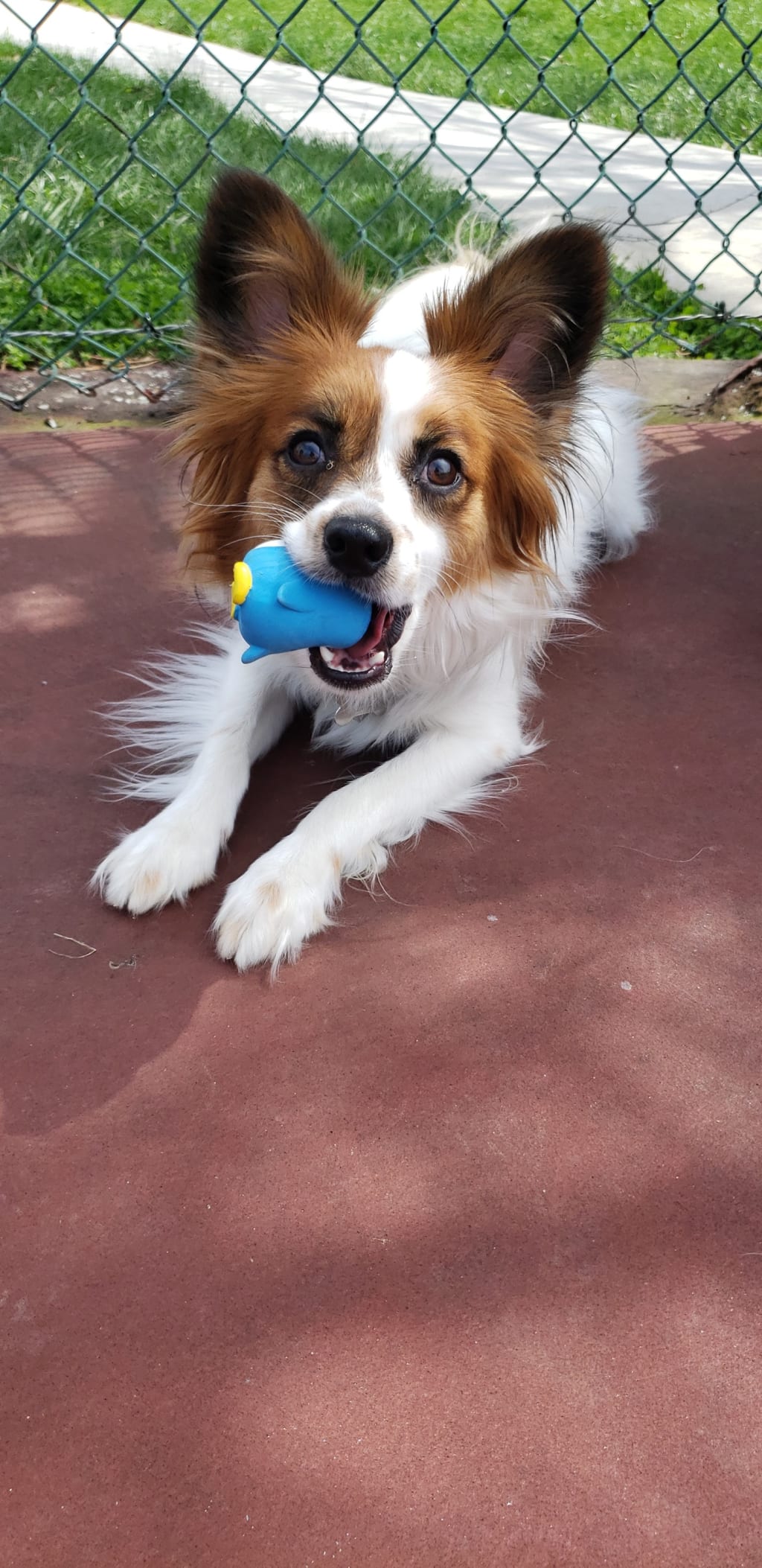
Yes, Canine Autism is a thing. It's still getting researched. Some vets accept it; others are more skeptical. The behaviorists and professionals I sought out in desperation agreed that my dog is, indeed, autistic. Some people laugh in my face; others' facial features are washed with understanding. A few people even said, "I think my dog has it too." Let me tell you, having an autistic dog isn't easy, and working from home with him makes things even more complicated.
Oscar, a very large papillon, just turned 3 on March 31st of 2021. I got him as a puppy... he was a grief purchase. In late June of 2018, my first papillon, Lily, died of kidney disease. She was only 10, and my sister and I were not expecting it. When she first got the diagnosis, we were given much hope that we'd have her for a few more years. Meagan, my sister, and I bought the medication and the expensive ingredients required to make our own dog food. We painfully learned we only had a few more months. Then, she needed to go to the hospital during a bad week. The young vet said they'd just flush out the kidneys and she'd be fine. He said it was a common thing. We still thought we had a few more months. Then we learned we didn't. Then we thought we had maybe a week. The older, more experienced vet came to work his shift at the hospital. He examined Lily and saw her kidneys failed. Then, Meagan and I thought we maybe had a few hours to say goodbye, but we were told she only had minutes before it was time to put her down. Meagan and I did what was best, but the pain was raw. During the 10 years we took care of Lily, we only spent 4 days apart from her. She was loved. I'll never forget the feeling I had after she was put to rest and the nurse walked over with Lily's pink collar. I heard the familiar jingle and knew she wasn't there.
Within three hours, my hysterical self was at a pet store. I'm sorry. I know the reputation pet stores have. I looked for a breeder-- I really did. There were only 7 papillon puppies for sale in the United States at that time (papillons are pricey and typically only give birth to one puppy at a time), and one pup happened to be 30 minutes from my house. So, I drove there, still crying, and asked to see him. I cried when they took him out, and I cried during my first meeting with him. I was crying when I signed the paperwork to take him home. I was a mess. I wasn't fit to be buying a puppy, but I did. I have the old credit card statement to prove it. I paid my 3,000 bucks.
Now, there were clues Oscar wasn't a typical puppy. We noticed he had a curious blue, foggy mark on his eyeball. Not the eyelid-- the actual eye. They said it was just a little injury. My vet said it was actually an injury that created a blind spot, and it is likely he got it from his mother. Oscar was so...different that he frustrated his mother into nearly biting his eye out. Let's just think about that. Mother dogs do not normally attack their babies unless there's something off about that baby. I was oblivious, just as I was oblivious to the other signs that were showing when I first met him inside the little playpen at the pet store.
My younger sister filmed my first meeting with Oscar, and it is when I watch that video back that I see those signs. He wouldn't look at us and focused on squirming away or biting constantly. He treated us like objects, not living things. He hated to be touched, and he seemed to be in his own little world. I cringe when I see myself in the video. My eyes are swollen and my skin is pink. The puppy's behavior means nothing, and I am determined to buy him before even seeing him. But I was grieving. I wanted a reason to get out of bed. I wanted a papillon. So, I bought the papillon with the crooked white stripe between his eyes and the unbalanced coat. He's mostly white on one side and mostly sable on the other. Those traits would have him disqualified from a dog show-- along with his size, but those traits make him all the more striking.
You don't hear about mean puppies. The idea sounds absurd, but he was a mean puppy. His wee little face would crinkle into a snarl and he'd try his best to bite when we tried to hold him or pet him. He was anxious, and I paid for dog trainers to help. One of the trainers declared he was the worst dog she'd ever seen. It took about 30 minutes to put a harness on him because he was so busy biting. It took about five minutes to put on a leash. Any time we had to physically touch the puppy, he was furious. "Dogs like that get put down," the trainer said, and she marveled that we kept him.
It stung that he wasn't happy to see me when I came home from work. My late papillon would stand on her hind legs and throw her front paws into the air. She'd then wiggle her hips and walk towards me. I would copy the dance, and we'd dance together to celebrate being reunited. Oscar did no such thing. He struggled to bond. Eventually, he did, but I hardly got a tail wag for months. He struggled to show any body language communication-- besides anger. I desperately attempted to socialize him, and we were asked not to come back to Puppy Play Time at PetCo. Oscar couldn't even communicate with his fellow puppies. He couldn't just play like the others. He'd look lost, attempt to play, and get outrage for a response. He didn't learn to play bow until he was nearly a year old.
When my elderly neighbor was left to babysit a protective boxer, Oscar had no idea he was in danger when that boxer was lunging and snarling, sending my neighbor down to bleed on her driveway. I'll never forget holding Oscar back with one arm and holding the boxer's leash back with the other. I screamed for help as I was frozen in place to hold back the dogs, one ready to kill and the other hoping to play, while my poor neighbor struggled to stand. She eventually managed to stagger up and took the boxer's leash. I ran Oscar in the house and then pounded on another neighbor's door for help. That other neighbor was a nurse. Luckily, everything was okay, but there was a lesson hammered in: Oscar wasn't typical. The world didn't make sense to him, and I couldn't make sense of him.
Once Oscar was given his diagnosis, things made a little more sense. He'd need patience and a lot of love. I have to remember I can't scoop him up to cuddle and his repetitive behaviors are something I have to accommodate. Did I stuff empty, plastic water bottles under all of my furniture to stop him from tucking his toys in repeatedly and scratching said furniture to get it out? Yes. Do I use his love for rhythm and patterns to put him in a trance to get a few minutes of peace? Yes. Do I cry of frustration? Not as much as before. There's been many nights where something will trigger him into a fit, and these fits can last for hours. He hates when furniture has been moved or if a deer is spotted in the yard. These fits consist of him having panic attacks and yapping. The sedative the vet prescribed had an opposite effect, the ASMR videos on YouTube work sometimes, and brushing him for an hour can help. A nice long walk at 2AM doesn't hurt, even though he gets plenty of exercise.
Working from home with Oscar is stressful. I do have mini play sessions with him throughout the day to keep him occupied and his mind busy. He's an excellent frisbee catcher and a lover of squeaky penguins. He thrives on a routine, and I try to help him have one. He's a smart little dog and continues to slowly improve. He is a challenge, but Oscar has given me more patience than I've ever had. When a student is rude or difficult, I am completely unphased. I can maintain a calm and pleasant demeanor, even if that student waited till the last minute to write that paper and it is about to be due. Oscar has also taught me to think outside the box. When there's a problem, I can come up with several solutions until one works. I can accommodate and adjust at moment's notice. Better yet, Oscar prepared me to work with students with special needs.
I was told that there was a student on "the spectrum," and she was struggling to write academic essays for a class. The assignments were overwhelming; the expectations stressed her. She was tasked with writing a research paper with opposing viewpoints. Firstly, she never dealt with opposing viewpoints. Secondly, the idea of writing something down that she didn't agree with left her utterly flabbergasted. When things didn't make sense to her, she shut down, but I was prepared. I knew that I needed to explain things as quickly and plainly as possible. I knew to break things down into steps. If there's too much going on, there's a sensory overload and nothing will get done.
A few days a week, the student and I had our webcams running. I'd be tutoring her, one on one, at least three hours a week. Progress was slow, but I knew my teachings about quotes, transitions, and opposing viewpoints would eventually click. Then, as the semester was drawing to a close, it did click. That student made rapid, astounding progress one day. We went from struggling through each paragraph to fluent writing. I watched her craft gorgeous sentences on the Live Microsoft Word document. Her voice went from unsure to strong and happy. She finished her drafts, revised her drafts, and wrote one of the best papers in the class. She got it, she understood it, and she could write. I never felt prouder in my tutoring career than I did that moment. I needed a Kleenex to dab my eyes as I finished reading her completed research paper. She learned how to wield her words to express herself to an audience more eloquently than many of the students I see. All she needed was time, patience, and understanding. Thanks to my little furry coworker, I knew exactly how to give those things.
I will frequently refer to Oscar as my "champion" because he does overcome much as he tries to function in a world that's not made for him, but he's also my champion for helping me be a better tutor.
About the Creator
Keep reading
More stories from Molly E. Hamilton and writers in Petlife and other communities.
Understanding the Causes, Symptoms, and Treatment Options for Colitis in Dogs
Colitis in dogs is a common gastrointestinal condition that affects the large intestine (colon). When the colon becomes inflamed, it can lead to uncomfortable and sometimes alarming symptoms for your pet.
By Dominion Valley Animal Hospital7 days ago in Petlife
Unofficial Challenge: Black History Celebration
Forward: February 28th, 10:53 PM, EST... The final hour of Black History Month, 2026. Hello fellow writers. I've had this challenge waiting in my drafts for most of the month. But I held off on publishing it, until now.
By Sam Spinelli4 days ago in Writers




Comments
There are no comments for this story
Be the first to respond and start the conversation.