
From Chaos to Calm: Train Your Dog in 7 Days.
A Simple, Proven Routine to Transform Your Dog’s Behavior in Just One Week.

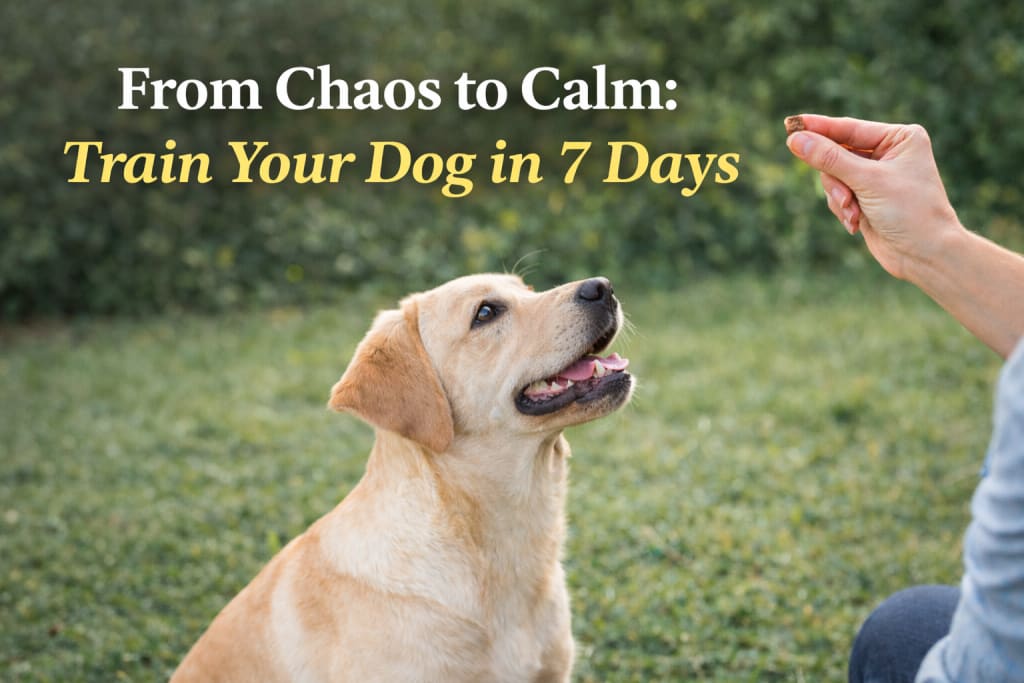
Bringing home a new puppy — whether it’s a puppy with tons of energy or an adult dog with old habits — can feel like stepping into beautiful chaos. One minute they’re melting your heart with those innocent eyes, and the next they’re chewing on shoes, barking nonstop, or running errands at 1 a.m.
But here’s a fact that many owners don’t realize:
👉 Your dog can become calmer, more obedient, and easier to manage in just seven days — if you follow a structured plan.
This story isn’t just a guide — it’s a journey into how one week can completely transform your relationship with your dog.
Day 1: Establishing the Foundation
The first day is the most important. Dogs thrive on routine, and when they don’t know what’s expected of them, they act out of confusion — not disobedience.
First-time dog owner Emily learned this the hard way. She adopted a sweet but wild six-month-old mixed breed named Milo. He jumped on everyone, barked at the slightest noise, and treated the house like an indoor playground.
That first morning, Emily made a simple change:
She introduced structure.
- Mealtimes were set.
- Walks were scheduled.
- Playtime was limited.
- Rest time was encouraged, not optional.
Within hours, Milo was already calm. Not because he was trained — but because he finally understood what to expect.
Dogs aren’t inherently chaotic — they just need clarity.
Day 2: Teaching “Sit” – The Mother of All Commands
Day 2 focused on one command: Sit.
Many owners rush through training, trying to teach five things in one session. Emily did the opposite — she built Milo’s confidence with one easy win.
She used:
- Small, gentle treats
- A calming voice
- Short 3-minute training bursts
- And like magic, Milo understood.
Why “sit”? Because it teaches self-control. A dog that can sit on command can help him avoid bad habits like jumping up, whining, and grabbing food.
By the end of Day 2, Milo had previously sat:
- Putting on his leash
- Receiving his food bowl
- Greeting guests
One small command, a huge change.
Day 3: Leash Manners
Walking used to be Emily’s nightmare. Milo pulled like he was training for a sledding competition. But on the third day, he changed his tune.
He didn’t jerk the leash.
He didn’t bark.
Every time he pulled, she just stopped walking.
No progress = no movement.
Milo learned in minutes: pulling gets me nowhere.
By the end of the walk, he stayed close, looked for guidance, and walked almost politely.
Dogs are smarter than we think — they just need consistent boundaries.
Day 4: “Stay” and “Come” – Safety Commands
Emily introduced two life-saving commands:
1️⃣ Stay.
This command teaches patience and tolerance.
She started with:
- 1 second stay
- Then 3 seconds
- Then one step back
- And gradually more distance
By the end of the session, Milo could stay still for 10 seconds. A huge win.
2️⃣ Come (Recall)
The most important command a dog will ever learn.
Emily first practiced indoors, creating her own “reward zone”:
- Happy sound
- Treats.
- Praise
Milo loved it – because coming to Emily always felt rewarding.
Good recall doesn’t come from strength – it grows through trust.
Day 5: Breaking Bad Habits
Every dog has at least one annoying habit. Milo had three:
- Jumping
- Barking at the door
- Chewing the slipper
Emily tackled them one by one.
Jumping
Every time he jumped, she put him back.
Jumping = Ignore.
Four paws on the floor = Attention.
The behavior changed within days.
Barking
Emily taught him a “quiet” cue by rewarding moments of calm instead of yelling at him for barking.
Chewing.
Instead of scolding, she told him to chew on toys.
Redirection > Punishment.
Every time.
Day 6: Mental Stimulation
A tired dog is good.
- A mentally stimulated dog is perfect.
- Emily added:
- Puzzle toys
- Sniffing games
- "Find the cure" challenges
Melo's brain worked harder, his energy was balanced, and his behavior improved dramatically. Mental exercise is just as important as physical activity — sometimes more so.
Day 7: Bringing it all together
On the final day, Emily tested everything in real-world scenarios:
- Walking around a mess
- Guests arriving
- Following commands in the yard
- Staying calm before meals
- Sitting down before car rides
To her surprise, Milo was no longer the chaotic child she had struggled with the day before.
He was attentive.
He was calm.
He looked to her for guidance.
It wasn't magic.
It wasn't luck.
It was consistency, clarity, and connection.
The real secret: You're training yourself, too.
The truth is, dog training isn’t just about the dog – it’s about you becoming a better leader.
Your energy becomes their energy.
Your comfort becomes their comfort.
Your routine becomes their comfort.
Emily didn’t just train Milo.
She learned how to speak his language, set boundaries, and build trust.
And that’s why one week was enough.
What you can learn from this 7-day transformation.
If Emily and Milo did it, so can you.
Here’s what’s really important:
- Keep training sessions short
- Reward good behavior immediately.
- Be consistent every single day
- Use a calm tone, not frustration
- Set a routine and stick to it
Your dog doesn’t need perfection – they need guidance.
About the Creator
Paw Planet
Start writing...🐾 Paw Planet is where puppy love meets storytelling—sharing heartwarming tales, training tips, and adventures of wagging tails. A home for dog lovers who believe every paw print tells a story. 🐶✨
Keep reading
More stories from Paw Planet and writers in Petlife and other communities.
One Week to a Well-Behaved Dog: Your Step-by-Step Guide
If you’ve ever felt overwhelmed by your dog’s behavior — jumping up, barking, pulling on the leash, or ignoring commands — you’re not alone. Many dog owners assume that training involves months of hard work, endless classes, and constant frustration. But the truth is, with the right approach, you can dramatically improve your dog’s behavior in just one week.
By Paw Planet a day ago in Petlife
A Dart at Dusk
Seconds ago, the sullen sun set on the two of us… my exuberant furry companion and me. A fresh breeze embraces us, delivering welcome relief from the day’s oppressive heat. His typical stumbling and staggering along — apace with a sloth — has turned into trip-trapping, high-stepping, almost skipping along.
By Angie the Archivist 📚🪶24 days ago in Petlife
Badger did "Big Hup" Today!
Badger has had a year off since losing his eye to adjust to being a dog again. Since that time, he's lounged around the house or the kennel, taking brief walks on a leash, adjusting to walking in a straight line. Walking in a straight line has actually taken a lot of effort on his part, as his instinct was to drift in the direction that he could see or away from things by which he felt threatened. Heeling was a thing of the past. He either lagged behind me so that he could see me or ended up nearly to the end of his leash, several feet from my left leg because he brushed against me unexpectedly.
By Kimberly J Egan6 days ago in Petlife



Comments
There are no comments for this story
Be the first to respond and start the conversation.