
Emotional Support Animal
If you do not know about emotional support animals and their difference from pets, keep reading this article.


An emotional support animal (ESA) is a type of assistance animal that provides emotional support to individuals with mental or emotional disabilities. ESAs are not trained to perform specific tasks, unlike service animals, but their mere presence provides comfort and support to their owners.
In the U.S., under the Fair Housing Act and the Air Carrier Access Act, individuals with ESAs may be entitled to live with their animal in housing that has a "no pets" policy and to bring their animal on airplanes with them. However, there are restrictions and requirements for certifying an animal as an ESA, and not all animals qualify for this status.
What are the benefits of Emotional Support Animals?
Emotional support animals (ESAs) can provide comfort and support to individuals with mental or emotional disabilities by serving as a source of comfort, reducing symptoms of anxiety, depression and stress, and improving overall mood and well-being. Additionally, ESAs may provide a sense of security, help with socialization, and serve as a coping mechanism for their owners.
Having an ESA can also improve physical health by reducing blood pressure and decreasing the risk of heart disease. It's important to note that while ESAs are not trained service animals and are not afforded the same legal protections as service animals, they may be protected under the Fair Housing Act and the Air Carrier Access Act.
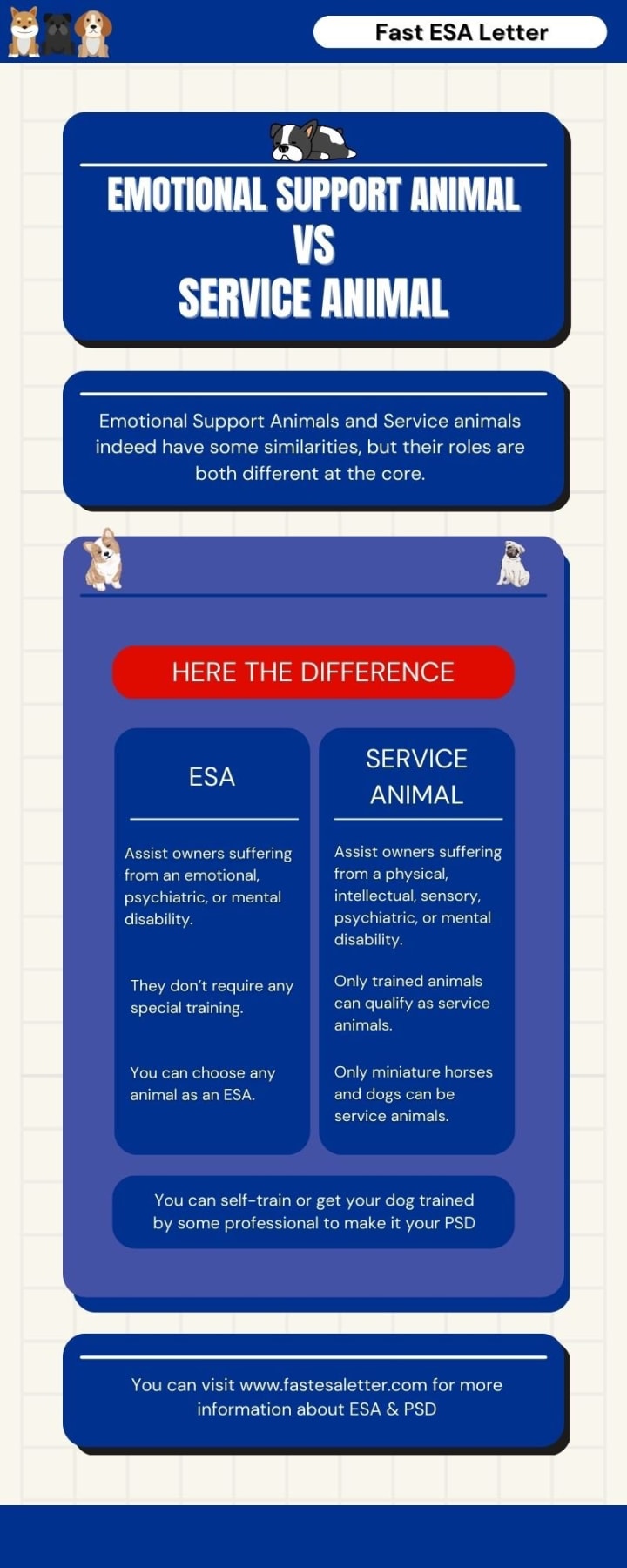
What is the difference between an Emotional Support Animal and a Service Animal?
An Emotional Support Animal (ESA) provides emotional support and comfort to individuals with mental or emotional disabilities. A Service Animal, on the other hand, is trained to perform specific tasks for individuals with disabilities, such as guiding those who are visually impaired or alerting those who have seizures. ESAs are not legally required to have specific training, while Service Animals are. The legal protections for Service Animals are stronger, including the right to accompany their handlers in public places where pets are not typically allowed.
What are the laws around emotional support animals?
Emotional support animals (ESAs) are animals that provide comfort and support to individuals with mental or emotional disabilities, and are recognized as assistance animals under the Fair Housing Act (FHA) and the Air Carrier Access Act (ACAA).
Under the FHA, landlords must make reasonable accommodations for individuals with ESAs, allowing them to live with their animal even if the property has a "no pets" policy.
The ACAA requires airlines to allow individuals with ESAs to bring their animal onboard, free of charge, as a reasonable accommodation for their disability.
It's important to note that ESAs do not have the same rights as service animals, which are trained to perform specific tasks for individuals with disabilities. Businesses are not required by law to allow emotional support animals, except in specific situations covered by the FHA and the ACAA.
How to Qualify for an Emotional Support Animal?
To qualify for an emotional support animal, you need to have a documented mental or emotional disability and a letter from a licensed mental health professional (e.g., therapist, psychologist, or psychiatrist) stating that the animal provides emotional support that alleviates one or more of the symptoms of your disability. The letter should include
- the professional's license number,
- type of license, and
- the date and their signature.
Note that the professional must have a therapeutic relationship with you and be able to demonstrate how the animal helps your specific disability.
How to Make Your Dog an Emotional Support Dog?
Here are the steps to make your dog an emotional support dog:
- Consult with a licensed mental health professional: They can determine if having an emotional support dog would be beneficial for your mental health.
- Obtain an ESA letter: A licensed mental health professional must write an ESA letter that verifies your need for an emotional support dog.
- Train your dog: While emotional support dogs do not require specific training, it's important for your dog to have basic obedience training and be well-behaved in public.
- Register your dog: While registration is not necessary, it can help provide evidence that your dog is an emotional support animal.
- Follow rules and regulations: Familiarize yourself with the rules and regulations surrounding emotional support dogs, such as airline travel and housing laws.
#emotionalsupportanimal, #esa, #esadog, #esaassistancedog, #emotionalsupportdog, #whatisanesa
About the Creator
Nyra Clark
I adore animals, which is why I have two dogs and one cat. When I have free time, I enjoy writing about pets. Currently, I work as a content writer for a healthcare organisation that provides ESA Letter in the United States.
Keep reading
More stories from Nyra Clark and writers in Petlife and other communities.
Get Your Legit Emotional Support Animal Letter in New York
In New York, emotional support animals (ESAs) are recognized as a form of reasonable accommodation for individuals with disabilities under the Fair Housing Act (FHA) and the Air Carrier Access Act (ACAA). However, to qualify for these accommodations, you will need an ESA letter from a licensed mental health professional.
By Nyra Clark3 years ago in Petlife
A Dart at Dusk
Seconds ago, the sullen sun set on the two of us… my exuberant furry companion and me. A fresh breeze embraces us, delivering welcome relief from the day’s oppressive heat. His typical stumbling and staggering along — apace with a sloth — has turned into trip-trapping, high-stepping, almost skipping along.
By Angie the Archivist 📚🪶7 days ago in Petlife
Rachel Reviews: The Spiral Archive by Pieter Hendrik
It's difficult for me to know where to start with a review of this book as it was, for me, an entirely unique experience and one that I'll probably never have again. I don't want that to be interpreted as unenjoyable but it has left me scratching my head a little and ruminating on its content, its themes and its characters.
By Rachel Deeming2 days ago in BookClub




Comments
There are no comments for this story
Be the first to respond and start the conversation.