
Did We Just De-Extinct Dire Wolves?!
Extinction was supposed to be forever—until science rewrote the rules

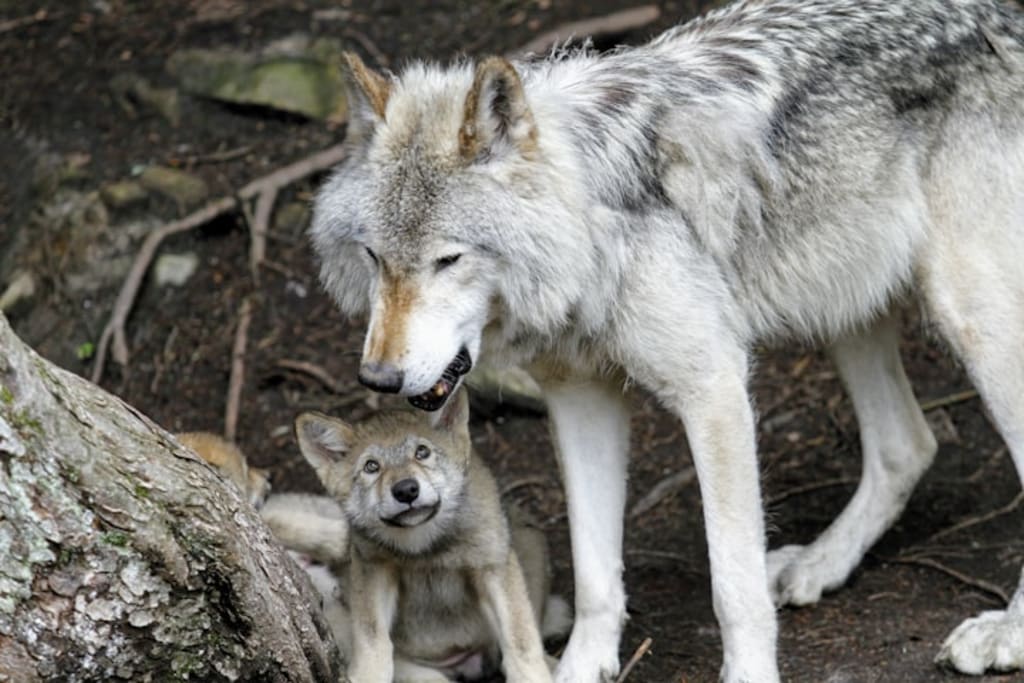
On April 7th, 2025, a biomedical company called Colossal Biosciences made a huge announcement.
For the first time in over ten thousand years, our planet was home to living dire wolves, and they’d been the ones to bring them back from extinction.
If true, this would be the first successful de-extinction, ever.
That’s a big claim, and it immediately got researchers’ attention.
And the rest of the Internet.
Including Hank, who’s made at least two videos on the subject!
The biggest question everyone has is how is this even possible when other de-extinctions haven’t even been able to get off the ground?
So today, we’re gonna talk about dire wolves, de-extinction, and some of the fundamental problems with bringing any species, dire wolf or not, back from the dead.
Before we get into bringing the dire wolves back, let’s talk about the first time they were around.
Dire wolves lived in North America during the Pleistocene, and first appeared at least 250,000 years ago.
They were massive, up to two meters in length and around 68 kilograms, making them roughly 25% bigger than gray wolves – our now-familiar North American species.
And trust me, we will be talking a lot about gray wolves today.
Researchers hypothesize that dire wolves were adapted to eat mega-prey that was around in the Americas at the time, animals like horses and ground sloths and stuff like that.
They were also really abundant, at least from what we can tell in the fossil record.
We find a lot more of their bones in places like the La Brea Tar Pits than other carnivores, like the smaller gray wolves.
This in itself is weird, since usually bigger carnivores are less abundant than smaller ones in an ecosystem.
So the huge stacks of dire wolf bones that we’ve found so far indicate that they were ecological oddballs.
But the bigger they are, the harder they fall, and dire wolves were no exception.
They disappeared when the other megafauna of North America died out in the early Holocene, roughly 10,000 years ago.
Which brings us to the biotechnology company that claims to have brought them back.
This biotech company called Colossal Biosciences announced that they’d recreated the dire wolf using an entirely new method of de-extinction.
Most other attempts at any kind of de-extinction have focused on cloning an individual member of the species and then having one of their close living relatives act as a surrogate.
People have talked about doing this for all kinds of species, from woolly mammoths to thylacines.
But most of these attempts haven’t been that successful, because cloning is hard.
A 2024 paper suggests you have only a 2 to 10% chance of achieving a successful birth via cloning, and that’s for the not-extinct animals.
These hurdles get even higher for mammals, owing to the way their young develop.
So to get around all of that, scientists at Colossal tried a different approach.
Rather than recreate the dire wolf through a process like cloning, they took a shortcut and used gray wolves as their starting canvas.
Because gray wolves are their closest relatives, right?
We’ll come back to that… The idea was to compare the dire wolf and gray wolf genomes side by side, and then just… write in the most important dire-wolfey bits to get dire wolves.
If it was that easy, you would think someone would have already done it, but fun fact: It is not that easy.
First problem: We do not have the dire wolf genome.
Not all of it, anyway.
While other studies had published dire wolf genetic data, it wasn’t as complete as the researchers needed it to be.
So they found their own!
Using a 13,000 year old dire wolf tooth and a 72,000 year old skull, the researchers sequenced a larger total percentage of the dire wolf genome.
When it comes to replicating DNA like this, you can check how good your yield was by basically seeing how many identical copies of the same bit of code you’re able to sequence.
And when we’re talking about ancient DNA, five copies or more usually means that you got enough high-quality DNA to be confident enough that you put all the pieces together.
According to a pre-print of their paper, they got high-quality copies for 6% of the genome out of the tooth, and 82% from the skull.
This is a genuinely huge leap up from what the researchers were able to capture in that 2021 paper, and this team deserves major props for getting this much usable DNA from these fossils.
But I do wanna note that as of right now this pre-print is not yet peer reviewed or even necessarily finalized, so this could change.
Also, most of the rest of this story is from their PR materials, and the data aren’t available as of this recording.
They identified a few dozen genes that differed between dire wolves and gray wolves, some of which controlled body size.
They also found a few that indicate dire wolves had paler coats than modern wolves, which we never could have known about without the new genetic material.
The researchers then edited the genes of gray wolf embryos to match some of the dire wolf genes.
The resulting embryos were implanted into surrogate mothers, and they were off to the races.
The result is wolf pups that are larger than gray wolf pups, with pale coats.
Right now there’s three of them – brothers Romulus and Remus, who are from the same litter, and Khaleesi, who was born later.
The SciShow team have… notes… on those name choices, but… whatever.
They made a total of 20 changes to 14 genes, and 15 of those changes match up to what they found in the dire wolf DNA they sequenced.
For the rest, they made edits that they claim were comparable to what was in the dire wolf genome.
And while they’ve released plenty of photos of these wolves to the public, and they are very pretty, there are lots of scientists who say that the claim that these are dire wolves is… overstated.
For starters, there are some flaws in the idea that gray wolves are a perfect template to use for building a dire wolf.
It’s been pointed out that genetic evidence doesn’t support the idea that gray wolves are the closest relatives of dire wolves… or even that close at all, relative to the canid family tree.
In fact, a 2021 study on dire wolf genetics found that the dire wolves and other modern canids were so distantly related that it supports keeping them in a separate genus, calling them Aenocyon dirus instead of Canis dirus.
If you caught that we flashed two different systematic names on screen at the beginning of the video, this is why.
The current consensus is that dire wolves split from all other canids over five million years ago, and the branch of the tree with everything from coyotes and jackals to gray wolves originates in Africa, while the line that gave rise to dire wolves is all-American.
Putting dire and gray wolves on totally different sides of the family tree.
And here’s the weird thing - while Colossal’s marketing team says that their genetic evidence puts gray wolves as the closest living relatives of dire wolves, their actual family tree...doesn’t.
Like, their own tree shows the living wolves and dholes and jackals all being their own group, and dire wolves branching off earlier.
I also want to be clear here – what they show is that all living canids are equally closely related to dire wolves.
So it would have been perfectly fine for them to say that, and then add that they picked gray wolves because they’re big, or also in the Americas, or any other reason.
It’s just a weird thing to claim?
Now, there’s another reason that many scientists aren’t convinced that these pups should be considered dire wolves.
And to explain it, we have to talk about what a species even is.
Because the thing is, researchers don’t have just one definition for a species.
We have… at least twenty five.
They’re called species concepts, which are basically a bunch of working definitions of the term that scientists use in different research contexts.
And the reason we need so many is that actually like, defining a species is way harder than it seems.
As in, nobody has come up with a satisfying definition for a species that can be applied to every living thing.
Hence, researchers have spent decades arguing with each other trying to come up with the least bad definition, and it all started with one.
One of the OG species concepts was the brainchild of Ernst Mayr, one of the founders of modern evolutionary biology.
He came up with what’s called the biological species concept, which says that if you have a population of organisms that interbreed with each other and don’t interbreed with others, those breeding populations make up a species.
Which is interesting, because in order to have a species, you kind of have to have… two?
You need to be able to identify populations that have gene flow with each other, but you also need populations that don’t get any gene flow into that group.
It’s that gene flow across the in-group that unites them as one species.
But those of you who are interested in microbes might see a problem, because organisms that don’t reproduce sexually can’t be accounted for in this definition.
And microbiologists aren’t the only ones who’ve got beef with the biological species concept.
Since it relies on the ability to observe how populations interact, and how they breed, it’s nearly impossible to apply the biological species concept to any species that are extinct.
Which means that paleontologists have had to come up with their own species concepts, and there are a few.
One of the more general criticisms of the biological species concept is that it only applies to a snapshot of time, and doesn’t take history into account.
So some other researchers came up with a concept that does: The Lineage Species Concept.
The lineage species concept says that a species consists of a group of organisms with a single ancestor-descendant relationship that makes up one connected branch on the evolutionary tree.
This lets you combine the populations past and present to define your species, but the downside is that the best way to prove these ancestor-descendant relationships is with DNA evidence, and once you get too far back into the fossil record, there just isn’t any.
When that happens, researchers turn to a tried and true way of evaluating evidence – their eyeballs.
Under the morphological species concept, two or more organisms are part of the same species if they share enough physical attributes, especially if those are unique as compared to other organisms.
Basically, if they look the same, they are the same.
This is kind of a species concept of last resort, since there are a whole bunch of potential pitfalls.
Like for instance, what if you find a fossil of an individual with a pathology that makes it look different from its group?
You might unknowingly make up a new species just for this fossil, when that doesn’t reflect reality.
With all of that out of the way, how hard it is to figure out what a species is, so let’s talk about whether these new dire wolf pups fit the bill.
It should be pretty clear that the biological species concept is immediately out.
There are only three of these pups in existence, and odds are that their caretakers won’t allow them to breed on their own.
Next up is the lineage species concept, and again, this shoe doesn’t fit.
The egg cells that all of these wolves developed from were from a dog, and the genetic code used in forming their genome was ever-so-slightly modified gray wolf DNA.
Meaning that the living pups have no direct ancestor-descendant connection to the dire wolves of days gone by.
Now, here’s where it gets a little hazy.
The researchers at Colossal argue that if their wolves have enough genetic tweaks that make these wolves look like the dire wolves, then that’s just as good as having a living clone.
It’s the morphological species concept, but for living animals.
But that also relies on us assuming that these pups actually look and act like extinct dire wolves, and we don’t know that they do.
In fact, there’s a good argument that they don’t.
When Colossal selected the genes that they were going to tweak in the wolves, they noticed that some of the genes present in the dire wolves were related to some not so great health effects in gray wolves, like deafness or blindness.
So rather than copy those exact mutations over, they made edits that would approximate those same effects.
But we have no way of knowing if they got it right, because we don’t have the original dire wolves to compare to.
And, we haven’t even gotten into the ethical concerns around bringing back dire wolves, of which there are...many.
Like we said at the beginning, dire wolves lived in an ecosystem that’s fundamentally different from the one we have today.
None of their original prey are alive, and having nothing to eat was what killed them all last time.
So some researchers argue that there’s no point in bringing them back because nature has already recovered from their absence, and it would be cruel to bring back a species that has no place being anything other than a cover model for a George R R Martin novel.
From all this, it seems pretty clear that Romulus, Remus, and Khaleesi are in fact a trio of gray wolves with a killer PR team.
They might be able to tell us some stuff about the extinct dire wolves, but the biggest thing they reveal is just how far we are from ever truly bringing an extinct species back from the dead.
Did we resurrect the past, or rewrite nature’s final verdict? Let me know on a comment and thanks for reading.
About the Creator
Keep reading
More stories from taylor lindani and writers in Petlife and other communities.
Are Lick Mats Actually Good For Dogs, Cats, and Small Pets?
If you have been to pet shops or online pet groups lately, you have likely seen the pet lick mat. These bright, bumpy rubber mats are a huge hit, and for good reason. Pet owners find that their dogs, cats, and small pets love them.
By Alice Adams5 days ago in Petlife
Wisteria Woo RIP
Wisteria Woo Silver~Rhodesian Ridgeback Cane Corso mix~ 7.19.15-3.2.26 My service dog, Wisteria, had been slowing down, having mysterious health symptoms like severe hives and unexplained injury. She went to the vet last month, but unfortunately, not all tests detect all problems. When we returned to the vet yesterday, upon much more concerning symptoms suddenly appearing, we learned she had a very large mass (10inx10in) likely the very aggressive hemangiosarcoma, and that we would only be buying a few months if we went through with treatment.
By K.B. Silver about an hour ago in Petlife
Who is your "Person"?
It's important to recognize that you cannot go through life as easily on your own. My name is Elizabeth and I'm a survivor of child abuse and horrific trauma. Healing from trauma is not a quick fix and recognizing that it will take time, is part of the struggle.
By Elizabeth Woodsa day ago in Psyche




Comments
There are no comments for this story
Be the first to respond and start the conversation.