
Can you believe this is the “most dangerous cat in the world”?
There is indeed such a strange cat species in the world. They have round eyes, patchy fur, and black stripes on their bodies and tails. Unlike their small appearance, cats of this species have become a "terror" to many other creatures.

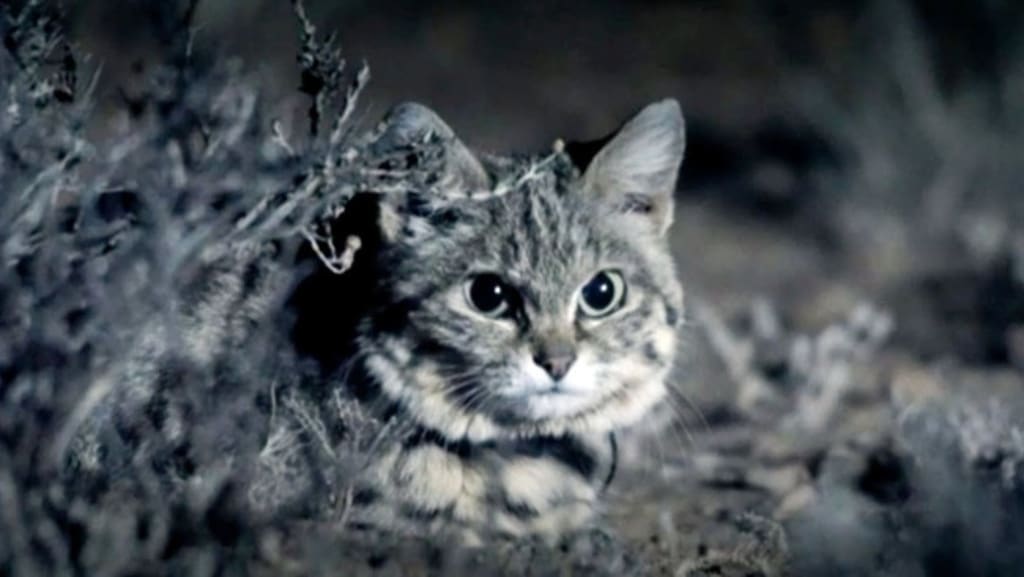
There is indeed such a strange cat species in the world. They have round eyes, patchy fur, and black stripes on their bodies and tails. Unlike their small appearance, cats of this species have become a "terror" to many other creatures.
Few people expect that behind the small and adorable appearance of the Black-footed cat is a skilled hunting ability that even other famous killers of the cat family such as tigers, leopards, lions... cannot match.
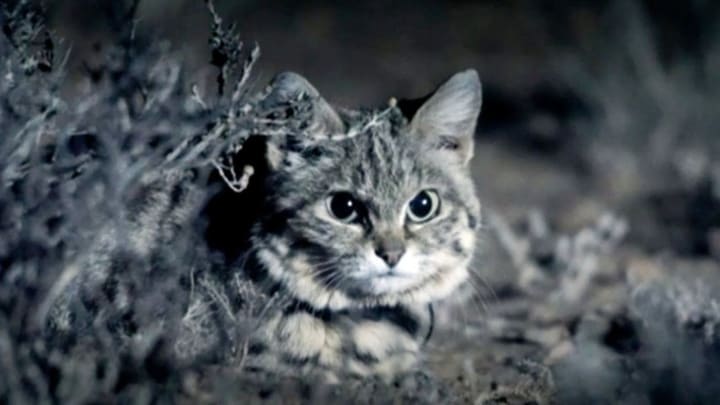
Black Footed Cat.
Black-footed cats, known to scientists as Gyra , can travel up to 20 miles each night in search of prey.
The black-footed cat may be considered the smallest African cat , even smaller than the common alley cat, but don't be fooled by its small stature, because it is actually the most effective hunting cat in the world.
This adorable animal has a fast metabolism, which requires it to be able to hunt almost non-stop, meaning it can kill an average of 10 to 14 rodents or small birds each night, more victims than a cheetah can kill in a month.
On top of that, its hunting success rate is around 60%, while lions are only successful in catching their victims around 20 to 25%.
The black-footed cat's eyesight is up to six times better than that of humans. Its night vision and hearing are excellent. Black-footed cats are mainly nocturnal, especially after sunset. Before sunrise, they will retreat to rest in burrows dug by other species or hide among rocks or hollow termite mounds.
To successfully catch prey, black-footed cats use three different techniques at the same time . These include the stalking technique, which is often used when hunting in bushes. Black-footed cats will quietly sneak under bushes and grasslands to search for potential prey. Sometimes, they will lie in ambush right at the entrance of their prey's cave. They are even willing to wait for hours. As soon as the prey shows its face, the black-footed cat will rush forward, knocking them out of the cave and pouncing on them. In addition, black-footed cats also have extremely fast hunting techniques when they rush through grass taller than humans in a split second to catch birds or mice.
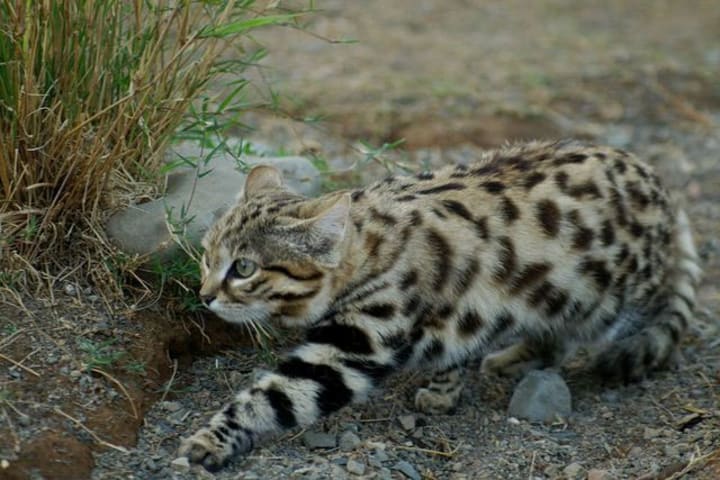
Black-footed cats quietly hunt among the bushes.
The black-footed cat's hunting skills were even featured in the PBS Nature miniseries " Super Cats ." An African legend says that black-footed cats can take down giraffes by biting their jugular arteries.
However, black-footed cats are not good climbers. Therefore, they do not live in trees. Zoologists say that because of their short tails and bodies, they cannot climb trees as easily as other cats. Instead, the "royal" black-footed cat spends a lot of time digging and expanding its burrows and territories on sandy ground.
The black-footed cat is found only in three southern African countries, Botswana, Namibia and South Africa , and is considered rare compared to other cat species on the African continent.
They prefer grassy plains, scrub deserts and sandy plains, areas with high densities of rodents and birds.
Most of the time, black-footed cats are solitary except when they are in heat and when they are raising their young. The heat period of black-footed cats is not long. Female cats only last for 1 to 2 days and they only agree to mate with males for 5 to 10 hours of that time. In addition, at this time, black-footed cats can emit special sounds that help them find mates more quickly and effectively.
Females usually give birth to 2 litters in 1 year. The gestation period is 63 to 68 days. On average, mother cats usually give birth to 1-4 kittens at a time. Newborn kittens weigh only 2 to 3 ounces. They will be weaned after 3 months. Mother cats will catch and leave live prey in the den for the kittens to practice hunting. After 3-4 months of age, kittens can live independently and are sexually mature at 8 to 12 months of age.
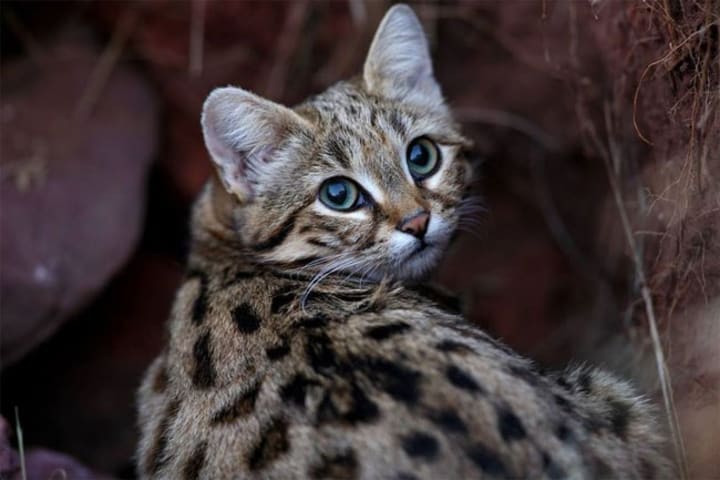

This African black-footed cat faces a number of man-made threats.
According to the International Association for the Conservation of Nature, black-footed cats are endangered. A single African black-footed cat can hunt and eat up to 3,000 rodents a year.
There is even a native African legend that claims that black-footed cats can take down giraffes.
Obviously it's just a myth, but it shows the perseverance of this natural-born but incredibly cute killer.
Unfortunately, this African black-footed cat faces a number of human-made threats, ranging from habitat destruction, to reduced prey availability, particularly due to overgrazing by livestock.
About the Creator
HK Decor
Telling stories my heart needs to tell <3 life is a journey, not a competition
If you like what you read, feel free to leave a tip,I would love some feedback
https://s.shopee.vn/7fFUMxnnBx?share_channel_code=8
A Dart at Dusk
Seconds ago, the sullen sun set on the two of us… my exuberant furry companion and me. A fresh breeze embraces us, delivering welcome relief from the day’s oppressive heat. His typical stumbling and staggering along — apace with a sloth — has turned into trip-trapping, high-stepping, almost skipping along.
By Angie the Archivist 📚🪶5 days ago in Petlife
What Does It Mean When a Puppy Sleeps Near You?
The Hidden Messages Behind Your Puppy’s Sleep Habits—and Why It Speaks Volumes About Their Bond With You --- You’ve just settled into your favorite chair, exhausted after a long day. Your puppy curls up beside you, tail tucked, breathing steady, eyelids slowly closing. It’s peaceful. Heartwarming. Almost magical.
By Ahmed aldeabella3 days ago in Petlife
Ludacris and Nelly draw backlash over bookings at MAGA-coded music festival
Ludacris and Nelly headlining a mostly right-wing event is good for them. It’s also great for the genre of hip hop. The two rap veterans have showcased their talents on other stages. Why can’t they perform for mostly MAGA folks and grab that bag?
By Skyler Saunders4 days ago in Beat



Comments
There are no comments for this story
Be the first to respond and start the conversation.