
A pregnant elephant, standing in the river, dies
The expanding range of human life and the deteriorating ecological environment have led more and more wild animals to start feeding on human living areas

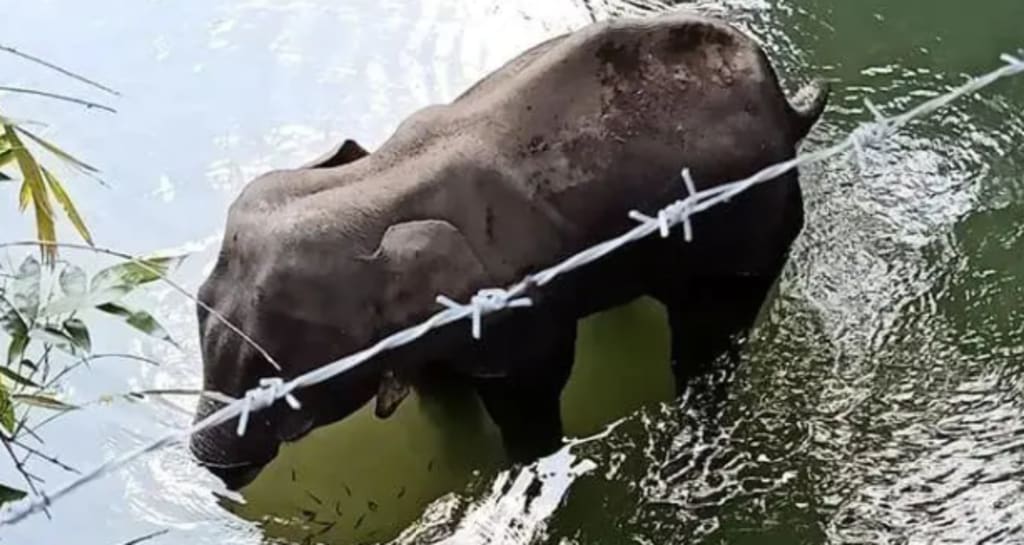
Recently, a pregnant elephant died in a river in Kerala, India.
This pregnant elephant was one of the many wild animals that have been foraging for food in human areas as a result of human range expansion and ecological degradation. She chose to feed in the human-inhabited Malappuram neighborhood but instead waited for a pineapple filled with homemade firecrackers, which exploded in her mouth the moment she swallowed it.
The pain was so intense that she started running around. Mohan Krishnan, a local forest warden, said that as the elephant ran away, she did not start attacking humans around her because she was hurt, nor did she damage the surrounding houses and facilities. Eventually, perhaps to prevent bugs from eating and biting her wounds, or perhaps being in the water would ease the pain, the elephant stood deep in the jungle until she died.
"She was probably more worried about the baby in her belly being attacked by humans again than starving." Mohan Krishnan, the forest warden involved in the rescue, said that when the rescuers tried to approach the elephant to offer rescue, the mother reacted quite violently and even showed signs of attacking the humans. The rescue failed. After the post-mortem examination, it was discovered that there were two dead bodies.
The incident caused a lot of outrage on social media, and many animal protection scholars as well as artists began to use the hashtag #RIPHumanity to express their concern about this tragic event.
Elephants, the largest animal on land, have almost no natural predators and have always played the role of protector of the ecosystem.
In August 1994, the Neal S. Blaisdell Center in Hawaii was putting on a big circus show, and the most notable part of the show was Tyke, the elephant who stood upright on his hind legs and dutifully drilled circles.
However, Tyke was not her usual self, she lost her usual spirit and stared blankly at the crowd. No one knew what Tyke was thinking until she suddenly ran into a staff member on the sidelines and rolled him up and slammed him to the ground, and then people realized she was finishing her "farewell performance.
It was too late for people to react, and the handler who came up to stop Tyke was crushed to death in less than a second when she stepped on him.
However, waiting for him at the gate were heavily armed police officers.
After a half-hour chase, the police said Tyke was out of control and needed to be shot immediately to avoid further casualties. Thus, Tyke fled in a panic and died at gunpoint, 86 shots in all.
After 20 years of being captured by humans, this is not the first time Tyke has "lost control". The first time was at a show in Pennsylvania, where Tyke orchestrated an escape that caused local chaos; three months later, she lost control for nearly half an hour at a show in North Dakota and the event had to be suspended ......
Instead of the "owners" taking notice, escape after the escape was punished more severely, until this time, she fell into a pool of blood.
Some people may think that 20 years ago now there is still a need to mention things.
Very necessary, because these cruel things happen all the time.
For many people who like to travel, one thing they must do if they go to Thailand is to ride an elephant to see the local beauty and enjoy the elephant painting a few small flowers with its trunk. Being able to get up close and personal with this amazing creature is worth it for the tourist, no matter what the budget.
But, for the elephants, they carry tourists, paint a tree, paint a flower, and go through years of abuse and beatings.
In Thailand, the vast majority of man-made domesticated elephants are used in the tourism industry, dutifully carrying tourists for their enjoyment and teasing.
Seemingly obedient elephants, behind the scenes, are a hell of pain and suffering.
At a very young age, baby elephants are forced to separate from their mothers.
Elephants are herd animals, and females will live with their mothers for the rest of their lives. Male elephants also live with their families until they reach sexual maturity at the age of 13. Unfortunately, captive elephant calves are forced to leave their mothers at an early age and are locked in a wooden enclosure. The enclosure is so small that the baby elephant cannot squat or lie down, but can only remain in a standing position. A little food and water are only enough to sustain their basic life.
Separated from their mother, the baby elephants are greeted by the inhumane "taming of the elephant" - Pha Jaan
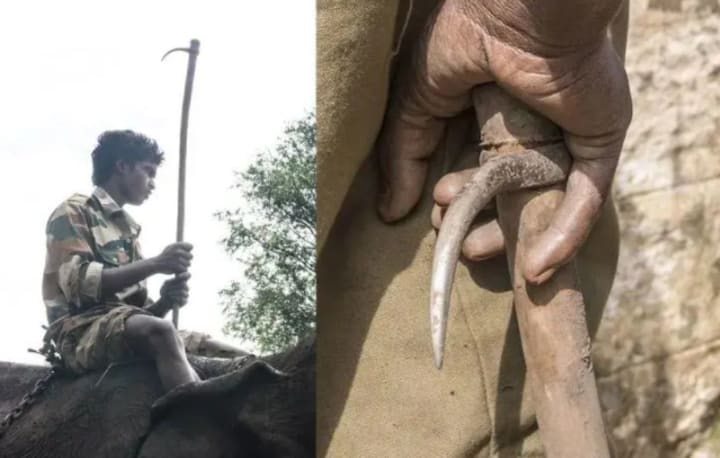
The elephant husband rides on the back of the baby elephant, and every morning and night he is constantly beaten with special "bullhooks", which can easily penetrate the elephant's skin. If you look closely at your ride "elephant ride", you are likely to find their bodies spotted with blood. At the same time, the elephant husband also takes the audio to create a loud noise to keep the baby elephant awake.
Bullhooks (elephant hooks)
This constant whipping and torture make the elephant obedient, and this "taming" method is called "Pha Jaan", which means "complete disconnection" and destroys the elephant's will. Day after day, it never stops. Until the elephant can't take it anymore and falls to his knees under the hook.
What follows is endless work to please the tourists.
Carrying endless numbers of humans through the forest. From the time the young elephant's spine was set up on an iron seat, year after year of carrying and trekking, the elephant's spine was deformed and its knees could not bend.
Remember the elephant in Cambodia called Sambo? Walking under high-temperature conditions carrying two tourists, he collapsed and died soon after.
Elephant painting is not humane.
Elephants who walk on all fours can only use their trunks to paint. However, the painting brush is not rolled up with the trunk, but live special brushes into their nostrils, and then crossed wooden sticks in the mouth of the nose to prevent falling. Elephant trunk is exceptionally sensitive, in each painting, the elephants feel not a proud sense of achievement, but endless discomfort and pain.
Perhaps only the painting of themselves is the most carefree it ~
However, elephants are not the only victims in the shameless pursuit of the economic interests of humans.
About the Creator
CEA
A bird in the hand is worth two in the bush.
Are Lick Mats Actually Good For Dogs, Cats, and Small Pets?
If you have been to pet shops or online pet groups lately, you have likely seen the pet lick mat. These bright, bumpy rubber mats are a huge hit, and for good reason. Pet owners find that their dogs, cats, and small pets love them.
By Alice Adams7 days ago in Petlife
Wisteria Woo RIP
Wisteria Woo Silver~Rhodesian Ridgeback Cane Corso mix~ 7.19.15-3.2.26 My service dog, Wisteria, had been slowing down, having mysterious health symptoms like severe hives and unexplained injury. She went to the vet last month, but unfortunately, not all tests detect all problems. When we returned to the vet yesterday, upon much more concerning symptoms suddenly appearing, we learned she had a very large mass (10inx10in) likely the very aggressive hemangiosarcoma, and that we would only be buying a few months if we went through with treatment.
By K.B. Silver 2 days ago in Petlife




Comments
There are no comments for this story
Be the first to respond and start the conversation.