
A Brief History of Canine Bravery For My Scaredy-Dog
Your ancestors didn’t fight saber-tooth tigers so you could be frightened by kittens!


My poor dog Willow is nudging me, whining. She’s shaking with fright. She’s pressing her chin on my leg, begging me to fix the big, scary world for her.
What has so frightened my 60-pound dog? Is there an intruder? Gunshots? Fireworks, a backfiring car, lightning, an earthquake, a psychotic clown?
Nope. She’s horrified because the upstairs neighbors are… walking.
Yep, walking. They’re walking around upstairs. And she hears their footsteps.
It’s terrifying.
Does this dog even know she’s descended from wolves?
Willow loves the backyard. The upstairs neighbors don’t use it much, so there are no other dogs or people there, and she’s happy to follow the sunbeams all day to keep up with her important snoozing schedule. When she notices the sun has moved, she wakes up, shakes herself off, and relocates to wherever the sun has taken up residence.
It all appears very relaxing. And it is. Unless…
That cat shows up. The tricky tuxedo one, who doesn’t respect fences and loves to beg all the neighborhood humans for spare belly rubs. When Willow sees the cat, she hightails it indoors. She’s terrified of cats. Heck, she’s terrified of kittens! We took in an abandoned kitten for a while, and every time it tried to love up on Willow, she’d act like a damn tiger tried to eat her.
My dear canine compadre, do you not realize that your ancestors once actually did fight tigers?
It’s true.
Humans First Reached What Is Now the Americas With Help From Dogs They’d Domesticated.
Mitochondrial DNA research suggests that wolves and dogs may have genetically split from each other as far back as 100,000 years ago, with additional domestication events between 40,000 and 20,000 years ago. The people of Asia managed to attract and befriend curious wolves by feeding them leftover lean meat, then selected their favorite ones and convinced them to get it on with each other. The result was docile wolf cubs with traits they’d selected, who could be handled and trained from birth.
Rinse and repeat ad nauseum, and a couple thousand years later, presto chango, we had Canis lupus familiaris, otherwise known as dogs.
Everyone benefited from the arrangement. Canines got food, protection from humans who might otherwise view them as dangerous competition, and nice warm fires to curl up next to over long winter nights. Humans got hunting partners with adorable powerful ears that heard every distant sound and alerted them to the dangers afoot. Plus, the humans got to hang out with dogs, which is literally the best.
Literally. The. Best. I’m pretty sure we got the better end of this deal.
Having dogs by our side really expanded the reach on planet Earth for our species. Unlike us, dogs have sharp meat-tearing teeth and the ability to use them effectively as a weapon against potential predators. We don’t know how hard humans tried to reach the Americas before they domesticated dogs, but we do know they successfully reached there, along with their canine companions, for the first time 10 to 15 thousand years ago.
That may sound like a long time, but humans evolved on this planet 200,000 years ago.
So what kept our two-legged, opposable thumb-wielding, flexible diet-having species off that continent for so long?
Tigers, mostly. Saber-toothed ones.
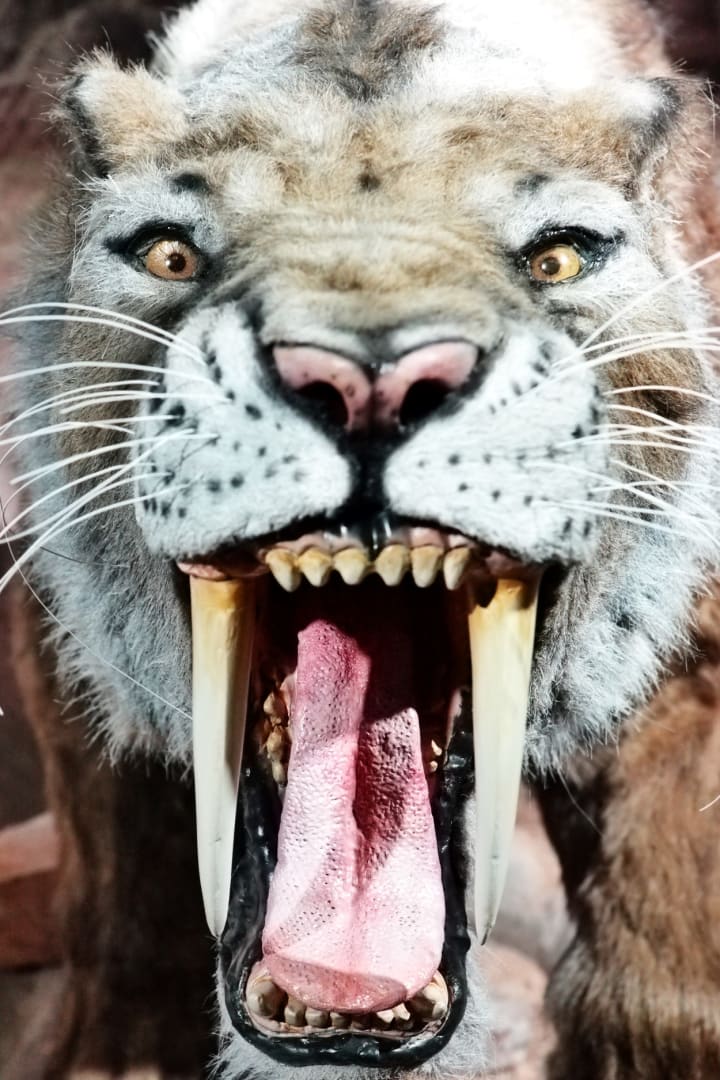
The path from Asia to the Americas was the Bering Land Bridge, which is thought to have connected what is now Eastern Siberia to Alaska. We know that there must have been times when the thousand miles between the two places were above water. Archaeological remains of identical plants and animals on either side prove it. Most notably, remains of saber-toothed tigers.
I don’t know about you, but I’m pretty sure I would not have been too keen on traveling across a narrow strait of land filled with man-eating tigers without a little help from our brave canine companions. DNA evidence shows that Asiatic dogs crossed the strait along with humans. They likely gave the humans (whose “claws” are so pathetic we diminutively refer to them as “fingernails”) a big boost defending against those vicious tigers.
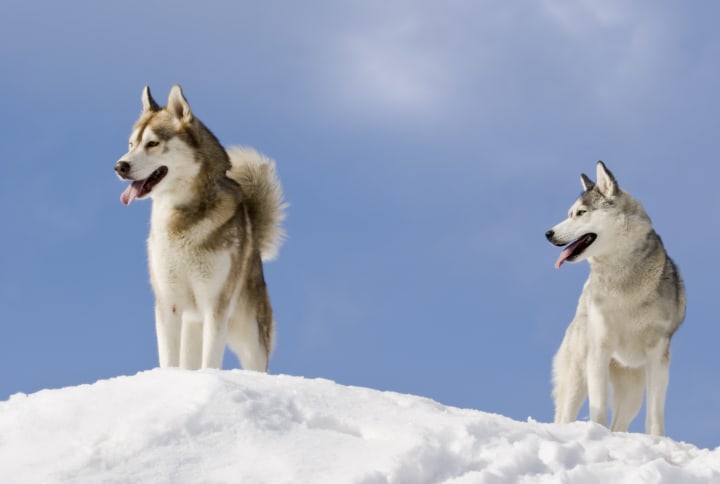
Good dogs, indeed!
Domesticated dogs once courageously bared their fangs and fought back against hunting packs of apex predators. So the question we must ask now is, Hey Willow, why are you so scared of the space heater?
My Dog’s Proud Ancestor, the Brave Korean Jindo
My partner and I took our dog in from an SPCA shelter when she was already an old lady, so we don’t know what sort of childhood she had. But we do know, from the magic of DNA kits, her breed breakdown.
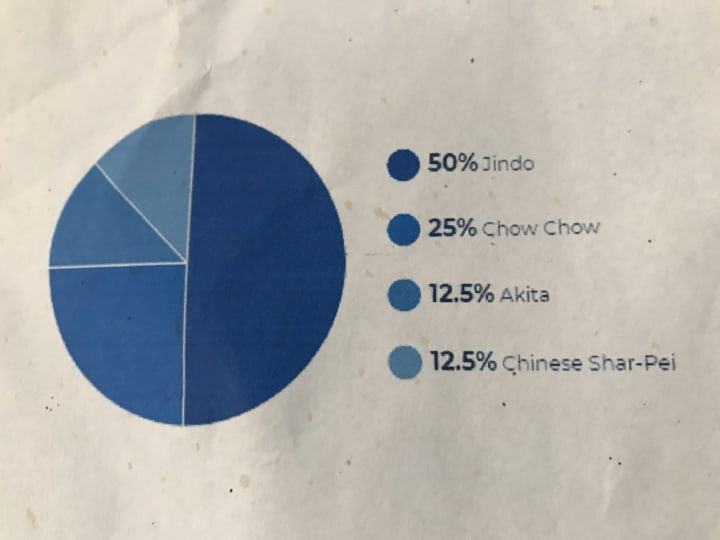
Before we got the test done, we’d never even heard of a Jindo, but once we learned that she’s 50% one, we looked into them.
Half of Willow’s ancestry was bred by the people of Korea’s Jindo Island to be hunters. The dogs must have excelled at it because they kept breeding them from the 13th century on.
That’s right. My dog, who ran off and hid when she saw a mouse, was bred to hunt.
To this day, the people of Jindo continue to breed them, even after Korea’s government declared the dogs a national treasure, limiting their export. The most purebred dogs can only be sold within the country, which is why you don’t see Jindos in dog shows.
You know how creepy and snobby dog shows are about breed purity, right? They’re all like, Is that a hint of chihuahua I see in that doberman? How gauche! So, outside Korea, Jindos don’t compete much. Though I’m sure they’re pretty happy they get to stay home doing nothing instead of traveling the world jumping through hoops.
The most famous story about a Jindo is one that takes place in 1993. A five year-old good girl named Baekgu (it means “white dog”) was sold by her elderly owner Park Bok-san to a buyer on the mainland because the dog was getting on her nerves. Seven months and over 180 miles later, the dog returned, skinny and bedraggled, crying at the old woman’s door. Park Bok-san finally came around to Baekgu after that, and they never parted again until the dog passed.
In some ways, this story doesn’t surprise me. Willow is incredibly loyal to my partner and me and searches for our comfort when she’s frightened. What surprises me is that my dog is related to a dog famous for making a brave 300 kilometer journey.
We’re talking about a dog who takes off in aimless terror if I accidentally drop her leash and the plastic dog poop bag holder thingy slaps the sidewalk. Her breed’s most famous member went on a journey over a bridge to an island where the water underneath made what my dog would consider ghastly, hair-raising, you know... flowing water sounds.
Have I mentioned that Willow is scared out of her wits by the sound of the shower running? Other than the water in her bowl, you won’t catch Willow willingly going anywhere near anything wet.
If she’d been Baekgu, she’d have stayed on the mainland for life.

My Willow is Far From Alone When It Comes to Anxiety
Coward or not, my partner and I are completely obsessed with our dog. We adore her like she was our own child. We’re perfectly willing to excuse all her phobias.
When we took Willow in, she was cowering at the back of the space the SPCA provided for her. She hated the sound of the other dogs barking. She was skinny, almost hairless, and she had benign tumors growing throughout her body that likely caused her pain. Still, when we brought her into a small private room to meet her up close, she jumped all over us, licking our faces, wagging her tail.
That girl wanted out of dog jail, pronto.
I imagine she went through a lot before she got to us. All we know about her time before is that they found her wandering the streets and she’d never been spayed. Had she been a puppy mill breeding dog? Did she originally come from a dog meat market far away? Was she involved in dog fighting? Or maybe she’d just been alone and lost on the streets for a long time. Any of these scenarios are bound to create phobias in a dog.
There are dogs who have been raised with nothing but love and protection who have phobias. There’s a Pomeranian who’s afraid of the toaster because one time a loud noise happened outside at the same time that the toast popped up. So, if any dog is allowed to be afraid of her own shadow, it’s my dog Willow.
In fact, 70% of dogs display anxiety from time to time, with 29% displaying “general fearfulness,” according to a study out of Finland. My guess is, it’s from hanging out with humans too much. We humans are a neurotic bunch, and dogs are social creatures who become more like us all the time.
Of course, the horrors that too many dogs face before they end up in a place like the SPCA can have long term effects. Like many rescue dogs, Willow exhibits signs of post-traumatic stress disorder. So my partner and I try to make her life as calm, stress-free, and supportive as possible.
We can’t stop that cat from hopping the fence into her backyard any more than we can stop the folks upstairs from walking from the bedroom to the bathroom. But we can certainly let her lean hard against our legs any time she wants.
Some people say that we shouldn’t “reward” our dog’s phobias by comforting her, but screw that. She’s had a long, hard life. She may not fight tigers or travel great distances alone, but she’s precious.
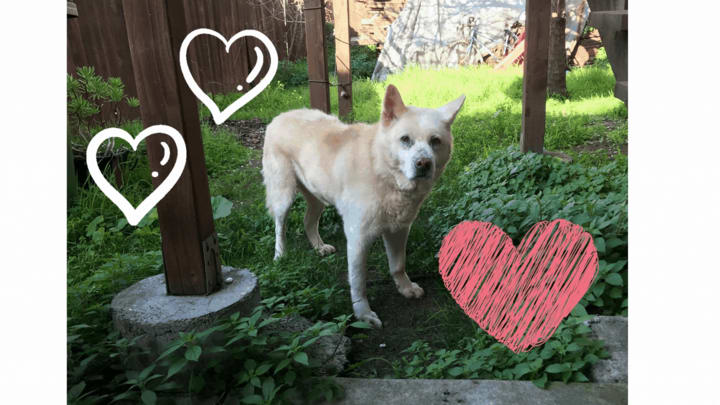
We’ll give Willow all the neck scratches and tummy pets she wants until the day she leaves this earthly plane for her version of heaven, which I suspect is a very calm, quiet place on a sunbeam.
About the Creator
Lissa Bay
Lissa is a writer and nanny who lives in Oakland, California. She enjoys books, books, playing Disney songs on ukulele for kiddos, books, and hanging out with her deeply world-weary dog, Willow. And, oh yeah, also—get this: books.
A Dart at Dusk
Seconds ago, the sullen sun set on the two of us… my exuberant furry companion and me. A fresh breeze embraces us, delivering welcome relief from the day’s oppressive heat. His typical stumbling and staggering along — apace with a sloth — has turned into trip-trapping, high-stepping, almost skipping along.
By Angie the Archivist 📚🪶5 days ago in Petlife
Your Puppy Can Feel Your Stress Instantly
The Incredible Science Behind How Puppies Sense Your Emotions and React Before You Even Realize It --- You walk into the room, shoulders slumped, jaw tight, heart racing from a stressful day. Before you even speak, your puppy is there—tail tucked, eyes alert, nose nudging your hand. Almost magically, they know something is wrong.
By Ahmed aldeabella3 days ago in Petlife


Comments
There are no comments for this story
Be the first to respond and start the conversation.