
10 interesting secrets about woodpeckers
While other birds use grass and branches to make nests, woodpeckers use their strong beaks to drill holes in tree trunks to make nests and catch insects.


Surprised with interesting facts about woodpeckers
1. Why don't woodpeckers get headaches?
Pileated woodpeckers, the largest species in North America, slam their heads into trees at speeds of up to 15 miles per hour, 20 times per second. So why aren't their heads blown to pieces?

Firm muscles, a sponge-like skull , and thick eyelids keep their brains intact.
Professor Schwab's research showed that woodpeckers could hit hard surfaces up to 20 times per second with a force 1,200 times greater than gravity without suffering any concussion, and their retinas were not injured, nor did their brains experience any problems.
“If you get hit hard on the head, you can rupture the blood vessels behind the eyeball and damage the nerves in that area. So when I see car accident victims and hear about woodpecker activity, the big question that comes to my mind is why these injuries don’t happen to these birds,” Schwab said.
Woodpeckers use straight-line strikes on tree trunks, which helps reduce the impact force and avoid concussions to the head. In addition, the bird's body is designed with special details to minimize negative impacts.
A millisecond before the strike, the dense muscles in the bird's neck contract, while the eyelids close tightly, causing some of the force to be released to the neck muscles, helping to protect the skull from the blow.
The compressible bones in the skull fuse together to form a protective cushion. At the same time, the tightly closed eyelids help the woodpecker protect its eyes from flying wood splinters and keep the pupil in place - preventing the pupil from being knocked out or dislocated by a strong impact.
“The eyelids act like a seat belt in a car, keeping the eye from flying out of the face. Otherwise, the acceleration could tear the retina,” Schwab says. In addition, the outer part of the eye itself is strong and filled with blood, which protects the retina from being pushed out.
Birds have very strong brains that can withstand repeated blows to the head. In humans, when the head is injured, the brain is jostled and shaken around in the cerebrospinal fluid. However, woodpeckers do not have this fluid, reducing the risk of damage.
Along with the straight, arrow-like strikes on the tree trunk that help avoid head trauma, the bird’s body is also designed to minimize the impact. A millisecond before the strike, the dense muscles in the bird’s neck contract and its eyelids close tightly. Some of the force is released into the neck muscles, protecting the skull from a devastating blow. Compressible bones in the skull also provide a protective cushion. Meanwhile, the bird’s tightly closed eyelids protect the eye from any wood splinters and keep the pupil in place.
“The eyelid acts like a seat belt and keeps the eye from being blown out of the face ,” says Schwab. “ Otherwise the acceleration would tear the retina.” The outer part of the eye itself is very strong and filled with blood to protect the retina from being jostled.
Bird brains are also remarkably resilient to such blows. Head injuries to humans often cause the brain to bounce around in cerebrospinal fluid. But woodpeckers have virtually no cerebrospinal fluid.
While scientists aren't sure whether woodpeckers get headaches, Schwab points out that the birds are at least remarkably pain-tolerant. "During courtship, male woodpeckers can drum up to 12,000 times a day. If they had to tell their partner, 'Not tonight, honey, I have a headache,' they wouldn't bother doing it."
2. Tail with sharp spikes
Woodpeckers are tree climbers and have a flexible body adapted to life in trees. Their tails have sharp spines that they use to dig into tree trunks. When the woodpecker uses its toenails to cut into the tree trunk, its tail acts as a third leg to help it grip the tree.

3. Smart and skillful
Most woodpeckers use their beaks to drill holes in trees to catch insects or make nests, but the acorn-eating woodpeckers of North and Central America are different. They drill hundreds of tiny holes in tree trunks to store acorns and retrieve them when needed, especially during the cold winter months.
4. Ground Woodpecker
As the name suggests, ground woodpeckers forage on the ground rather than in trees. They are commonly found in the grasslands of South Africa, Swaziland and Lesotho.
They also have earth-colored plumage to blend in with their surroundings. The main food of this bird is termites and other insects that live underground.
5. Climbing toe type foot
Woodpeckers have zygodactyl feet, meaning two toes point forward and two toes point back. This helps them to perch securely on tree trunks while hunting for food and to move on the ground.

6. Symbiotic relationship with hummingbirds
Some species of woodpeckers in North America are closely related to hummingbirds. While woodpeckers drill into trees to catch insects, hummingbirds will fly after them to suck the sap.
In return, hummingbirds serve to scare away larger birds that might try to steal the woodpecker’s feeding grounds. Hummingbirds normally feed on nectar, but nectar sources are scarce in winter, forcing them to feed on tree sap instead.
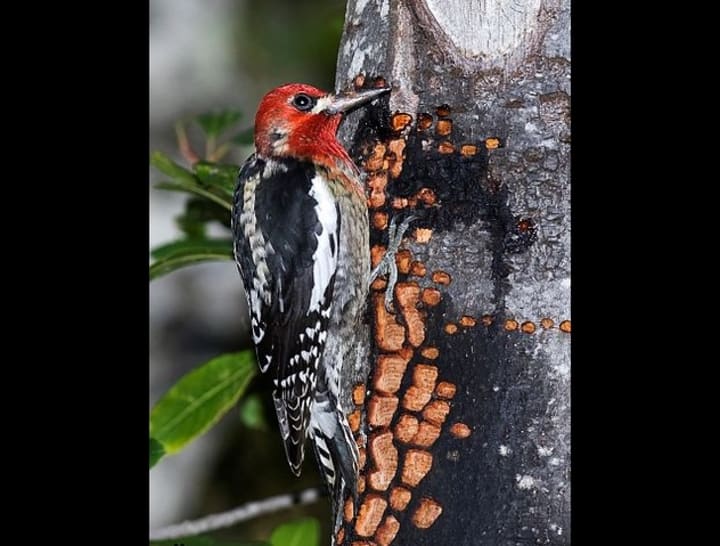
7. Gila Woodpecker
Living primarily in the desert regions of the southwestern United States and Mexico , Gila woodpeckers typically feed on insects found on cacti. They also eat cactus fruit and berries.
These birds are important to the Saguaro cactus because they catch harmful insects and clean up damaged stems.

8. “Shield” protects against wood chips and sawdust
Woodpeckers have bristles and soft hairs on their noses to help protect them from being damaged by wood chips and sawdust while chipping away at tree trunks.
The stiff feathers help prevent foreign objects from entering the nostrils while the soft feathers act as a filter to keep dust out as they breathe. Woodpeckers also have special feathers that protect their eyes.
9. Woodpecker catches flies
Unlike other woodpeckers that bore into tree trunks to catch insects, the American flycatcher woodpecker hunts for airborne insects such as flies or perches on tree trunks.
In the fall and winter, they usually eat acorns and other nuts. They also drill into tree trunks to make nests like other woodpeckers.

10. Crooked neck bird
In the same family as woodpeckers, the Eurasian wryneck looks more like a sparrow. Its neck is so flexible that it can bend backwards like a snake.
Wrynecks nest in open forests and forage on the ground. Their favorite food is ants.
About the Creator
Ken Daklak
Telling stories my heart needs to tell <3 life is a journey, not a competition
If you like what you read, feel free to leave a tip,I would love some feedback
https://s.shopee.vn/VwwLTGLe9
Keep reading
More stories from Ken Daklak and writers in Petlife and other communities.



Comments
There are no comments for this story
Be the first to respond and start the conversation.