
Your Brain Remembers Insults for 20 Years but Forgets Compliments in 30 Days
Understanding the strange way our minds hold on to pain and let go of praise.

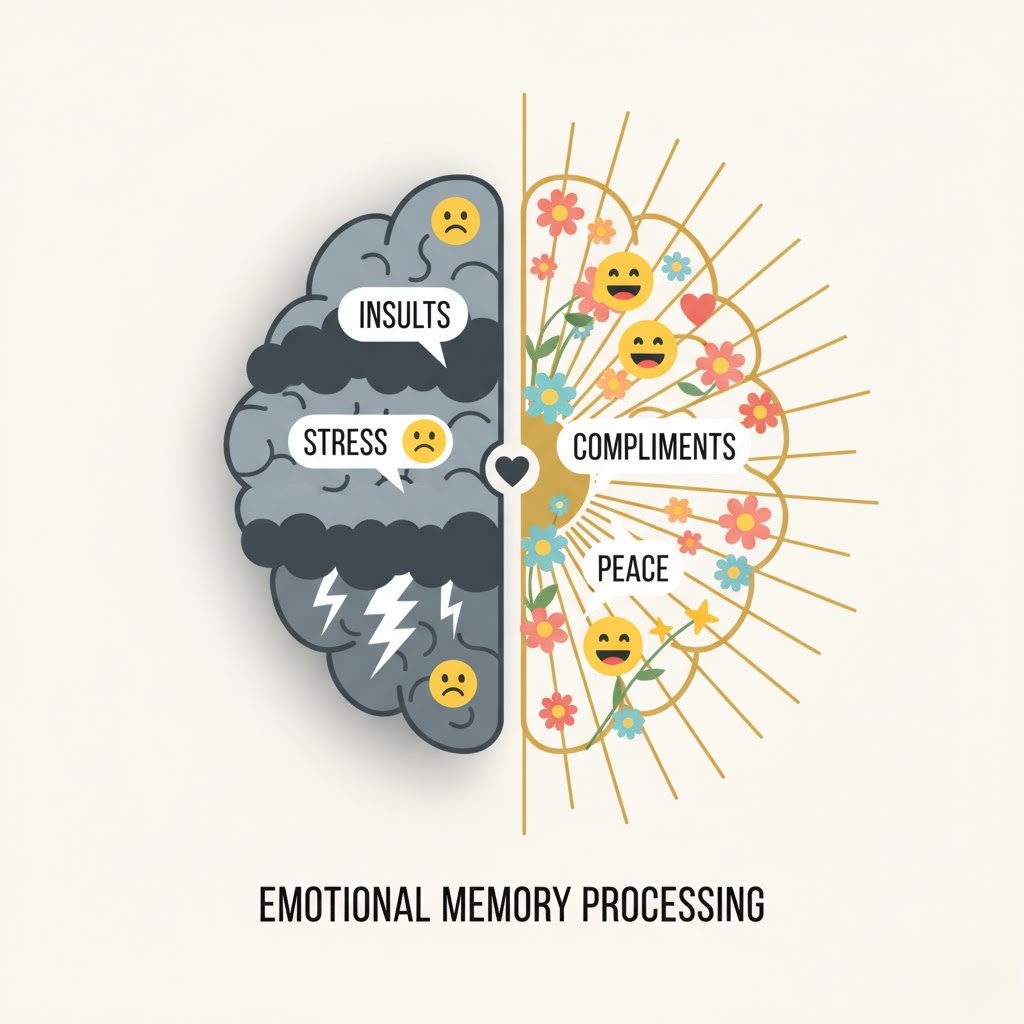
**The Mind’s Unfair Memory**
Have you ever noticed that one rude comment can stay with you for years, but a dozen kind words fade away in weeks? You’re not imagining it — science backs it up. The human brain is wired to **hold on to negative experiences** more strongly than positive ones. This means that even a small insult can echo in your mind for decades, while a compliment might disappear in just a few weeks.
It may sound unfair, but this survival mechanism helped our ancestors stay alive. By remembering dangers and painful moments, early humans learned how to avoid threats in the future. Compliments didn’t save lives — but **fear and caution did.**
**The Science Behind Negativity Bias**
Psychologists call this the **“negativity bias.”** It means your brain gives more attention and emotional weight to negative events. When someone insults you, your brain releases stress hormones like **cortisol**, making the memory stronger. But when you receive a compliment, the brain’s reaction is softer — you feel good for a moment, and then it fades.
Dr. John Cacioppo, a psychologist at the University of Chicago, found that our brains react more strongly to unpleasant images or words than to positive ones. It’s not your fault — it’s just how human biology works. Our brains evolved to **protect us**, not necessarily to make us happy.
**Why Compliments Don’t Stick**
A compliment feels great in the moment, but your brain doesn’t treat it as something urgent or dangerous. It’s like a warm breeze — pleasant, but passing. Insults, however, are like storm clouds. They trigger self-doubt, fear, and even shame, which your brain treats as potential “threats.”
That’s why you can recall a hurtful comment from your teenage years almost word-for-word, but you can’t remember every time someone told you that you looked nice last month. Compliments are short-term emotional boosts, while insults leave long-lasting emotional scars.
**Social Media and the Modern Mind**
In today’s world, negativity bias is even stronger because of **social media.** You might get 100 likes and kind comments, but that one negative remark stands out. You scroll back, read it again, and think about it for hours — even days.
Your brain is basically telling you, “This could be a threat to your social reputation!” And so, it locks that memory away more deeply. This is why many people feel anxious or low self-esteem even when most of their feedback is positive. The brain’s ancient wiring is reacting to modern life in the wrong way.
**How to Rewire Your Mind**
The good news? You can train your brain to **hold on to positivity longer.** Here are a few practical ways:
1. **Pause and absorb praise.** When someone compliments you, take 10–20 seconds to really let it sink in. The longer you focus on it, the more your brain stores it as a lasting memory.
2. **Write down good moments.** Keep a “positivity journal.” Each night, note one compliment or good event. Reading them back trains your brain to remember happiness.
3. **Challenge negative thoughts.** When an insult replays in your head, ask yourself, “Is this true? Does it matter now?” This helps weaken old painful memories.
4. **Surround yourself with positive voices.** The more kindness and encouragement you experience, the more your brain adapts to it.
5. **Practice gratitude.** Thinking daily about what you’re thankful for helps shift focus from hurt to healing.
**Healing Through Kindness**
It’s interesting — while insults last longer in your brain, kindness can still rewrite the story. Studies show that regular positive interactions, appreciation, and self-compassion can **reduce the emotional power** of old negative memories.
The next time someone compliments you, don’t brush it off. Smile, say thank you, and hold on to it like a treasure. And when someone hurts you, remember that your brain is wired to overreact — it doesn’t mean the insult defines you.
**Final Thoughts**
The fact that your brain remembers insults for 20 years but forgets compliments in 30 days might sound depressing — but it’s actually empowering. It shows that your mind is powerful, emotional, and deeply human. You can’t always control what happens to you, but you can **train your focus** to celebrate the good, forgive the bad, and build emotional strength.
So, the next time your brain replays that old insult, pause and replace it with a compliment — maybe one you never truly believed. The power to heal lies not in forgetting, but in **choosing what to remember.**
✨ **Moral of the Story:**
Your brain remembers pain to protect you — but with effort, you can teach it that joy deserves to stay, too.
About the Creator
Reader insights
Nice work
Very well written. Keep up the good work!
Top insights
Compelling and original writing
Creative use of language & vocab
Easy to read and follow
Well-structured & engaging content
Excellent storytelling
Original narrative & well developed characters
Expert insights and opinions
Arguments were carefully researched and presented
Eye opening
Niche topic & fresh perspectives
Heartfelt and relatable
The story invoked strong personal emotions
Masterful proofreading
Zero grammar & spelling mistakes
On-point and relevant
Writing reflected the title & theme
Keep reading
More stories from Kashif Wazir and writers in Motivation and other communities.
The Mental Benefits of Daily Workouts
Exercise is often linked to physical fitness, weight loss, or building strength, but its impact on mental health is just as powerful. Daily workouts not only improve your body but also enhance your mind, helping you feel happier, more focused, and less stressed. In 2025, with growing awareness about mental well-being, understanding the mental benefits of exercise is more important than ever.
By Kashif Wazir5 months ago in Motivation
Pandora’s Burden
“My brother warned me to not accept gifts from the one who commissioned you,” said Epimetheus to the woman clad in silvery raiments standing at the entrance to the temple. Her silver tiara and the silver rings on her fingers and toes glinted in the firelight cast by torches set on either side of the doorway. Lingering in the shadows, beyond the reach of the flames as she was, he could not tell what she held in her hands. At first what appeared to be a box was perhaps a funerary urn, or maybe merely an apple.
By J. Otis Haas3 days ago in Fiction




Comments (1)
This is so very true I remember years ago it hurts but sometimes forget the nice things to dwell on sadness