
Why We Feel Invisible in a Room Full of People
How Disconnection Can Exist Even When We’re Not Alone

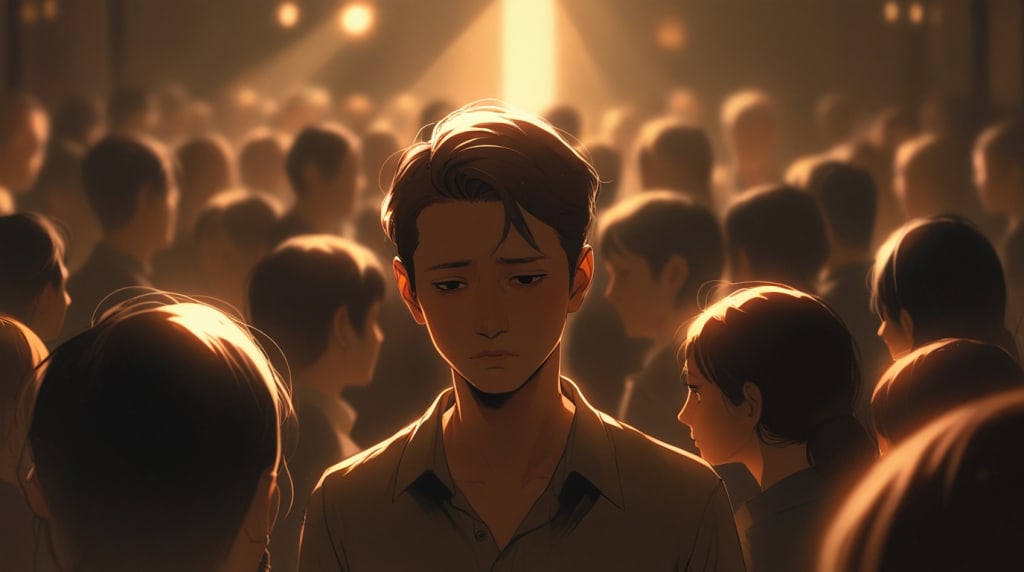
The Party Where No One Saw Her
Vanessa had been at the party for forty-three minutes, and she had become a ghost.
Not literally, of course. She was standing right there—by the kitchen island, holding a glass of wine she wasn't drinking, wearing the emerald dress her sister said made her look confident. She was physically present in a room with thirty-seven other people, all of them laughing and talking and *connecting* in ways that seemed to come so naturally to everyone but her.
But no one had spoken to her in twenty-two minutes. She'd counted.
She'd tried. She'd smiled at the woman refilling her drink. She'd stepped closer to a group discussing a Netflix show she'd actually watched. She'd even laughed at someone's joke, making sure her laugh was audible, a signal that said *I'm here, I'm engaged, I'm part of this.*
Nothing.
The conversation continued around her as if she were furniture. The group shifted slightly, and somehow, without anyone being explicitly rude, she found herself outside the circle again. Observing. Invisible.
Vanessa's throat tightened. That familiar feeling was rising—the one that made her want to grab her coat and disappear out the door, to drive home and sit in her apartment where at least the loneliness was expected instead of surprising.
She'd spent all week looking forward to this party. Her colleague had invited her, said it would be "low-key, really fun, great people." Vanessa had been so hopeful. Maybe this time would be different. Maybe this time she'd finally figure out how to be someone people wanted to talk to.
But here she was again. In a room full of people, drowning in isolation.
And the worst part—the part that made her eyes sting with tears she absolutely could not cry here—was that she didn't know what she was doing wrong.
She wasn't being rude. She wasn't being weird. She was just... there. Trying. And somehow, that wasn't enough.
At 9:47 p.m., Vanessa quietly set down her full glass of wine and left without saying goodbye. No one noticed her leave, just like no one had noticed her stay.
She drove home wondering: *What's wrong with me? Why can't people see me?*
---
The Psychology of Social Invisibility
Here's what Vanessa didn't know: there was nothing wrong with her.
Social invisibility—that haunting feeling of being overlooked even when you're physically present—isn't about your worth or likability. It's about the complex, often cruel psychology of group dynamics and human attention.
Dr. Kipling Williams, a psychologist who has spent decades studying ostracism and social exclusion, discovered something profound: the human brain processes social rejection the same way it processes physical pain.
When Vanessa stood in that kitchen, being casually ignored, her anterior cingulate cortex—the region that lights up when you stub your toe or burn your hand—was firing intensely. Her brain was screaming: *You're in danger. You're not part of the tribe. You might not survive.*
These aren't dramatic exaggerations. For hundreds of thousands of years, being excluded from your social group meant death. No protection. No shared resources. No one to warn you about predators or help you through illness.
Evolution wired us to be exquisitely sensitive to social rejection because social rejection used to be fatal. We carry that ancient wiring into modern cocktail parties, where exclusion won't kill us but *feels* like it might.
But here's the paradox: while Vanessa's pain was real, the invisibility itself wasn't personal. It was structural.
Research by Dr. Nicholas Christakis on social networks reveals that human attention operates like a spotlight, not a floodlight. In groups larger than about seven people, we unconsciously create attention hierarchies. Some people become central nodes—magnetic personalities who draw conversational energy. Others drift to the periphery.
And once you're at the periphery, staying there becomes a self-fulfilling prophecy.
Vanessa wasn't invisible because she was boring or unlikable. She was invisible because she'd ended up at the wrong position in a social geometry that no one was consciously creating but everyone was unconsciously maintaining.
---
The Ones Who Always Get Noticed
Across the room from where Vanessa had been standing, Marcus held court.
He was loud. Charismatic. The kind of person who seemed to expand to fill whatever space he occupied. People gravitated toward him like he had his own gravitational field.
Marcus told stories that made people laugh. He asked questions that made people feel interesting. He remembered names, made eye contact, touched people's arms just enough to create connection without crossing boundaries.
Everyone wanted to talk to Marcus. Including Vanessa, though she'd never gotten close enough to try.
What Vanessa didn't see—what no one at that party saw—was Marcus in his car afterward, gripping the steering wheel, exhausted beyond measure.
Being the center of attention wasn't effortless. It was performance. A role Marcus had perfected over years because being peripheral terrified him more than the exhaustion of being perpetually "on."
Marcus had learned early that visibility required volume. That if you weren't louder, funnier, more energetic than everyone else, you'd fade into the background. So he'd taught himself never to fade, even when every cell in his body wanted to be quiet.
Research by psychologist Dr. Susan Cain on introversion and extraversion reveals that what we perceive as "natural" social dominance is often learned behavior. People like Marcus aren't born magnetic—they've trained themselves to command attention because, at some point, invisibility hurt too much.
But here's what the psychology shows: high visibility and low visibility are both forms of disconnection.
Marcus was surrounded by people all night, but not one conversation went beneath the surface. Not one person asked how he was really doing. They wanted the performer, not the person.
He was visible, but not seen. And in some ways, that was just as lonely as Vanessa's invisibility.
---
The Social Script No One Taught Us
Vanessa's friend Lila had watched her leave the party. She'd noticed Vanessa standing alone but hadn't walked over. Not because she didn't care, but because... well, Vanessa had seemed fine. Quiet, but fine.
Three days later, when Vanessa finally told her the truth—how painful that party had been, how invisible she'd felt—Lila was stunned.
"I had no idea," she said. "I thought you were just being independent. I didn't want to bother you."
And there it was: the tragic miscommunication that perpetuates social invisibility.
Vanessa read Lila's distance as confirmation that she wasn't wanted. Lila read Vanessa's quietness as a preference for solitude. Both were wrong. Both were trying not to impose. Both ended up isolated.
Dr. Gillian Sandstrom's research on "minimal social interactions" reveals something hopeful: most people dramatically underestimate how much others want to talk to them. In study after study, people predicted they'd be bothering strangers by starting conversations, when in reality, those strangers were hoping someone would approach them.
We're all Vanessa, standing in metaphorical kitchens, convinced everyone else is effortlessly connected while we're uniquely unwanted. We're all waiting for someone else to bridge the gap, not realizing everyone is waiting for the same thing.
Social psychologist Dr. Jamil Zaki calls this the "liking gap"—the disconnect between how much we think people like us and how much they actually do. After first conversations, people consistently underestimate how much their conversation partner enjoyed talking to them.
Vanessa assumed no one wanted to talk to her. The truth was more complicated: people weren't rejecting her. They were caught in their own social anxieties, their own fear of imposition, their own desperate hope that someone else would make the first move.
Everyone was waiting. And in the waiting, everyone felt invisible.
---
The Ones Who Learned to Disappear
Vanessa's invisibility hadn't started at that party. It had roots that went back decades, to a thousand small moments when being seen felt dangerous.
She was twelve when she enthusiastically answered a question in class and got the answer wrong. The laughter wasn't cruel—just teenage thoughtlessness. But it taught her: *Speaking up is risky. Silence is safer.*
She was sixteen when she tried to join a lunch table and someone said, "Sorry, we're saving this seat," even though the seat stayed empty. The rejection wasn't personal—just social politics. But it taught her: *Wanting inclusion makes you vulnerable. Better to not want it at all.*
She was twenty-three at her first office job when she shared an idea in a meeting and her boss said, "Interesting," then moved on without discussion. The dismissal wasn't intentional—just a busy person managing a full agenda. But it taught her: *Your contributions don't matter. Stay small.*
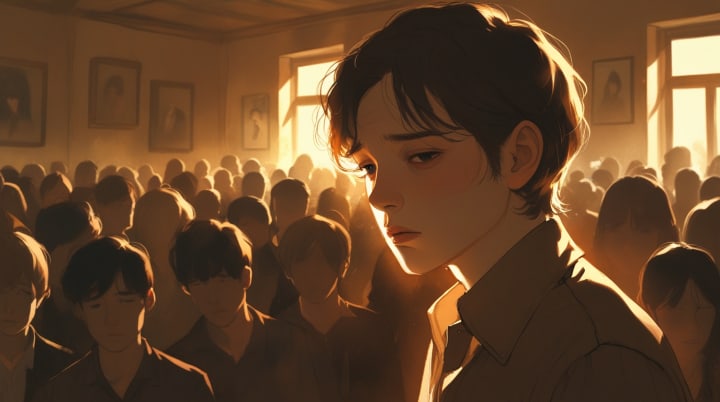
One by one, these experiences accumulated. And Vanessa's brain, trying to protect her from further hurt, developed a strategy: *Don't put yourself forward. Don't take up space. If you're not visible, you can't be rejected.*
Dr. Bessel van der Kolk's research on trauma and the body reveals that we carry these social wounds in our physiology. People who've experienced chronic social rejection often develop what's called a "collapsed" presence—hunched shoulders, minimal eye contact, a voice that apologizes for existing.
It's not a conscious choice. It's a nervous system strategy: *If I make myself small enough, maybe I won't get hurt again.*
But the tragedy is that making yourself small to avoid rejection guarantees the outcome you fear. People don't reject you—they simply don't notice you. And not being noticed feels identical to rejection.
Vanessa had spent years perfecting the art of invisibility to protect herself. And now she was suffering from the very safety she'd created.
---
The Moment Someone Finally Saw Her
Two weeks after the party, Vanessa was at a coffee shop, working on her laptop. She'd positioned herself in the corner—her usual spot, where she could observe without being observed.
A woman approached her table. "Excuse me, is anyone sitting here?"
Vanessa shook her head, expecting the woman to take the chair and move it elsewhere. But instead, she sat down.
"I hope this doesn't sound weird," the woman said, "but you come here a lot, right? I've seen you. You always look so focused. I've wanted to say hi for weeks but kept chickening out."
Vanessa stared. Someone had *noticed* her? Had wanted to talk to her but been nervous?
"I'm Elena," the woman continued. "I'm writing a novel and procrastinating spectacularly. What are you working on?"
And just like that, they were talking. Really talking. About work and writing and the strange loneliness of coffee shops full of people. Elena shared that she'd just moved to the city and felt invisible everywhere she went. Vanessa admitted she'd felt that way for years, even though she'd lived here her whole life.
"I thought it was just me," Elena said quietly.
"Me too."
What Vanessa didn't realize was happening: Elena's willingness to be vulnerable—to admit she'd been nervous, to confess her loneliness—had given Vanessa permission to drop her own protective invisibility.
Dr. Brené Brown's research on vulnerability and connection reveals this pattern: connection requires someone to go first. To risk being seen. To admit they're not effortlessly connected either.
When Elena took that risk, she didn't just start a conversation. She broke the spell of invisibility that had kept both of them isolated.
---
The Architecture of Being Seen
Over the next several months, something shifted for Vanessa. Not because she transformed into a different person, but because she started understanding the psychology of visibility differently.
She learned that being seen isn't about being the loudest or most charismatic person in the room. It's about being intentionally present instead of protectively absent.
She practiced what her new therapist called "active visibility"—small, deliberate choices that signaled her presence:
Making eye contact instead of looking at her phone. Asking one question in a group conversation instead of waiting to be asked. Sharing one opinion instead of staying neutral. Standing in an open posture instead of hugging the walls.
None of these felt natural at first. Her nervous system screamed that visibility meant danger, that taking up space would lead to rejection.
But research by Dr. Amy Cuddy on "power posing" and presence reveals something profound: you don't have to feel confident to act confident. And when you act confident—when you physically take up space and make yourself visible—your brain chemistry actually changes. Testosterone increases. Cortisol decreases. You become the confident person you're pretending to be.
Vanessa also learned to recognize the subtle ways she'd been contributing to her own invisibility.
She had a habit of positioning herself at the edges of rooms, literally placing herself in peripheral vision where people were least likely to notice her. She spoke softly, requiring people to lean in to hear her, which created a barrier to casual conversation. She rarely made the first move to start conversations, waiting instead to be approached.
None of this was conscious. But all of it communicated: *I'm not really here. You don't need to see me.*
Social psychologist Dr. Tanya Chartrand's research on "social mimicry" shows that humans unconsciously mirror each other's energy levels. If you bring low energy to an interaction—speaking quietly, holding back, taking up minimal space—others unconsciously match that energy, which reinforces your invisibility.
The cruel cycle: feeling invisible makes you behave invisibly, which makes others treat you as invisible, which confirms your feeling of invisibility.
Breaking the cycle meant taking the terrifying risk of being visible before she felt worthy of visibility.
---
The Others Who Feel Invisible Too
At a work event three months later, Vanessa noticed a young man standing alone by the bar. He had that particular stillness of someone trying very hard to look comfortable while feeling utterly out of place.
She recognized it immediately. She'd embodied that stillness for years.
Her first instinct was to stay where she was. To let someone else approach him. To protect herself from the awkwardness of a conversation that might not go well.
But then she thought about Elena in that coffee shop, taking the risk of saying hello. How that one moment of courage had changed everything.
Vanessa walked over.
"Hi," she said. "I'm Vanessa. I work in marketing. Is this your first company event?"
The relief on his face was instant. "Yes. I'm Adrian. I just started. I've been standing here for twenty minutes trying to figure out how to look like I'm not standing here alone."
Vanessa laughed. "I've been to dozens of these events and I still feel that way every time."
"Really? You seem so confident."
And in that moment, Vanessa realized something profound: her visibility didn't just help her. It helped him. Her willingness to approach someone who felt invisible made him feel seen.
Dr. Barbara Fredrickson's research on "positivity resonance" reveals that moments of genuine connection create physiological synchrony—heart rates align, breathing patterns match, stress hormones decrease in both people simultaneously.
When Vanessa made Adrian feel seen, she wasn't just being kind. She was creating the exact kind of connection she'd been desperately craving herself.
The invisibility she'd suffered through at countless parties and events had given her a superpower: she could spot other invisible people. She knew what they needed because she'd needed it herself.
And every time she took the risk of being the person who goes first—who extends the invitation, starts the conversation, bridges the gap—she was both healing her own wounds and preventing someone else from developing the same ones.
---
The Party Where Everything Changed
Six months after the party where she'd been invisible, Vanessa was invited to another gathering. Same colleague. Similar crowd. Even the same kitchen island.
She stood there with her wine glass, and felt the familiar pull to disappear into the corner, to protect herself, to stay small and safe.
But this time, she made a different choice.
She turned to the person next to her—a woman she'd never met—and said, "I'm terrible at parties. Please tell me I'm not the only one feeling awkward right now."
The woman's face broke into a relieved smile. "Oh thank god. I thought it was just me. I'm Maria."
"Vanessa."
And just like that, they were talking. Really talking. About the weirdness of networking events and the performance of professional socializing and how exhausting it is to pretend to be effortlessly social when you're not.
Two other people overheard and joined in. Then another. Before Vanessa knew it, she was at the center of a small group, having the kind of honest, funny, deeply human conversation she'd been craving for years.
She wasn't performing like Marcus. She wasn't pretending to be someone else. She was just being honest about her discomfort, and that honesty had created permission for everyone else to drop their performance too.
Later, Marcus himself approached her. "I overheard some of your conversation," he said quietly. "About feeling awkward at parties? I feel that way too. I just hide it by being loud."
Vanessa looked at him—this person she'd envied for his effortless charisma—and saw the exhaustion underneath. The performance. The loneliness of being visible but not seen.
"Want to join the awkward people conversation?" she asked. "It's way more interesting than the networking talk."
He smiled—a real smile, not the performative one she'd seen before. "Yeah. I really do."
---
The Truth About Invisibility
Vanessa still has moments when she feels invisible. At conferences. At family gatherings. In meetings where louder voices dominate.
But now she understands: invisibility isn't a verdict on her worth. It's a psychological phenomenon that affects almost everyone, just in different ways.
Some people feel invisible in crowds. Others feel invisible in intimate relationships. Some are overlooked professionally. Others are celebrated publicly but lonely privately.
We're all navigating the same fundamental human need: to be seen, known, valued for who we really are.
And the path to visibility isn't about becoming more charismatic or confident or extroverted. It's about being courageously honest about your humanity—your discomfort, your uncertainty, your imperfection.
Because here's what Vanessa finally learned: you don't become visible by being perfect. You become visible by being real.
By admitting when you feel awkward instead of pretending you don't. By approaching the other person standing alone instead of waiting to be approached. By sharing the vulnerable truth instead of the polished performance.
The people who feel most seen aren't the ones who've mastered the art of being impressive. They're the ones who've mastered the art of being honest.
And when you're honest about feeling invisible, something magical happens: other people who feel invisible suddenly see you. And in seeing you, they feel seen themselves.
Vanessa looks around the party now—at Maria, who's laughing at something someone said. At Adrian from her office, who she'd invited tonight, now deep in conversation with someone from accounting. At Marcus, looking genuinely relaxed for the first time since she's known him.
None of them are invisible anymore. Not because they changed who they are, but because they stopped trying so hard to be who they thought they should be.
She thinks about that night six months ago when she left in tears, convinced something was fundamentally wrong with her.
If she could talk to that version of herself, she'd say: *There's nothing wrong with you. You're not invisible because you're worthless. You're invisible because you're hiding. And you're hiding because you're scared. And you're scared because being seen is terrifying when you don't believe you're worth seeing.*
*But you are. You always were.*
*And the moment you risk being seen—really seen, messily and imperfectly seen—you'll discover that everyone else has been waiting for permission to be seen too.*
*We're all invisible until someone is brave enough to go first.*
Vanessa raises her wine glass—this time actually drinking it—and catches Elena's eye across the room. Elena, who'd gone first in that coffee shop and changed everything.
She mouths: *Thank you.*
Elena smiles and mouths back: *You're doing it too now.*
And Vanessa realizes it's true. She's not waiting anymore. She's not hiding anymore.
She's finally, beautifully, terrifyingly visible.
And it turns out, being seen is worth every uncomfortable moment it took to get here.
----------------------------------------------
Thanks for Reading!
About the Creator
Keep reading
More stories from Ameer Moavia and writers in Motivation and other communities.
Why We Stay in Relationships That Break Us
The coffee had gone cold in my hands, but I didn't notice. I was too busy staring at my phone, waiting for it to light up with his name. It was our fifth anniversary, and he'd forgotten. Again. But this time, I told myself, would be different. This time, I wouldn't cry. This time, I wouldn't make excuses for him. I cried anyway. And made excuses. Again. That night, as I lay in bed alone—despite sharing it with someone—I asked myself the question I'd been avoiding for years: Why do I stay? The answer was more complicated than I wanted it to be. The Architecture of Staying We don't wake up one day and decide to accept less than we deserve. It happens gradually, like water wearing away stone. One compromise leads to another. One overlooked hurt becomes a pattern. Before we know it, we're living in a relationship that looks nothing like the one we dreamed of, yet we can't seem to find the door. I stayed because leaving felt impossible. Not because I couldn't physically walk away, but because I'd built my entire identity around being his partner. Who would I be without him? The question terrified me more than the reality of staying in something that was slowly crushing my spirit. My friends would ask, "Why don't you just leave?" As if it were that simple. As if love and pain didn't become so tangled together that you couldn't tell where one ended and the other began. The Sunk Cost of the Heart There's an economic principle called the sunk cost fallacy—the idea that we continue investing in something because of how much we've already invested, even when it's clear we're losing. We do this with money, with careers, and especially with relationships. I'd given him six years. Six years of my twenties, the years everyone said were supposed to be the best of my life. How could I walk away from that? Wouldn't leaving mean all that time, all that effort, all that love was wasted? I see now what I couldn't see then: staying doesn't honor the time you've invested. It just ensures you'll lose more. Every day I stayed, I was betting against myself. I was choosing the familiar ache over the unknown possibility of something better. And I was teaching my heart that its needs came second. The Illusion of Potential I didn't fall in love with who he was. I fell in love with who he could be. I saw his potential like a sculptor sees a masterpiece in a block of marble. I just had to chip away at the rough edges, be patient, love him harder, and eventually, he'd become the man I knew he could be. But people aren't projects. And love isn't a renovation. I spent years waiting for him to change, not realizing I was the one being transformed. I was becoming smaller, quieter, more accommodating. I was learning to read his moods like a weather forecast, adjusting my entire existence to avoid the storm. The person I was trying to create didn't exist. And the person I was becoming? I didn't recognize her anymore. Fear Dressed as Love The truth I didn't want to face was this: I wasn't staying because of love. I was staying because of fear. Fear that I'd never find anyone else. Fear that I was too damaged, too difficult, too much and not enough all at once. Fear that being alone would be worse than being with someone who made me feel lonely. Society had taught me well. It whispered that a bad relationship was better than no relationship. That I should be grateful someone wanted me at all. That if I just tried harder, loved better, gave more, things would improve. So I stayed. And stayed. And stayed.
By Ameer Moavia2 months ago in Motivation
Stop Planning for Survival, Start Planning for Success
Many people plan their lives around survival. They plan how to get through the week, how to pay the next bill, how to manage the next responsibility, or how to avoid falling further behind. Their energy goes toward reacting to immediate problems rather than building toward long-term possibilities.
By Stacy Valentineabout 5 hours ago in Motivation
A Transparent Look at Vocal Challenges and Top Stories
Almost three years ago, we shared a resource article that served as a place for people to suggest new challenge prompts. We thought it would be a good idea to refresh that thread, and take the opportunity to answer a few common questions about top stories, how challenges are judged and how submissions are reviewed.
By Vocal Curation Team4 days ago in Resources


Comments
There are no comments for this story
Be the first to respond and start the conversation.