
Why Small Tasks feel So Heavy Now
I wasn't burned out by decisions, but exhausted by small ones.
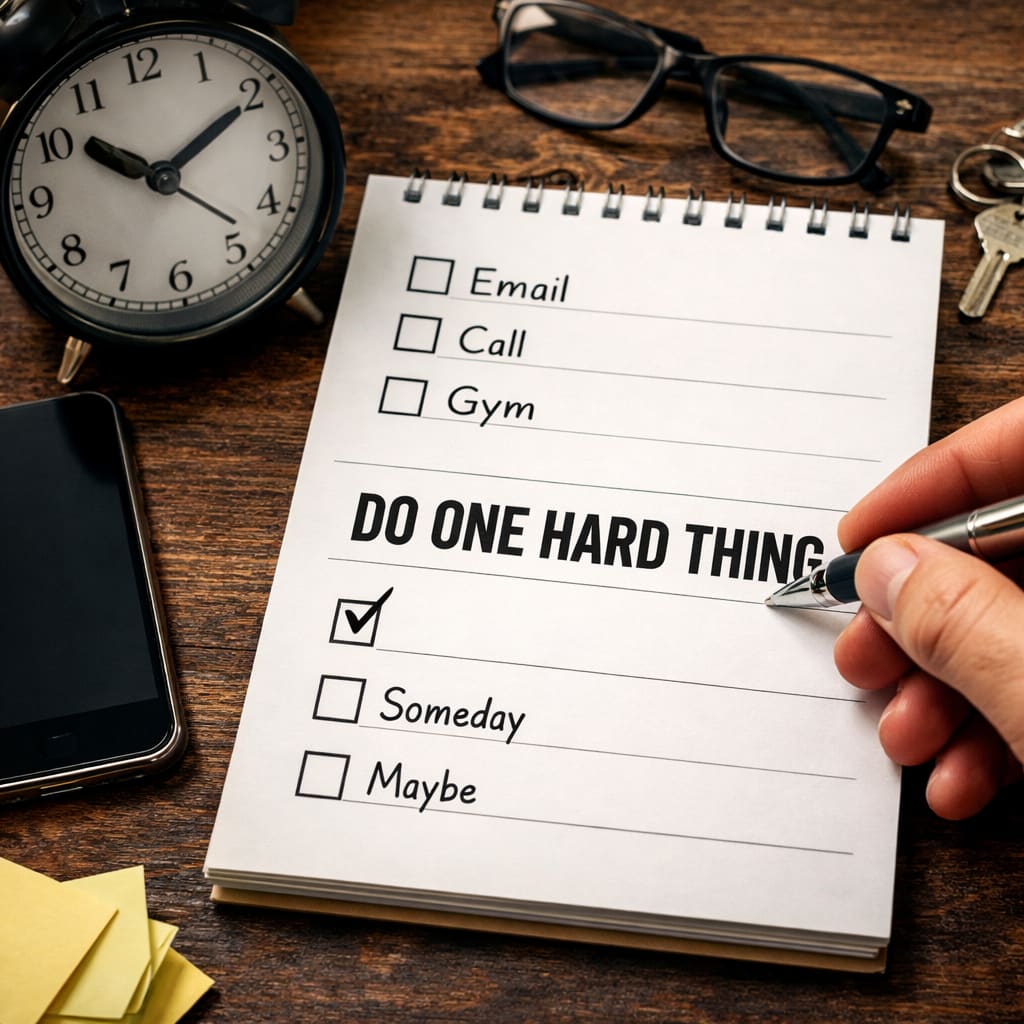
I didn’t realize how much energy I was spending not doing things until I started tracking it.
The email I wouldn’t send.
The form I wouldn’t submit.
The appointment I definitely needed to book—but somehow never did.
None of it was difficult. That was the problem.
I knew exactly what to say. I had the information ready. In some cases, I’d even drafted the message and left it sitting there, unsent, like a dare. The subject line polished. The tone calibrated. Friendly, but competent. Casual, but not careless.
All that remained was clicking “send.”
And yet, every time I thought about finishing the task, my body reacted as if I were about to do something dangerous.
Heart rate up. Thoughts racing. A sudden urge to check the news. Refresh a feed. Reorganize my desk. Do laundry I didn’t care about. Anything except the thing.
So I did what any reasonable adult does when faced with mild psychological discomfort: I postponed it. Tomorrow felt safer. Tomorrow always does.
There’s a popular idea that procrastination is a time-management issue. That if you just optimized your workflow, color-coded your calendar, or downloaded the right app, the problem would disappear. In my experience, that’s rarely true.
I didn’t lack tools. I lacked tolerance.
Most procrastination isn’t about time. It’s about threat.
At some point—not all at once, and not dramatically—I started associating ordinary responsibilities with risk. Saying the wrong thing. Making the wrong choice. Being misunderstood. Being exposed as less capable than I appeared.
Modern life makes this easy. Every email feels permanent. Every form feels like it feeds an invisible system that remembers your mistakes forever. Every interaction carries the faint possibility of screenshots, receipts, metrics, or consequences that outlive the moment itself.
Nothing catastrophic had happened. That was the most confusing part. On paper, my life was fine. I was functioning. Meeting deadlines. Showing up. But my tolerance for friction had quietly dropped to zero.
The smallest obstacles began to feel loaded. A call meant explaining myself. A form meant committing to a choice. An email meant opening a door I couldn’t easily close again.
The result was a strange kind of paralysis.
I wasn’t overwhelmed by big decisions. I was stalled by small ones. The kind you can justify putting off because they don’t seem urgent—until they start stacking up. Until your days become crowded with mental sticky notes, all screaming softly at once.
I noticed it most at night. That low-grade hum of unfinished business. The sense that I hadn’t failed, exactly—but that I also hadn’t moved. I was busy maintaining the appearance of competence while quietly avoiding anything that might challenge it.
What finally helped wasn’t motivation or discipline. It wasn’t a system or a breakthrough insight.
It was lowering the bar.
I stopped asking myself to be productive. I stopped trying to “get back on track,” as if I’d derailed some imaginary version of my life that was perfectly managed and emotionally frictionless. Instead, I picked one task I didn’t want to do and made it the only thing that mattered.
One hard thing.
Not the hardest thing. Not the most important thing. Not everything on the list. Just the one I was avoiding most.
Sometimes it was sending the email. Sometimes it was booking the appointment. Sometimes it was opening a document I hadn’t touched in weeks and reading the first paragraph without fixing anything.
Sometimes it took five minutes. Sometimes it took an hour. Occasionally, it took an entire day of circling the task, building up nerve, calming myself down, talking myself out of talking myself out of it.
But once it was done, something shifted.
The world didn’t collapse. No one called me out. No hidden authority figure appeared to inform me I’d done it wrong. The imagined consequences never arrived.
What did arrive was quieter, but more useful.
Relief.
Space.
A small return of trust.
More importantly, my confidence came back—not in a dramatic way, but functionally. I started trusting myself to handle discomfort again. To survive minor exposure. To be imperfect in motion instead of flawless in stasis.
Doing one hard thing reminded me that avoidance had been costing me more than effort ever did. That the energy spent bracing, deflecting, and delaying far outweighed the discomfort of simply acting.
It also reminded me of something easy to forget in an optimized, over-monitored world: most actions are reversible. Most mistakes are survivable. Most people are too busy managing their own invisible lists to scrutinize yours.
Now, when I feel that familiar resistance—the sudden urge to delay, distract, disengage—I don’t negotiate with it. I don’t analyze it. I don’t try to outthink it with productivity logic.
I pick one hard thing and do it.
Sometimes it’s all I do that day. Sometimes it’s the first step that unlocks the rest. Either way, it’s enough.
The rest usually follows—not because I’ve fixed myself, but because I’ve remembered how to move.
About the Creator
Ю Н
I write restrained, dialogue-driven stories about control, avoidance, and choice—using ordinary moments to explore how people reclaim agency through small, uncomfortable actions.
Keep reading
More stories from writers in Motivation and other communities.
One Hard Thing
Stop me if you’ve heard this one before: You have the number, you know your schedule- you’ve even picked out the perfect day and time to make this appointment. Shoot, you’ve even picked out alternative days and times just in case their schedules can’t accommodate you!
By Taylor Rigsby3 days ago in Motivation
Examples of Integrity in the Workplace That Earn Long Term Respect
Integrity isn't a buzzword. It is a daily activity that influences culture, trust, and reputation. In the modern workplace, integrity describes how people behave when no one is looking and how they make decisions under pressure. Integrity, according to the Bloom Boldly platform, is the unsung force behind successful careers and businesses.
By Bloom Boldly3 days ago in Motivation
The Path to Salvation
The late autumn evening air filled the monk's lungs, but it wasn't the season that chilled his bones. The heavy-handed presence of evil he had sensed upon entering the woods surrounding this mountain village had not bothered to conceal itself from him.
By Made in DNA7 days ago in Fiction




Comments
There are no comments for this story
Be the first to respond and start the conversation.