
Why Don’t We Americans Eat Our Meals Like the British
Like Americans

FOOD FIGHTS
This is a question I’ve been asking my friends for years — yet no one has an answer.
I first learned the difference when I lived in Canada for three years in the mid-seventies. I was there with my then-husband while we studied at the University of Calgary and participated in an almost year-long archaeological dig in northern Sudan.
One of our professors — and leader of our archaeological excavation — was the distinguished Professor Peter Shinnie, renowned for his research and writings on ancient Nubia and his work at the ancient Sudanese townsite of Meroë.
We often dined with our fellow anthropology students from Great Britain, and we were warned that we should quickly learn the continental style of eating before we set off to Meroë with Dr. Shinnie.
Oxford-educated and a former RAF pilot and intelligence officer, Dr. Shinnie was the epitome of British cultured sophistication. He was fluent in Arabic and Greek and was a pioneering researcher and gifted writer.
Although he never spoke of politics around us students, he was known to be a previous member of the Communist Party.
In addition to Shinnie’s exhausting list of accomplishments, he curated the antiquities museum in Khartoum, founded the international journal Kush, and was previously the director of antiquities in Uganda. He had also served as a professor of archaeology at the university in newly independent Ghana — where he succeeded TE Lawrence’s brother, more known as Lawrence of Arabia.
To say we were intimidated by this man would be an understatement. Although he didn’t require the same, he often mentioned in class that when he was a student, his professors regularly assigned readings that were in Greek or Latin.
If students complained, the professors simply told them they should learn the language if they couldn’t find an interpreter. Either that or flunk the class.
Students who’d previously traveled to Meroë with him told us that dining outside under the African sky would become a memorable experience for us. They were right.
Our mud-brick enclosures near the excavation site had no running water or electricity, and our meals were prepared by a Sudanese tribesman who stayed with us throughout the duration of the excavation.
Although we were in the middle of the desert, Dr. Shinnie required that our meals be laid out with a proper tablecloth adorned with nice china and silverware (not sterling, but I wouldn’t have been surprised).
Oil lamps provided our only light, and yes, the sky was so black that the stars looked ten times bigger than they really were. And a full moon seemed to take up half the sky.
And as you might even imagine, we were also served tea sharply at 4:30 every afternoon.
Shinnie will watch the way you eat, we were told. The professor was a stickler for impeccable manners, and it was well known that he considered the American dining style “barbaric.”
It couldn’t have been any less “barbaric” than how we dined below. There’s me (in sunglasses) and two fellow student archaeologists eating lunch at a small diner in a remote Sudanese village. As you can see, we were eating everything by hand. (It’s ful sudani, a dish made of fava beans, cumin, and other spices.)
Being from the American South, I suspected he was already prejudiced against us. He probably imagined that all of us slow-talking, twangy Southerners were hopelessly ill-educated and culturally illiterate.
We quickly learned to navigate this new way of dining, and I’m pleased to report Dr. Shinnie was sufficiently satisfied — maybe even a bit surprised.
After eating continental style for over fifty years, I now concur with Dr. Shinnie’s assessment.
In the U.S., diners hold their fork in their left hand and their knife in the right. Once a bite is cut, the knife is placed back on the plate, and diners then switch the fork over to their right hand — a motion some refer to as a zigzag style.
If you’ve ever noticed, there’s typically a bit (sometimes a lot) of clanging and banging noises when eating American style.
Laura Windsor, author of Modern British Manners and an expert in royal etiquette, says, “When we’re at the table in the U.K., we want to give the least distraction, and we don’t want to make noises, which includes clattering the cutlery on the plate.”
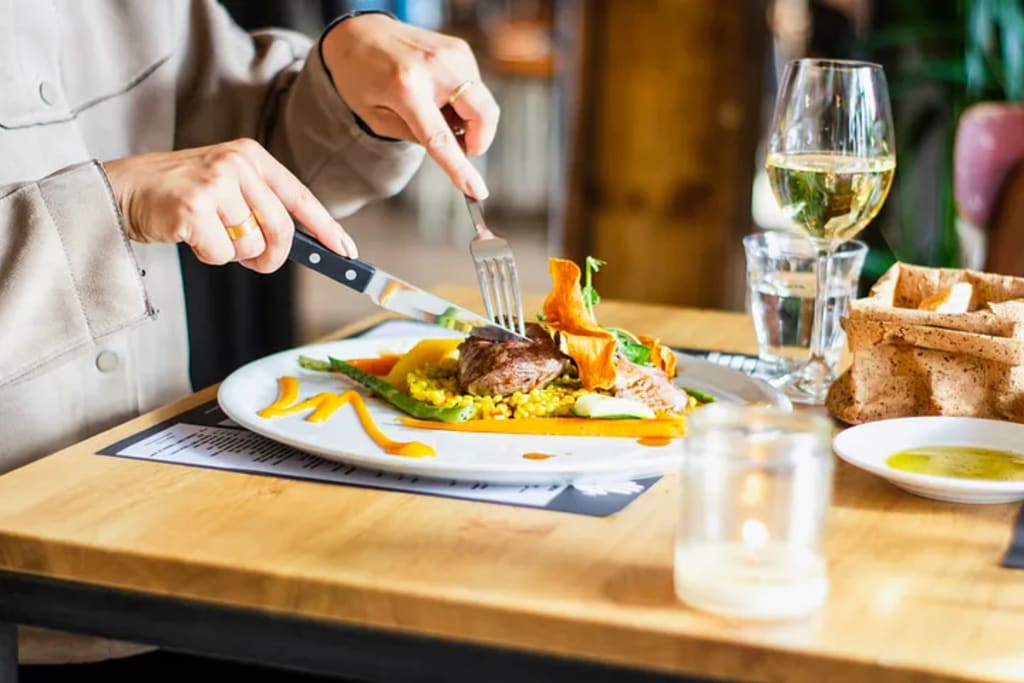
Honestly, the continental dining style is so much more efficient. You hold the fork in your left hand and cut with the knife in your right hand. The knife typically doesn’t leave the right hand, meaning all the pauses and switching of cutlery in the American fashion doesn’t exist in the continental style of dining.
Even worse than our zigzagging, clang-banging eating style, Americans sometimes cut up several pieces of meat (or veggies) before actually eating them. (Ugh!)
This is fine for the kiddos— when you’re three or four years old — but the cutting up of multiple bites does not look classy in other parts of the world.
Windsor says this practice looks less than elegant — which is why you only cut one bite at a time and eat one bite at a time. “We like our small bites. We don’t come to the table to stuff our faces. We come to eat and have conversations with people,” she explains.
A spy who was caught making a cutlery mistake
During WWII, an American espionage agent was spotted by the Gestapo dining in a restaurant in a small French village behind enemy lines.
Despite his training, he made a minor but deadly error. He forgot that Europeans eat their food with their knife in their right hand and their fork in the left.
As he placed his fork in his right hand to eat a nice, juicy bite of steak, the Gestapo agent pounced upon him.
Although this story has been told and retold as a true event, there is no accepted record of a particular spy being caught in this manner — but it certainly could be true!
Conclusion
There are other differences between the American and continental dining styles besides the placement and use of cutlery — including cutlery placement at the end of the meal and the “resting” and “finished” positions of the utensils.
Other differences: when dining in Britain, hands should be kept below the table during the meal when the cutlery is not being used. But in France, according to etiquette experts, this is considered impolite; hands should always be visible at the dining table.
In some cultures, it’s considered rude to leave food on the plate at the end of a meal, yet in others, it’s considered rude not to.
As an American living in the U.S., the only part of the continental dining style I use daily is the holding the fork and knife during meals.
In my opinion, this is the easiest and by far the most efficient way to eat. I don’t know why more of us haven’t adopted this style.
About the Creator
Keep reading
More stories from writers in Motivation and other communities.
One Hard Thing
Stop me if you’ve heard this one before: You have the number, you know your schedule- you’ve even picked out the perfect day and time to make this appointment. Shoot, you’ve even picked out alternative days and times just in case their schedules can’t accommodate you!
By Taylor Rigsby9 days ago in Motivation



Comments (1)
❤️❤️❤️❤️