
When the Forest Held Its Breath
A Winter Tale of Animals, Survival, and Silent Kindness

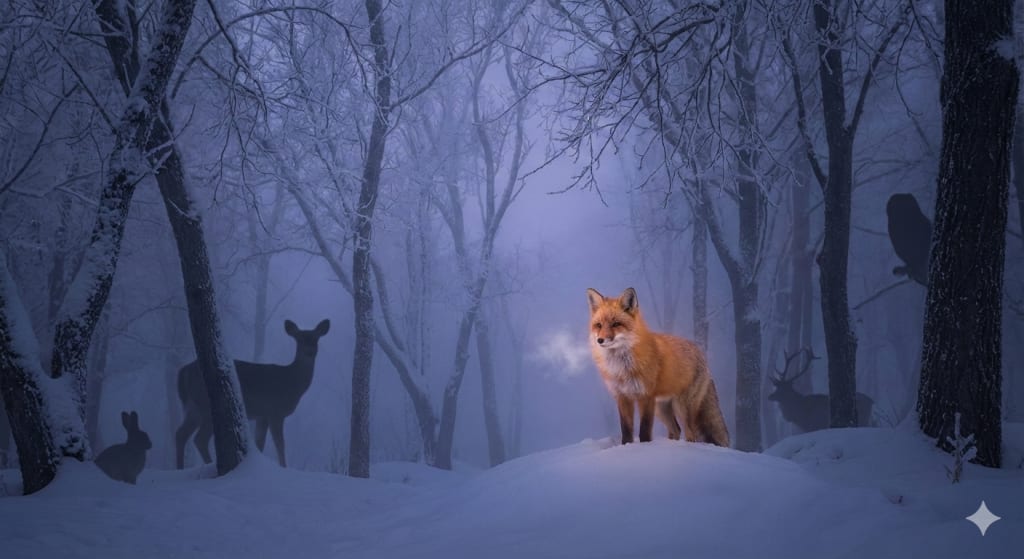
Winter arrived in the forest not as a sudden storm, but as a quiet promise whispered through the trees. The leaves had already fallen, carpeting the ground in shades of gold and brown, and the wind carried a sharper edge each morning. The animals knew what was coming. They always did. Winter was not a surprise—it was a test.
At the heart of the forest stood an ancient oak, its branches bare and stretching toward the pale sky like open hands. Beneath it lived many creatures, each preparing in their own way. The squirrels worked tirelessly, darting back and forth to bury acorns beneath the frozen soil. The rabbits gathered dry grass and lined their burrows carefully. The birds flocked together, discussing in nervous chirps whether to stay or fly south before the cold became cruel.
Among them was Luma, a young fox with a coat the color of burning embers. This would be her first winter alone. Her mother had taught her the basics—how to hunt, where to find shelter, how to listen to the forest—but experience, Luma was learning, was something no lesson could replace. She watched the older foxes with admiration and a hint of fear, wondering if she would be strong enough when the snow finally fell.
Nearby, in a hollow log, lived Bram the badger. Old and slow, Bram had survived many winters, though each one took something from him—strength from his legs, sharpness from his senses. Still, he was wise, and the younger animals often sought his advice. Bram spent his days reinforcing his den, pushing mud and leaves into every crack, preparing for the long months of sleep and silence.
As the first snowflakes drifted down, the forest transformed. Sound softened, and the world seemed smaller, quieter. Food became harder to find. Paths disappeared beneath thick white blankets. Hunger became a constant companion.
One bitter morning, Luma followed a trail that led her farther from home than she intended. The scent of prey was faint, almost teasing. She chased it through frozen bushes and across a narrow stream until the trail vanished completely. When she looked up, panic tightened her chest. The familiar oak was nowhere in sight.
As the sky darkened, the temperature dropped sharply. Luma curled her tail around herself, trying to stay warm. She thought of her mother, of the warmth they once shared in their den. Fear crept in—not the kind that makes you run, but the kind that freezes you in place.
Just then, she heard a soft crunch of footsteps. From behind a cluster of snow-covered rocks emerged Mira, a doe known for her gentleness. Mira had lost her own fawn to a harsh winter years ago and had since developed a quiet watchfulness over the forest’s younger creatures.
“You’re far from home,” Mira said softly.
Luma lowered her head, ashamed. Mira led her to a sheltered grove where the wind was gentler. Though Mira could not offer warmth like a den, her presence was comfort enough. They waited together through the night, sharing silence and strength.
Elsewhere, the winter showed no mercy. A family of mice struggled as their stored seeds dwindled. A raven with an injured wing could no longer fly south and faced the cold alone. Seeing this, Bram emerged from his den despite the pain in his joints. He opened part of his stored food, sharing what he could.
“Winter takes,” Bram said gruffly, “but it doesn’t forbid giving.”
Word spread quietly through the forest. The birds dropped seeds near the mice’s tunnels. The rabbits guided the raven to a warm barn at the forest’s edge. Small acts, hardly noticeable on their own, began to weave a fragile web of survival.
The coldest night came without warning. The moon hung sharp and bright, and the forest seemed to hold its breath. Luma, now back in her territory, heard a faint cry. She followed the sound to find a hedgehog trapped beneath fallen branches, unable to move.
Instinct told her to hunt. Hunger burned in her belly. But something else—something she had learned from Mira and Bram—stirred within her. She pushed the branches aside, freeing the hedgehog, who scurried away without a word.
When spring finally returned, it did so gently. Snow melted into streams, buds appeared on bare branches, and the forest exhaled. Those who survived emerged thinner, scarred, but alive.
Luma stood beneath the ancient oak once more, no longer just a young fox, but a guardian of sorts. She had learned that winter was not only about endurance—it was about connection.
The forest had survived because its animals remembered something important: even in the coldest season, kindness could be the warmest shelter of all.
About the Creator
Keep reading
More stories from Farhad and writers in Motivation and other communities.
The Quiet Strength of My Mother
Some heroes wear uniforms, carry weapons, or stand beneath bright lights while crowds applaud them. But the greatest hero of my life never asked for applause. She worked quietly, loved deeply, and stood strong even when the world felt unbearably heavy. This story is about my mother—a woman whose strength shaped my life long before I understood what strength truly meant.
By Farhad3 months ago in Motivation
The Piggy Project
I’ve had so many names in this life I lose track of which ones were ever really mine and which ones I wore because someone needed me to. Some were handed to me before I had words to refuse them, before I knew what they meant, before I knew I could say no. Most weren’t meant to hurt. That doesn’t mean they didn’t leave marks. Marks that told me who I belong to, who I am by way of who claims me, recognizes me in the good and bad, who walks beside me.
By Fatal Serendipity5 days ago in Confessions




Comments
There are no comments for this story
Be the first to respond and start the conversation.