
When Porn Replaces Real Human Connection
The Digital Mirage and the Hollowing of Human Touch
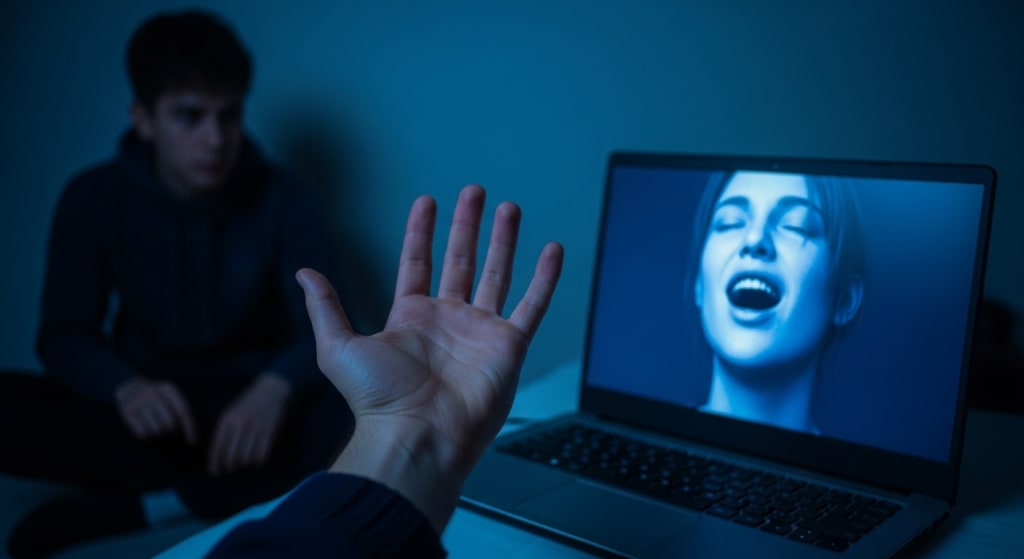
We live in an age of unprecedented access. With a few clicks, we can summon a world of information, entertainment, and, most potently, sexual stimulation. Pornography, once hidden in the shadows, is now a mainstream, multi-billion dollar industry available in the palm of our hand. While debates about its morality and ethics rage on, a more insidious and quieter crisis is unfolding: the gradual, systematic replacement of real human intimacy with a digital facsimile. This isn't a story about vice, but about loss—the theft of vulnerability, the erosion of connection, and the hollowing out of our capacity for true intimacy.
Pornography, in its modern, hardcore iteration, is not simply a recording of sex. It is a hyper-stylized product, engineered for maximum arousal. It operates on a fantasy logic where bodies are perfect, consent is instantaneous and unwavering, and pleasure is a performance divorced from emotion. There are no awkward moments, no whispered conversations, no need for emotional attunement. It’s a world where the complex, messy, and beautiful dance of human connection is reduced to a transactional script.
This is where the theft begins. For the developing brain, especially that of a young person with little to no real-world sexual experience, porn becomes the default textbook. It doesn't just show sex; it defines it. It sets expectations for what bodies should look like, what acts should be performed, and what pleasure should sound like. The problem is, this textbook is a work of fiction. When these scripted expectations collide with the reality of a fumbling, tender, and emotionally charged encounter with another person, the result is often disappointment, anxiety, and performance pressure. The real thing can feel inadequate compared to the flawless, high-octane fantasy.
This creates a dangerous feedback loop. Real intimacy requires vulnerability—the courage to be seen, truly seen, in all our imperfect humanity. It requires communication, patience, and a willingness to navigate another person's unique and sometimes confusing landscape of desire. Porn offers a shortcut, a way to experience a simulation of sexuality without any of the emotional risk. You are in complete control. You can curate the experience, skip the boring parts, and avoid the terrifying prospect of being judged or rejected. Why engage in the difficult, vulnerable work of connecting with a real person when a more intense, less complicated alternative is readily available?
The answer lies in what is lost in that transaction. Intimacy—into-me-see—is the profound sense of being known and accepted by another. It’s built in the quiet moments after sex, the shared laughter over a clumsy moment, the comfort of a hand on your shoulder when you feel insecure. It is the glue of human bonds. Pornography, by its very nature, cannot provide this. It is a one-way street. The pixels on the screen cannot see you, cannot know you, and cannot care for you. The "connection" is an illusion, a neurological trick that provides the dopamine hit of sexual release without the oxytocin-rich afterglow of genuine bonding.
Over time, this can rewire our neural pathways. The brain’s reward system, constantly bombarded with supernormal stimuli, becomes desensitized. The subtle, nuanced cues of a real partner may fail to register, seeming bland in comparison to the exaggerated and relentless stimulation of porn. This can lead to sexual dysfunction, but more profoundly, it leads to relational dysfunction. The consumer may find themselves disconnected, emotionally flat, and unable to muster the same excitement for a real, flawed human being as they can for their curated digital harem. The real world begins to feel like a low-resolution version of the fantasy.
The consequence is a deep and pervasive loneliness. We are social creatures, hardwired for connection. When we substitute the simulated for the real, we starve a fundamental part of our humanity. We may be sexually satiated, but we are intimately malnourished. This loneliness often drives the user back to the very thing that caused it, creating a cycle of isolation that can be difficult to break. It’s a cycle that erodes self-esteem, fosters social anxiety, and builds walls between individuals who desperately crave to let someone in.
Breaking free from this cycle is not about shaming desire, but about reclaiming what has been stolen. It is a conscious choice to choose the difficult, beautiful mess of reality over the sterile, easy perfection of the fantasy. It means relearning how to be vulnerable, how to communicate desires and fears, and how to be present with another person without the filter of performance. It means embracing awkwardness as a part of the journey and seeking connection over mere climax.
The true rebellion in our hyper-connected, yet deeply disconnected world, is to seek out the slow, the quiet, and the real. It is to log off and reach out. To understand that the most profound sensations are not just physical, but emotional—the safety of a trusted gaze, the electricity of a genuine touch, and the unparalleled intimacy of being fully known, and chosen, by another human being, exactly as you are. That is a connection no digital mirage can ever replicate or replace.
About the Creator
HAADI
Dark Side Of Our Society
Keep reading
More stories from HAADI and writers in Motivation and other communities.
The Weight of White
Arthur sat in the cold, a can of flat beer sweating in his grip. The workshop air was thick with the ghost of sawdust and the acrid tang of burnt ambition. It was well past midnight. Outside, the world was muffling itself under a heavy, relentless fall of snow. He hadn’t turned on the heater, couldn't justify the electric bill. His breath plumed in the dim light cast by a single bare bulb hanging over his workbench, illuminating nothing but the stacked failures: unfinished cuts of oak, a half-sanded pew leg, a ledger filled with red ink.
By HAADI13 days ago in Motivation
Looking back: 2025 was a beast
It's difficult to know how to start this. I've suggested that it's been a tough one from my title and in many ways, it has; however, there is an argument that it's not been that extraordinary at all, merely this wonderful thing we call "life" with all its climaxes and pitfalls.
By Rachel Deeming25 days ago in Motivation
What I Learned Too Late
I spent years rushing. Rushing to finish tasks, chasing opportunities, trying to prove myself to the world. I thought success was about speed, about doing more, being more, having more. I believed that if I worked hard enough, life would reward me instantly.
By Fazal Hadiabout 3 hours ago in Motivation


Comments
There are no comments for this story
Be the first to respond and start the conversation.