
What Is Critical Thinking and How It Helps in Daily Life
How to Think Clearly and Make Better Decisions Every Day

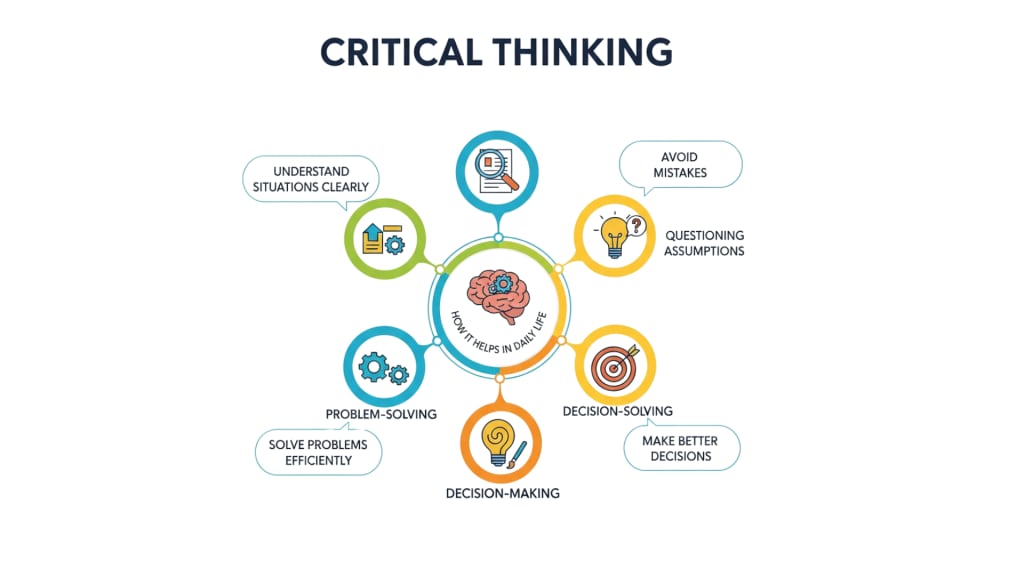
1. Introduction – Why This Topic Matters
In today’s fast-moving world, information comes at us every second — from news, social media, and people around us. With so many voices and opinions, it’s easy to get confused or make quick decisions without thinking deeply. That’s why critical thinking has become one of the most important life skills we can develop.
Critical thinking helps us pause, analyze, and see things clearly before reacting. It allows us to make better choices at work, in school, and even in our personal relationships. As the saying goes, “In a world full of information, knowing how to think clearly is more valuable than ever.”
2. What Is Critical Thinking?
Critical thinking means thinking carefully before you believe or decide something. It helps you look at information, ask questions, and find out if it is really true.
When you use critical thinking, you don’t just believe everything you see or hear. You stop and think, “Is this right? Where did this information come from? Can I trust it?”
For example:
- Before believing news on social media, you check if it comes from a real and trusted source.
- Before buying something online, you read reviews and see what other people say about it.
- Before agreeing with someone’s opinion, you try to understand their reason and check if it makes sense.
In simple words, critical thinking means using your brain, not your feelings, to make good choices. It helps you find the truth, solve problems, and make better decisions in school, work, and everyday life.
3. The Core Skills of Critical Thinking
Critical thinking is not just one single skill. It is made up of many small thinking habits that work together to help you make smart and fair decisions every day. These habits help you understand information, find the truth, and solve problems in a better way.
Let’s look at the main skills that make up critical thinking:
The Main Skills of Critical Thinking
Observation
This means paying close attention to what is happening around you. A good observer notices small details, listens carefully, and collects facts before making a decision.
For example: Before judging a situation, you first watch, listen, and understand what’s really going on.
Analysis
This means breaking big information into smaller parts to understand it better. You look for patterns, reasons, and connections.
For example: If your test results go down, you analyze why — maybe you didn’t sleep well, didn’t study enough, or didn’t understand the topic.
Evaluation (Checking the Truth)
Evaluation means carefully examining information to see if it’s true, fair, or useful. It’s about not believing everything right away — instead, you take a moment to check if it really makes sense.
For example: If you see a post on social media saying something surprising, you might ask:
- “Is this information correct?”
- “Who said this, and can I trust them?”
- “Do other reliable sources say the same thing?”
By doing this, you learn to tell the difference between real facts and opinions or false claims, which helps you make smarter and more confident decisions.
Communication (Sharing and Listening)
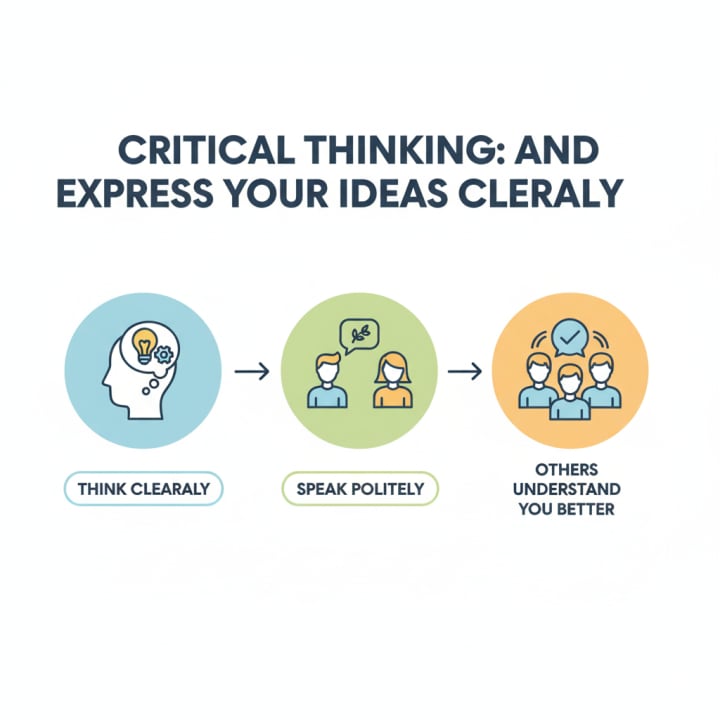
Critical thinking isn’t just about thinking silently — it’s also about expressing your ideas clearly and respectfully. When you can explain what you think in simple, polite words, others can understand you better. Good communication also means listening carefully to other people’s opinions, even if they’re different from yours. By doing this, you can see new sides of a topic, learn new ideas, and improve your own thinking.
Problem-Solving (Finding the Best Solution)
Problem-solving means using all your thinking skills to make smart and safe choices. Instead of reacting too fast, you pause, look at the problem from all sides, and think about different options. Then, you pick the best and most helpful solution.
For example: If something goes wrong at school or at work, instead of getting upset, you think calmly about what caused it and how to fix it. That’s smart problem-solving!
Open-Mindedness (Being Ready to Learn New Ideas)
Open-mindedness means being willing to listen to new or different ideas, even when they don’t match what you already believe. Open-minded people don’t judge quickly — they try to understand others first.
For example: If someone has a different opinion, you listen carefully and think about their point of view. This helps you learn new things, grow wiser, and see the world more clearly.
4. Why Critical Thinking Matters in Today’s World
We live in a digital world where social media, ads, and influencers constantly try to affect what we think, feel, and buy. Many of these messages are made to touch our emotions — not to make us think logically. That’s why critical thinking is so important. It helps protect us from being easily fooled.
Without critical thinking, people can believe fake news, get trapped in online scams, or make emotional choices that hurt them later. But a critical thinker takes a moment to pause and ask:
- “Is this information true?”
- “Who is saying this, and why?”
- “Does this really make sense?”
In daily life, this skill helps you make smarter and safer decisions. In the workplace, it’s even more valuable. Employers love people who can solve problems, analyze situations, and make wise decisions instead of reacting too quickly.
In short, critical thinking is not just about how you think — it’s a life skill and a career strength that helps you succeed in the modern world.
5. How Critical Thinking Helps in Everyday Life
Critical thinking isn’t only for classrooms or offices — it’s something that helps you every single day. It guides your choices, your emotions, and even how you deal with people. Here’s how it makes life smoother and smarter:
🛒 Smarter Decisions: Before buying something, you take time to compare prices, read reviews, and think about real value, not just what looks attractive.
🤝 Better Relationships: When you face disagreements, you listen first and think before replying, which helps you stay calm and communicate with respect.
💰 Wiser Financial Choices: You question your spending habits — asking, “Do I really need this, or should I save for something more important?”
🧘 Emotional Control: Critical thinking helps you pause and think before reacting. You understand your feelings better and manage stress more peacefully.
🎯 Stronger Goal Setting: You set clear, realistic goals and plan practical steps to reach them, instead of rushing or giving up too soon.
In simple words, critical thinking helps you live smarter, calmer, and more confidently every day.
6. Steps to Improve Critical Thinking
Anyone can learn to think more clearly and deeply — it just takes practice and a few simple habits each day. Here’s how you can start improving your critical thinking skills:
🔹 Ask Questions Instead of Accepting Things Blindly
Don’t believe everything you hear or see right away. Always ask questions like “Why?”, “How do I know this is true?”, or “Who is saying this and why?”. This helps you look beyond surface information.
🔹 Seek Different Opinions and Analyze Both Sides
Listen to people who think differently from you. Understanding other viewpoints helps you see the bigger picture and strengthens your reasoning.
🔹 Practice Mindfulness and Reflection
Spend a few minutes each day thinking about your actions, feelings, or decisions. Reflecting calmly helps you understand yourself better and avoid quick judgments.
🔹 Read Widely and Think Independently
Read books, articles, and news from various reliable sources. The more perspectives you explore, the sharper your thinking becomes — and you learn to form your own informed opinions.
🔹 Build Small, Daily Habits
Write your thoughts in a journal, discuss ideas with friends, or solve brain puzzles. Small challenges like these train your brain to think logically and creatively.
With these simple steps, you’ll slowly develop the clarity, confidence, and logic that define a true critical thinker.
7. Common Barriers to Critical Thinking
Even when we try our best to think clearly, certain habits or emotions can get in the way. These are called barriers to critical thinking — and understanding them helps us avoid mistakes.
⚠️ Biases and Emotions
Sometimes our feelings or past experiences make us see things only our way. When emotions control us, we stop thinking clearly and fairly.
⚠️ Overconfidence
When we think we’re always right, we stop learning. If we don’t listen to others or admit mistakes, we miss new ideas and ways to get better.
⚠️ Lack of Reliable Information
If we decide without checking facts or believe false sources, we can get confused and make wrong choices.
💡 How to Overcome These Barriers
To think clearly and make good decisions, it’s important to keep an open mind. Try to look at things from different sides, not just your own point of view. Everyone has feelings and opinions, but we should not let them control how we think.
Before believing any information, take a little time to check if it’s true. Look for trusted sources like books, teachers, or reliable websites. Don’t just believe everything you hear or see online — some things can be wrong or confusing.
Also, remember that it’s okay to make mistakes. Nobody is perfect. When you find out you’re wrong, admit it and learn from it. That’s how smart people grow and improve. Each mistake teaches us something new and helps us become wiser and more confident in the future.
So, stay curious, ask questions, check the facts, and always be honest with yourself. That’s the best way to overcome these barriers and become a better thinker.
8. The Real-Life Benefits of Critical Thinking
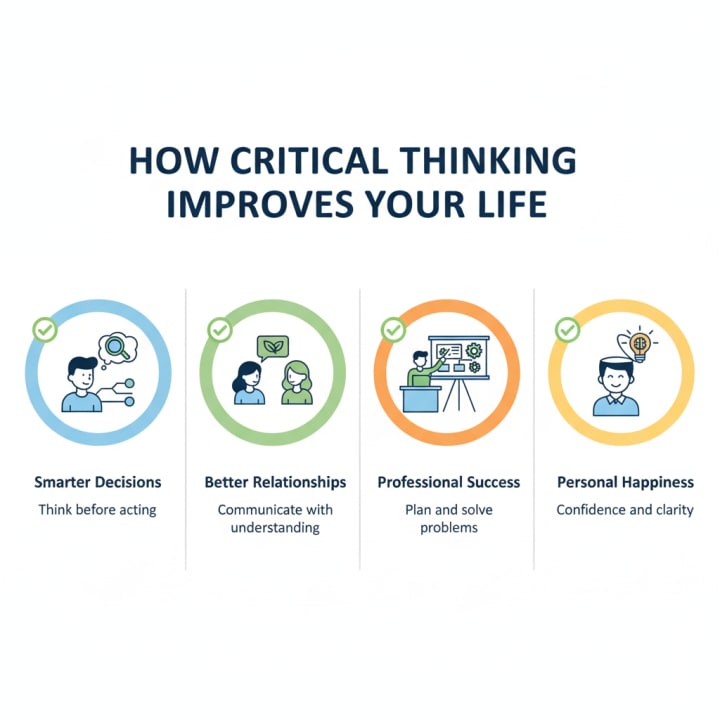
When you practice critical thinking, your life improves in many ways — both big and small:
✅ Smarter Decisions: You think before acting, reducing regrets.
✅ Better Relationships: You communicate with understanding, not anger.
✅ Professional Success: Leaders use critical thinking to plan, solve problems, and make fair choices.
✅ Personal Happiness: A clear mind leads to less confusion and more confidence.
Critical thinking doesn’t make life perfect, but it helps you make choices that truly match your values and goals.
9. Conclusion – The Mindset of a Critical Thinker
Critical thinking is not just a skill — it is a way of thinking about life. It teaches you to pause and think carefully before you believe or do something.
In today’s world, we hear many opinions, news, and emotions every day. Critical thinking helps you stay calm, fair, and smart when you face all this information.
When you think critically, you don’t just live your life — you understand it better. You make better choices, solve problems wisely, and see the truth more clearly.
In simple words, a critical thinker is someone who uses reason, asks questions, and always looks for the truth.
About the Creator
Bilal khan
Welcome to my corner on Vocal Media! I bring you inspiring journeys of great people, useful life hacks, and ideas to help you learn, grow, and stay motivated.
Keep reading
More stories from Bilal khan and writers in Motivation and other communities.
How A Poor Boy Created Rolls-Royce
Rolls-Royce makes some of the most beautiful and expensive cars in the world, and rich people dream of buying one. But what many people do not know is that the story of this luxury car began with a poor little boy who spent his childhood in hardship, working as a child laborer.
By Bilal khan 5 months ago in Motivation
The Light Beyond the Fog
In the quiet coastal town of Whitby in northern England, where the sea winds often carried thick morning fog, lived a young man named Daniel Mercer. Whitby was beautiful but small, and for many young people it felt like a place where dreams arrived slowly—or not at all. Daniel grew up in a modest home above his mother’s small bakery. The smell of fresh bread and cinnamon rolls filled the air every morning before sunrise. His mother worked tirelessly, kneading dough while the town still slept. Daniel admired her strength, but deep inside he dreamed of something bigger. He wanted to become an engineer. Ever since he was a child, Daniel loved building things. Broken radios, old bicycles, discarded machines—he collected them all and tried to understand how they worked. His tiny bedroom slowly turned into a workshop filled with wires, screws, and small tools. But dreams are rarely easy. When Daniel finished secondary school, he applied to several universities. Weeks passed, then months. One by one, the letters arrived. Rejection. Another rejection. And another. Daniel sat quietly at the kitchen table staring at the final letter. His mother placed a warm cup of tea beside him. “Dreams don’t end because a door closes,” she said softly. “Sometimes they’re just asking you to find another way in.” Daniel nodded, but doubt filled his mind. Many of his friends had already found jobs in nearby towns. Some told him he was chasing an impossible dream. For a while, Daniel worked at the bakery with his mother. Every morning at 4 a.m., he helped prepare bread and pastries for the day. It was honest work, but each time he passed his old workshop corner, he felt the quiet ache of unfinished dreams. One rainy afternoon, while repairing the bakery’s old electric mixer, Daniel had an idea. The machine was inefficient and consumed too much electricity. With a few adjustments and a small motor he built himself, Daniel managed to reduce the energy use by almost half. His mother was amazed. Soon, nearby shop owners began hearing about Daniel’s small invention. A café owner asked if he could fix their coffee grinder. A butcher wanted help improving his refrigeration unit. Daniel started spending evenings repairing and improving machines for local businesses. What began as small favors slowly turned into a growing reputation. One day, a professor from a technical college in Leeds visited Whitby and stopped by the bakery. He heard about Daniel’s mechanical talent and asked to see his work. Daniel nervously showed him his workshop—small, messy, but full of creativity. The professor smiled. “Talent like this shouldn’t stay hidden,” he said. Within months, Daniel received an offer to study engineering at the college with a partial scholarship. For the first time in years, Daniel felt the fog lifting. University life was challenging. Many of his classmates had advanced education and expensive equipment, while Daniel had only his determination and experience from the bakery workshop. But he worked harder than anyone else. Late nights in the laboratory. Early mornings studying designs. Weekends building prototypes. Three years later, Daniel graduated with honors. Soon after, he launched a small startup focused on designing energy-efficient machines for small businesses—bakeries, cafés, and restaurants across Europe. The idea was simple: help small family businesses reduce energy costs and operate more sustainably. Within five years, Daniel’s company expanded across the United Kingdom, Germany, and France. His technology helped hundreds of local businesses save money and reduce electricity consumption. Yet despite his success, Daniel never forgot where he started. Whenever he visited Whitby, he still woke up early to help his mother in the bakery. The same mixer he had once repaired now sat proudly in the corner, still running smoothly. Looking at it, Daniel often remembered the moment when everything seemed lost. Success, he realized, is not about avoiding failure. It is about continuing forward when the path disappears into fog. Because sometimes, the light that guides us forward isn’t waiting somewhere far away. Sometimes, it’s something we build ourselves.
By Iazaz hussain4 days ago in Motivation
Four years after fleeing domestic violence
(Trigger warning: This article covers the topic of domestic violence. If you or someone you know needs help, please contact the National Domestic Violence Hotline for help https://www.thehotline.org/ 1–800–799–7233)
By Kristine Franklin6 days ago in Motivation




Comments
There are no comments for this story
Be the first to respond and start the conversation.