
Three Billion Solutions
The relieving side to the famed Rubik's Cube

“Over three billion combinations… only one solution,” read the box of gold and black. For years in my adolescence I marveled at the beauty of it. The vivid colors that were printed on each individual cube, and how beautiful it looked when it was solved straight out of the box. The untouched texture of the stickers, the smell of the plastic; it was blissful to me. Even the thought of scrambling such a work of art made my stomach tie in knots. It was because I knew in my mind that once I decided to mix the pieces, the aesthetically pleasing glow of the solved cube would then become a jumbled puzzle of whites, blues, reds, yellows, oranges, and greens. I would never have guessed that I would be able to actually solve a puzzle that has such an enormously high number of possible twists, turns, and permutations. Yet here I am nearly a decade later; an avid collector and solver of Rubik’s Cubes.
I began purchasing Rubik’s Cubes at a young stage in my life. It was always the coolest gift to me. I grew up distanced from most of my family, especially on my mother’s side, and whenever my relatives didn’t know what to get me, they would always send me a Rubik’s Cube. At the time, I never knew exactly how to solve it… Hell, I couldn’t even get one side correct. But the importance of what I saw in the cube was what really made it matter to me. I saw the cube as a work of art, rather than a toy. I truly appreciated being able to gaze at its many colors, and even though I didn’t know how to place matching colors next to each other, it still pleased me to twist and turn the sides of the cube. But year after year I started coming to a realization: I have so many of these damn cubes, and I don’t even know how to solve one!
It was at this time when I decided that I would become a Rubik’s Cube expert; a virtuoso in the art of cubing. I found a very significant desire within myself to finally return all of these cubes to their alluring primal state, matching stickers and all. At a mere ten years old, I began plotting how exactly I would understand the knowledge it took to solve the cube, and it overwhelmed my tenacious little heart. In fact, I was so excited every time I opened a newly packed Rubik’s Cube that I would obliviously thrash through the packaging without noticing that the solution formulae lay inside it too. Knowing I had no old boxes left over, I turned to YouTube to guide me, and that’s what birthed my fascination with solving and completing Rubik’s Cubes. I “favorited” the solution videos that were posted, and would stay up day and night practicing the solutions (formally called algorithms) that restored the scrambled cube.
When I first discovered that these algorithms were the key to decoding the Rubik’s puzzle, I didn’t believe it. I was also very young and I didn’t quite grasp the concept of algorithms and how they were used to solve not only Rubik’s Cubes, but much more complex things like computer software and even mathematics. At first this revelation deflated my excitement about finally solving the cube. The algorithms proved very difficult at first because I had to remember them in sequence, otherwise it would not compute on the cube. One wrong turn, and I was back at square one looking at a disarranged disco-ball. Of course, I made plenty of mistakes when first learning the correct sequences, and this irritated me very much. I actually became so infuriated that I learned how to disassemble the cube into pieces and reassemble it in order to satisfy my own urge to “solve” the cube. I convinced myself that I needed to know the cube “inside and out” to fully understand how the cube operated. It made me think that I wasn’t intellectually advanced enough to solve it on my own, and that I needed to lean on these algorithms to solve the cube instead of just using my wits and intuition. But then I began to think about how ingenious it really was, and how it could be used on cubes of greater dimensions, like the 4 x 4 cube, and the 5 x 5 cube, and so on and so forth.
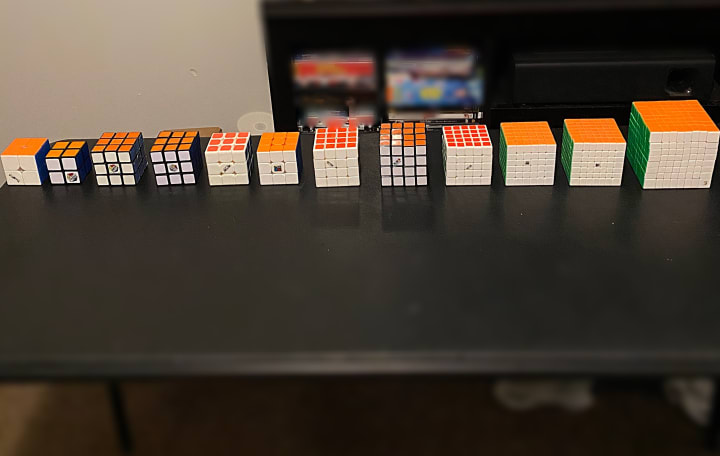
The original Rubik’s cube was a 3 x 3 cube, and it’s the acclaimed golden standard in cubing. This made me appreciate it even more because that is where my passion truly started. When moving your way up the dimensional food chain, you learn some new algorithms and techniques, but you always end up shaping the cube to fit the basic form: the 3 x 3 cube. In other words, you end up turning the larger cubes like the 4 x 4 and 5 x 5 into a larger version of a 3 x 3, and it solves just the same! I became so overwhelmed with joy when I realized this. It compelled me to purchase basically every cube that was created by Rubik’s. I didn’t know how I was going to solve them, I just knew that I wanted to learn. I never was one to get excited about learning, and this was truthfully the first time I became ecstatic about educating myself about something, regardless of whether it was scholastic or not.
As the years progressed, I became more adept at cube solving. I practiced algorithms for years and years. I would twist and turn the cubes until my hands were cramping, until the stickers’ adhesive decayed and peeled off at the corners, until the pieces would literally fall off; I loved it. It took me ten more years to comprehend just how significant the Rubik’s Cube meant to me. As a child I was diagnosed with Generalized Anxiety Disorder, or GAD for short. I also was diagnosed with another condition known as Obsessive Compulsive Order (OCD). Both of these issues were very difficult for me, but I always attempted to quell the feelings of panic and angst that roared within myself. I didn’t let it defeat me. I would go on to try a wide array of activities such as video games, sports, making friends, etc. However, none of them ever seemed to sufficiently relieve the storm that raged on in my head. And after all of my efforts had been exhausted, and I sat back in awe of how persistent my illness was, I realized that there was always one constant that brought me joy and tranquility: cubing.
Jittering the leg up and down while in a sitting position is a very good comparison to the relief that I experience when I cube. It's something that is very simple, but just as equally effective in soothing anxiety and excess energy. With each turn of a face, there is a simultaneous therapeutic effect that occurs in my brain. There is a connection that travels from the neurons in my brain, down through the veins of my arms, into the very bones of my hands. That connection is euphoric to me. The raging sinusoidal wave that started as my anxiety slowly dissipates, the peak slowly meets the trough, and then the freedom bell rings. I am finally unchained from the constant worrying and despairing, the tremors that shake my body, the butterflies that plague my stomach, and suddenly the instant-gratification takes my mind hostage. I become wholly entranced in the process of solving the cube, and each step that I take to solve it only adds to my eagerness to admire the finished product. There are several stages involved when solving a Rubik’s Cube, and that is perhaps why it intrigues me so remarkably. Maybe it is because I know what the end result of all of those stages will produce, or perhaps it is the process of engaging in each step that is therapeutic to me, I haven’t quite come to a conclusion yet. But perhaps the most perplexing idea that I have taken from my passion for cubing is remembering the saying, “over three billion combinations… one solution,” and correlating it to some of life’s most prudent questions. Perhaps there are three billion ways not to solve a particular issue, but there is only one. Or perhaps there are many situations that just require a very specific sequence of steps, like an algorithm, to actually solve the issue properly. One thing is for certain, I have found my one solution!
About the Creator
Keep reading
More stories from Zackery Hansen and writers in Motivation and other communities.
Deadly Dusk
As he opened his eyes, all he could think about was the intense ringing that pierced his inner ear. Trying to catch his bearings, he slowly looked up to see the cloth ceiling of the car that he lay in. Suddenly he realized that he was upside down, and it all came back to him; the spikes in the street, the screeching of the tires, the thud of his head bashing the steering wheel... he was stuck. The ringing started to dissipate, and he began to hear something much more sinister: the haunting moans and violent clanging of the zombies hitting the windows. He now knew the situation he was in, and began plotting his escape. He searched his person for any weapons that he could use and felt the cold steel of his 44 magnum pistol which was holstered on his left side.
By Zackery Hansen5 years ago in Fiction
One Hard Thing
Stop me if you’ve heard this one before: You have the number, you know your schedule- you’ve even picked out the perfect day and time to make this appointment. Shoot, you’ve even picked out alternative days and times just in case their schedules can’t accommodate you!
By Taylor Rigsby4 days ago in Motivation




Comments
There are no comments for this story
Be the first to respond and start the conversation.