


When I was younger, I made it a habit to regularly engage in in-depth conversation with elderly people, if for no other reason than to learn the life lessons and hear the anecdotes they had to share. I attempted to recall a particular reason why I argued for such a regimen, but it slipped my mind. I don't know why I did it. It's possible that this is due to the fact that they were less busy and more extroverted than my own parents, who were more quiet. I can't recall the reason why I first started doing it, but it appears to be a routine that I've kept up into my senior years. It is always intriguing to hear other people's viewpoints on life's many different challenges and topics, which is one of the primary reasons why I find it so interesting to engage in these kinds of conversations. During the course of setting up meetings with the aforementioned individuals and discussing a wide range of topics with them, I discovered, much to my utter surprise, that corporate vice presidents, executive directors, CEOs, firm owners, and even entrepreneurs are, in fact, fairly simple folks. This was something that completely blew my mind. My surprise was quite clear to everyone. They don't make things more complicated than they need to be when they're attempting to get others interested in what they have to say, when they're presenting themselves, or when they're giving their thoughts to other people. They are considerably easier to get in touch with compared to managers at lower levels, which makes it much simpler to have any type of conversation with them regarding certain issues.
As you move up the levels, you will see that you are being bombarded with an increasing amount of irrelevant material that does not contribute anything to the conversation. It is for this reason that people working at higher levels of the organization, such as executives, have a greater likelihood of being successful in their employment than those working at lower levels. When we are trying to think about something or make a decision, one of the typical mistakes that we make is that we add an excessive amount of particular information to the process that we are trying to think about. We added some of our own feelings into the mix, as if the circumstance wasn't already dangerous enough on its own. Exams in higher education are similar in that they purposefully present a vast amount of information that is not pertinent to the question at hand in order to evaluate a student's ability to sift through the material and determine which aspects of the information are relevant. Acquiring knowledge that is pertinent to the issue at hand is necessary in order to arrive at the correct response. This is exactly how life is now treating us. In the end, it is up to us to decide whether we want to simplify life by concentrating on the essential facts or make things more difficult. Our responses to the information we get determine the level of success we achieve in all we do.
People who are exceptionally productive tend to reduce the hurdles that their job presents with the aim of optimizing their output, which may be accomplished by keeping things as simple and easy as is practically possible. The establishment of such a routine is not as simple as it appears at first glance. You'll need to exercise a great deal of patience while it's being put together. We can keep the amount of information stored in our working memory within acceptable limits if we keep our ideas as simple and uncomplicated as possible. In spite of the fact that our sensory organs have a limited capacity, our minds are constantly bombarded with more information than they can efficiently process. George Miller, a psychologist, came up with a theory that became known as the "seven plus or minus two rule." This theory proposes that an individual's short-term memory can only store a total of seven items of information at once.
Just keep in mind that the amount of time you spend worrying about minor details in any one work will reduce your overall efficiency. People driven to achieve their goals are aware of this fact, and as a result, they put in a lot of effort to simplify their processes whenever and wherever they can. Blogger Leo Babauta stated that the process of simplicity might be broken down into two steps: first, determining what is necessary, and then acting only on that understanding. Take out the remaining items from the contents. Keeping things simple and uncomplicated allows your mind to perform at its highest potential. Try it.
About the Creator
Dr. Sulaiman Algharbi
Retired after more than 28 years of experience with the Saudi Aramco Company. Has a Ph.D. degree in business administration. Book author. Articles writer. Owner of ten patents.
Instagram: https://www.instagram.com/sulaiman.algharbi/
Keep reading
More stories from Dr. Sulaiman Algharbi and writers in Motivation and other communities.
Be You
In the vast tapestry of our modern society, which often propels us towards conformity, it's all too easy to blend into the background. But pause for a moment and consider this compelling notion: true fulfillment and happiness may not reside within the confines of the ordinary. What if you could shatter the chains of normalcy and transform into a figure of extraordinary significance, leaving an indelible imprint on the world? Let's embark on a journey of discovery, exploring how the celebration and embracing of individuality can pave the path to a life teeming with miracles.
By Dr. Sulaiman Algharbi2 years ago in Motivation
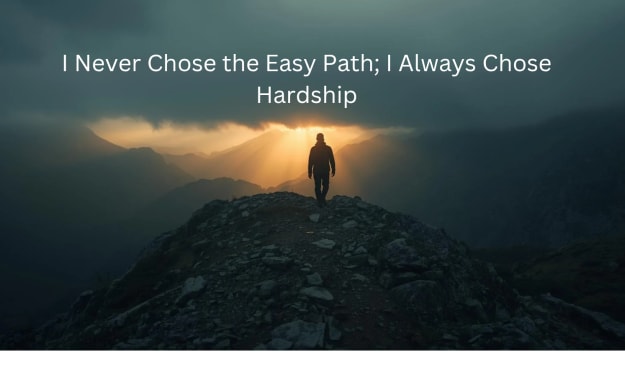
I Never Chose the Easy Path; I Always Chose Hardship
From the earliest memories I can recall, life presented me with two roads. One was smooth, inviting, and well-trodden—a path that promised comfort, approval, and ease. The other was rough, rocky, and uncertain—a path of struggle, obstacles, and lessons that demanded effort, patience, and resilience. I never chose the smooth road. I never took shortcuts. Not because I was fearless, but because something deep inside refused to let me live a life that wasn’t earned. The easy path whispered promises of fleeting satisfaction, fleeting success, and fleeting recognition. It was tempting. Many around me chose it, and I often wondered if I was foolish for ignoring it. But I learned early that true growth is rarely convenient. The easiest choice often leads to emptiness, to regret, to a quiet knowing that you could have been more than you allowed yourself to be. Hardship became my teacher long before success ever noticed me. The lessons it offered were harsh, uncompromising, and often lonely. There were days when choosing the hard path felt like choosing isolation. While others were celebrated for small accomplishments, supported by friends and family, I walked in silence, with doubt as my companion. Progress was invisible to the world. Failures were frequent and relentless. Many nights, I returned home tired, my heart heavy, my mind questioning why I even bothered. Yet even in that silence, I was being shaped. I was learning the value of persistence, of dedication, and of refusing to give up on myself. The hard path forced honesty. It refused to allow excuses. It stripped away illusions and pretenses. I was left face-to-face with my limits, my fears, and my own humanity. On this path, I discovered strengths I never knew I had: patience I had never cultivated, resilience I had doubted, and self-respect that grew every time I stood up instead of walking away. These were not lessons that could be taught in comfort. They were only learned in struggle, in challenge, and in the quiet persistence of refusing to quit when no one was watching. I remember one time vividly. I had a goal that seemed impossible—one that required me to sacrifice comfort, leisure, and social approval. The easy path was right there: a way to avoid the challenge, to be “okay,” to follow what others had done before me. Many advised me to take it. “It’s safer,” they said. “It’s simpler,” they said. But I could feel, deep inside, that taking the easy way would leave me empty. I chose the hard path. The journey was grueling. Every step felt like pushing against gravity. But with each challenge, I gained more than I ever would have on the easy road. I gained endurance, confidence, and an understanding that real achievement is never handed—it is earned. Strength, I realized, isn’t loud. It doesn’t announce itself. It grows quietly, in the moments no one sees—the early mornings, the long nights, the repeated failures, the times you push forward when giving up would be understandable. Resilience is not simply surviving; it is deliberately choosing to continue, to stand again, to pursue the path that tests you the most. It is knowing that walking away is easier but will never lead to the person you are capable of becoming. I have walked many hard roads in life. Each one was different, yet the lessons were the same: comfort cannot teach endurance, shortcuts cannot teach discipline, and fleeting success cannot teach respect. Every struggle, no matter how small, adds to your character. Every failure is a mirror that shows you who you really are. And every choice to face hardship instead of fleeing builds a foundation that lasts long after temporary victories fade. There were times when I felt truly alone. People around me often misunderstood my choices. Friends, family, colleagues—they all questioned why I refused the easy way, why I worked harder, why I pushed myself beyond what seemed necessary. They didn’t see the growth happening quietly inside me. They didn’t see the small victories, the lessons learned, the resilience being forged. But eventually, the results spoke for themselves—not in a loud announcement, but in the quiet confidence and self-respect that I had built from the inside out. Life, I have learned, rewards those who endure hardship. Not always immediately. Not always visibly. But it rewards those who persist, who face struggle head-on, and who refuse to settle for anything less than becoming their fullest selves. Success that comes without effort is temporary; strength and self-respect are eternal. Hardship tests us, but it also teaches us. It shows us the depth of our own courage, the strength of our will, and the power of refusing to surrender. The lessons of the hard path are subtle, often invisible, and always lasting. I learned that failing is not shameful; failing is a necessary step toward mastery. I learned that enduring pain, even when no one notices, builds a type of strength that comfort never can. I learned that the more difficult the path, the deeper the reward—not measured in wealth or fame, but in character, wisdom, and self-respect. Every choice to embrace struggle instead of avoiding it shaped me. Every sacrifice, every extra hour, every moment of doubt faced instead of ignored, added to the foundation of the person I am today. My life was not easy. It was messy, unpredictable, and often overwhelming. But it was authentic. It was mine. And through hardship, I became resilient. I became someone who can face challenges without fear because I have faced them before. I became someone who respects themselves because I have honored my own effort. I became someone capable of growth because I refused to choose comfort over character. I often reflect on the people around me who chose the easy path. Many of them achieved quick victories, immediate recognition, and temporary peace. But over time, I noticed something important: the victories were shallow, the peace fleeting, and the growth minimal. They lacked the depth of resilience, the quiet power of self-respect, and the profound satisfaction that comes from knowing you endured, you learned, and you became someone stronger. Choosing hardship is not glamorous. It is not celebrated in real-time. It is often lonely, exhausting, and demanding. But it is transformative. It shapes your mind, your heart, and your spirit in ways comfort never can. It teaches discipline, patience, humility, and courage. It makes failure meaningful, effort valuable, and success earned. The hard path is where true people are made—people who understand that life’s challenges are not punishments, but opportunities. Opportunities to become better, stronger, wiser, and more capable. I never chose the easy path. I always chose the harder road, the one that tested me, the one that demanded effort, and the one that required me to face myself honestly. I walked through fear, doubt, exhaustion, and setbacks. I fell, and I got up. I failed, and I tried again. I cried, I questioned, I endured. And through it all, I became someone I could respect, someone who knew the value of persistence, someone who understood that hardship is not the enemy—it is the greatest teacher. Today, I measure success differently. I do not measure it by comfort, convenience, or ease. I measure it by growth, resilience, and the depth of self-respect I have cultivated. I measure it by how I faced challenges I could not ignore, how I embraced struggles that seemed unbearable, and how I refused to take shortcuts at the cost of my own becoming. I never chose the easy path. I chose the one that made me resilient. I chose the one that taught me self-respect. I chose the one that allowed me to become the person I am today. And if I had the choice again, I would choose the hard path every single time. Because the road of struggle is not only a journey—it is the making of a human being.writing...
By Ihtisham Ulhaq5 days ago in Motivation



Comments
There are no comments for this story
Be the first to respond and start the conversation.