
The University of the Dirt Road: Rosa Quispe’s Marathon for a Single Word
In the high Andes of Peru, a mother who couldn't read the alphabet decided that the mountains would not stop her son from learning it. For four years, she turned a ten-kilometer trek into a daily act of defiance against destiny.

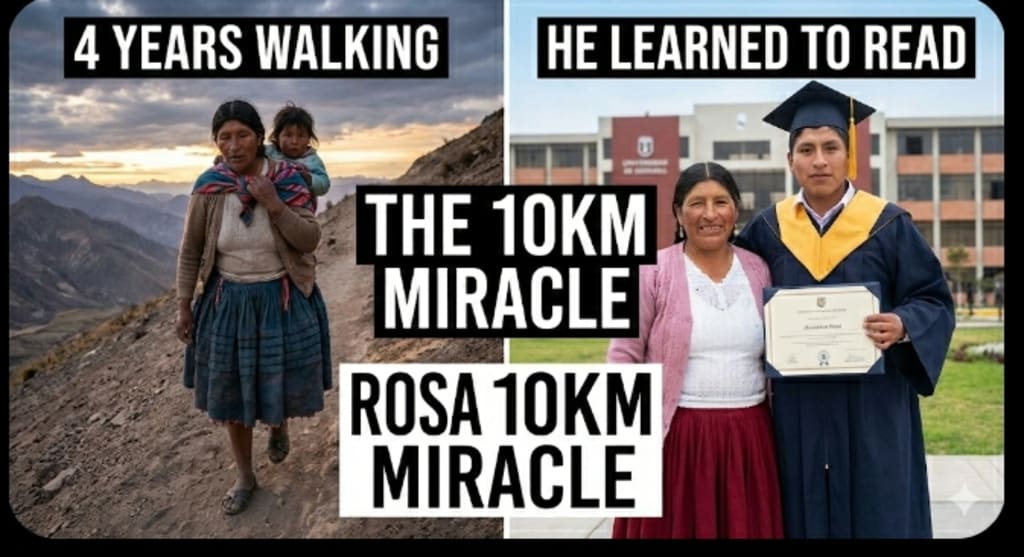
The inspiring true story of Rosa Quispe, a Peruvian farmer who walked 10km a day for four years so her son with a learning disability could access education.
Introduction: The Oxygen-Starved World
To understand this story, you must first understand the geography.
The village of Chillihuani lies high in the Peruvian Andes, nearly 4,000 meters (13,000 feet) above sea level. The air here is thin. It offers half the oxygen found at the beach. The wind does not blow; it cuts. The landscape is a monochrome of brown earth, gray stone, and the stark white of distant glaciers.
It is a place where survival is the primary occupation. Education is a luxury.
Rosa Quispe was a woman of this earth. She was short, with skin weathered by the ultraviolet sun and hands calloused from pulling potatoes out of the frozen ground. She wore the traditional polleras—the heavy, layered wool skirts of the region—and sandals made from recycled tires, known as ojotas.
Rosa could not read. She could not write. To her, a book was a mysterious object, a brick of paper that held secrets she was locked out of.
But Rosa had a son named Mateo.
And Mateo had a problem. Or, as the village saw it, a defect.
Part I: The Verdict
Mateo was seven years old, but he did not speak like the other children. He struggled to focus. He couldn't hold a pencil correctly. In the small, one-room schoolhouse in the village, he was a disruption.
The teacher was not cruel, but he was overwhelmed. He had forty students and no resources.
One afternoon, he called Rosa to the door.
"Señora," he said, looking at his boots. "Mateo... he is not like the others. He is lento (slow). He cannot learn here. He just stares at the wall. It is a waste of his time, and yours."
Rosa listened. She didn't argue. In her culture, you did not argue with men in suits or teachers with books.
"Take him to the field," the teacher suggested. "Teach him to farm. That is a good life. It is the life you have."
Rosa took Mateo’s hand and walked home.
The path was steep. Mateo tripped over his own feet. He looked up at her with wide, brown eyes that held a universe of confusion. He knew he had failed, but he didn't know why.
Rosa looked at her son. She looked at the mud on his knees.
She remembered the feeling of signing a document with a thumbprint because she couldn't write her name. She remembered the shame of asking strangers to read medicine bottles for her.
She looked at the mountains that walled them in.
"No," she whispered to the wind. "Not him."
Part II: The Map of Impossible
Rosa asked questions. She went to the market in the valley. She asked the priest. She asked the shopkeepers.
Eventually, someone told her about a program. There was a school in the town of Sicuani that had a teacher trained in "special needs." They taught children who learned differently.
But Sicuani was not close.
From Rosa’s hut, the main road was a distant line. To get to the school, one had to traverse five kilometers of mountain trails, cross a river, and descend into the valley. And then, five kilometers back up.
Ten kilometers. Every day.
There was no bus that came this high. They had no car. They had no donkey.
Rosa did the math. Ten kilometers in the Andes is not like ten kilometers on a treadmill. It is a vertical battle. It takes hours.
She looked at her sandals. She looked at her farm, which needed tending.
If she did this, she would lose half her working day. They would have less food. They would be poorer.
But if she didn't do it, Mateo would be her. He would be a thumbprint on a page.
Rosa made a decision that defies the logic of economics and enters the logic of love.
Part III: The Morning Routine
The routine began at 3:30 AM.
The Andes are pitch black at that hour. The cold is absolute.
Rosa would wake up and light a fire using dried dung and straw. She would boil water for mate de coca to stave off the hunger and the altitude sickness. She would wrap a piece of cheese and some boiled corn (choclo) in a cloth.
Then, she would wake Mateo.
"Wake up, mi amor," she would whisper. "We have to walk."
Mateo was groggy. He didn't want to go. He didn't understand why they had to walk when the other kids were sleeping.
"Why?" he would ask.
"Because there is a key," Rosa would say. "And we are going to get it."
They stepped out of the hut into the freezing dark.
Part IV: The Walk
The first kilometer was the hardest. It was a steep descent over loose shale. Rosa held Mateo’s hand so tight her knuckles were white. If he slipped, he could tumble into the ravine.
The wind whipped her skirts. Her feet, exposed in the sandals, went numb within minutes.
They walked in silence mostly. Rosa needed her breath.
As the sun began to crest over the peaks, painting the glaciers in gold and pink, the world would wake up. They would pass herds of alpacas. They would pass other farmers staring at them.
"Where are you going, Rosa?" a neighbor yelled one morning. "The fields are that way!"
"I am going to school," Rosa yelled back.
The neighbor laughed. "You are too old for school!"
"It is for him," she said, pointing to Mateo.
"The slow one?" the neighbor scoffed. "You are wearing out your shoes for nothing, woman."
Rosa didn't stop. She didn't turn her head. She just squeezed Mateo’s hand.
Let them talk, she thought. They talk. We walk.
By the time they reached the valley floor, three hours had passed. They were sweaty, dusty, and exhausted.
They arrived at the schoolhouse door just as the bell rang.
Rosa would kneel down. She would wipe the dust off Mateo’s face with her shawl. She would straighten his collar.
"Go," she said. "Listen. Catch the words."
Mateo went inside.
Rosa didn't go home. It was too far to go back and come back again.
So, she sat on a stone wall outside the school. For four hours.
She waited. She spun wool with a drop spindle she carried in her pocket. She watched the city people in their shoes. She watched the cars. She felt invisible.
But she wasn't invisible. She was a sentinel.
Part V: The Silent Years
This was not a one-week experiment. This was not a month-long trial.
This went on for four years.
Rain season came. The trails turned to mud slides. Rosa wrapped plastic bags around their legs. They slipped. They fell. They arrived covered in muck.
Winter came. The temperatures dropped below freezing. Rosa gave Mateo her heavy poncho and walked in her thin sweater. She shivered so hard her teeth rattled, but she never turned back.
There were days when Mateo cried.
"I hate this!" he would scream on the trail. "My legs hurt! I want to stop!"
Rosa would stop. She would crouch down to his level.
She didn't have sophisticated pedagogical theories. She didn't know about positive reinforcement.
She pointed to a large rock.
"Mateo," she said. "Can you move that rock?"
"No," he said. "It's too big."
"If you hit it with a hammer once, will it break?"
"No."
"But if you hit it every day for a year?"
Mateo wiped his nose. "It will break."
"The books are the rock," she said. "We are the hammer. We keep hitting."
Part VI: The Teacher’s Witness
The teacher in Sicuani, a woman named Elena, watched this daily ritual with awe.
She saw Rosa arrive every morning, exhausted but dignified. She saw her waiting on the wall. She saw the bleeding cracks in Rosa's heels.
One day, Elena came out to the wall.
"Señora Rosa," she said. "You know... Mateo is struggling. It is very hard for him. The progress is slow."
Elena was trying to manage expectations. She didn't want this mother to break her heart.
Rosa looked up from her wool.
"Is he moving forward?" Rosa asked.
"A little. Yes. Very slowly."
"Then we will keep walking," Rosa said.
"But..." Elena hesitated. "You are walking ten kilometers. Is it worth it for 'a little'?"
Rosa smiled. It was a smile that contained the wisdom of the mountains.
"Señora Teacher," Rosa said. "I cannot give him land. I do not own any. I cannot give him money. I have none. All I can give him is this walk. If I stop walking, I take away his only chance. I am not walking for a grade. I am walking for his life."
Elena went back inside and cried. Then, she doubled her efforts with Mateo.
Part VII: The Breakthrough
It didn't happen like in the movies. There was no magical moment where the clouds parted and Mateo suddenly recited poetry.
It happened on a Tuesday afternoon, three years into the walking.
Mateo was ten years old.
He came out of the school holding a piece of paper. He ran to the stone wall where Rosa was waiting.
"Mamá!" he shouted.
He held up the paper. It was a drawing of a dog. Underneath, in wobbly, uneven letters, was a sentence.
El perro corre rapido. (The dog runs fast.)
"Look," Mateo said.
"It is a nice dog," Rosa said, standing up to start the long walk home.
"No, Mamá. Listen."
Mateo took a breath. He put his finger under the first word.
"El..." he stammered. "Perro... corre... rapido."
Rosa froze.
The wind blew the dust around them. The cars honked in the street.
"Read it again," she whispered.
"El perro corre rapido."
Rosa Quispe, who could not read those words, fell to her knees in the dirt. She grabbed her son’s face. She looked into his eyes.
The fog was gone. The confusion she used to see there—the look of a child who thinks he is broken—was gone. In its place was a spark.
He had unlocked the code.
Rosa started to cry. She cried for the thousands of kilometers. She cried for the cold mornings. She cried for the insults of the neighbors.
"You did it," she sobbed. "You broke the rock."
Part VIII: The Return
The walk back up the mountain that day was the fastest they ever walked.
Rosa didn't feel her feet. She felt like she was floating.
When they got to the village, she didn't brag. She didn't go to the neighbor who had mocked her.
She went to her hut. She lit the fire. She made dinner.
But that night, as Mateo slept, she looked at him differently. He was no longer just a farmhand. He was a boy with a key in his pocket.
She knew then that he would leave her one day. She knew the road she walked him down led out of the village, out of the poverty, and away from her.
And she accepted that. That is the tragedy and the glory of parenthood. You build the bridge so your child can cross it and leave you behind.
Part IX: The Graduate
Years passed.
The walk ended when a road was finally built, and a bus began to run. Mateo continued his schooling. He went to high school. He worked harder than anyone because he knew the price of his seat in the classroom.
He didn't stop there.
He applied to university in Cusco. He got in.
Rosa sold her best alpacas to pay for his enrollment.
Mateo studied education. Specifically, he studied special education and speech therapy.
Today, Mateo is a grown man. He wears a suit. He works in a clinic in the city. He helps children who have stuttering problems, dyslexia, and learning disabilities.
He helps children who are told they are "slow."
He tells them, "You are not slow. You are just climbing a steep mountain. And I will walk with you."
Conclusion: The Footprints
When a journalist finally found Mateo to interview him about his work, they asked him the standard question.
"Who is your greatest inspiration? Is it a professor? A philosopher?"
Mateo smiled. He reached into his wallet and pulled out a small, battered photo of an old woman in a wool hat, standing on a dirt path.
"My mother," he said. "Rosa."
"Was she a teacher?" the journalist asked.
"No," Mateo said. "She couldn't read a single word."
"Then how did she teach you?"
Mateo looked at the photo.
"She taught me that if you want something bad enough, you endure the pain to get it. She taught me that love is an action, not a feeling. She taught me that the path doesn't exist until you walk it."
Mateo put the photo away.
"She created the road with her feet," he said. "My degree has my name on it, but it belongs to her legs."
The Lesson
We live in a world that is obsessed with "hacks." We want the shortcut. We want the 4-hour work week. We want the pill that makes us smart, the app that makes us rich.
We have forgotten the ancient power of endurance.
Rosa Quispe didn't have a strategy. She didn't have a network. She didn't have a grant.
She had two feet and a mother’s heart.
She proves that you don't need resources to change the future. You need resolve.
You need the willingness to wake up in the dark, wrap your bleeding feet, and start walking.
Because sometimes, the miracle isn't at the finish line.
The miracle is that you had the courage to start the walk at all.
About the Creator
Frank Massey
Tech, AI, and social media writer with a passion for storytelling. I turn complex trends into engaging, relatable content. Exploring the future, one story at a time
Keep reading
More stories from Frank Massey and writers in Motivation and other communities.
One Hard Thing
Stop me if you’ve heard this one before: You have the number, you know your schedule- you’ve even picked out the perfect day and time to make this appointment. Shoot, you’ve even picked out alternative days and times just in case their schedules can’t accommodate you!
By Taylor Rigsby3 days ago in Motivation


Comments
There are no comments for this story
Be the first to respond and start the conversation.