
The Teacher Who Almost Quit — Then Everything Changed
Sometimes, the moment you want to give up is when you’re closest to making the difference you were meant to.

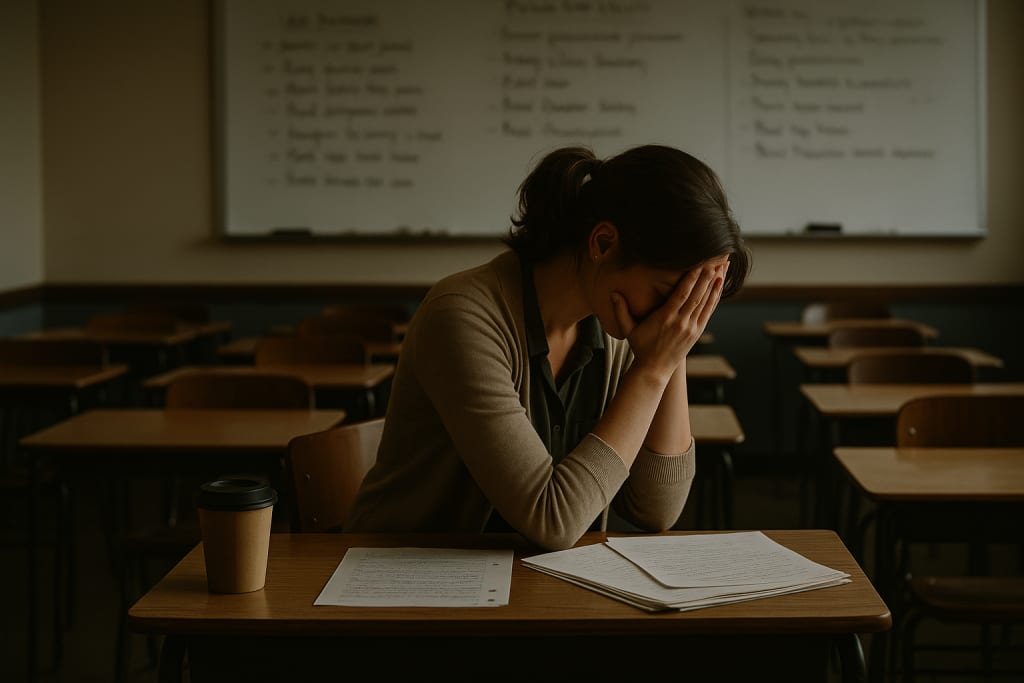
By October, Ms. Lawson was done.
It was only her second year teaching, but it felt like her tenth. Every day felt like a battle. Her 7th-grade English class was loud, defiant, exhausting. She spent more time managing chaos than actually teaching. Phones buzzed under desks. Arguments erupted mid-lesson. No one turned in homework. And worst of all, they didn’t seem to care.
She used to love the idea of teaching. She’d entered the profession with optimism and purpose — the kind you carry fresh out of college when you still believe in the power of books and passionate speeches. She imagined herself like her own 8th grade teacher, who once told her she was "meant to write stories that matter."
But this? This was burnout, plain and raw. She cried in her car. Counted down minutes in class. Questioned her own competence every night. She was twenty-eight and already dreaming of quitting.
One day, after a particularly brutal class period where two students cursed at each other and one stormed out slamming the door, she stayed late. Her room was silent. The sun had set. Her desk lamp cast long shadows over unfinished lesson plans.
That’s when she noticed a piece of folded paper wedged between two books on her desk.
It was from Isaiah — the quietest student in class. Barely spoke. Rarely made eye contact. Always sat in the back row like he was trying to disappear.
Her first thought was, Great, another apology for bad behavior. But as she opened the note, her breath caught.
“Ms. Lawson,
I just wanted to say thank you for not giving up on us, even though we make it hard. I know I don’t say much in class, but I like your stories. They make me think. Sometimes I even go home and write poems. I haven’t shown anyone yet, but maybe one day I will.
Anyway… please don’t leave. You’re the only teacher who talks to us like we matter.
- Isaiah.”
She read it twice. Three times.
Something cracked open inside her, not the broken kind of crack, but the kind that lets light through.
The next morning, she returned with something different in her energy. Not a full recovery. Not a miracle. But a thread of hope.
She redesigned her curriculum to include student voices. Opened the floor for discussions about identity, music, fear, and dreams. She started reading one anonymous student poem a week, giving shy writers like Isaiah a voice without pressure.
Her students noticed.
Isaiah eventually shared a poem with his name on it. Then others followed. Attendance improved. Homework, though not perfect, trickled in. And the classroom that once felt like a war zone started to feel like a community.
That spring, her class entered a statewide poetry slam as a group submission. They didn’t win — but they stood on stage together, reading verses about resilience, love, and surviving the school system.
When the school year ended, Ms. Lawson didn’t quit. She stayed.
A decade later, she’s still teaching, and mentoring young educators who are just starting out, reminding them that every class has an Isaiah. You just have to hang on long enough to hear them speak.
Motivational Takeaway:
The impact you have isn’t always immediate. Sometimes, the most disruptive students are carrying the heaviest silence. Don’t quit on the hard days — they’re often the turning point. Someone out there is waiting for your consistency to be the proof they need that they matter.
About the Creator
Keep reading
More stories from Mohammadreza Gholami and writers in Motivation and other communities.
Full Moon
There are days when it feels like my body is arguing with itself. Multiple sclerosis already demands negotiation. Fatigue shapes my energy. My legs can feel unreliable. Sensations appear without warning. Some days they feel heavy. Other days they feel like they are vibrating from the inside, a constant electrical hum that no one else can see.
By Millie Hardy-Sims4 days ago in Motivation
The Hollywood Star Who Invented Wi-Fi: The Hidden Genius of Hedy Lamarr
Right now, as you read these words, invisible waves of energy are pulsing through the air around you. They are bouncing off walls, passing through glass, and connecting your device to a vast, infinite global network. Whether you are using a smartphone, a laptop, or a tablet, you are relying on a technology so fundamental to modern human existence that we panic the moment we lose it: Wi-Fi.
By Frank Massey 3 days ago in Motivation
REEEEEEEEE!
I'm on a low road right now. There are a literal million things to do and not one of them worth my time. I would rather sit in place and burn but the orbit takes me on its inevitable route 'round the center; and I a center in my own right, around which others orbit, and so on and so forth, ad infinitum, ad nauseum.
By C. Rommial Butler3 days ago in Poets




Comments
There are no comments for this story
Be the first to respond and start the conversation.