
The Boy Who Couldn't Read — Until He Rewrote the Rules
Sometimes, the greatest minds just learn differently.


Eli was nine when he realized he was different.
Not different like gifted or athletic. Different like: Why can’t I read like everyone else?
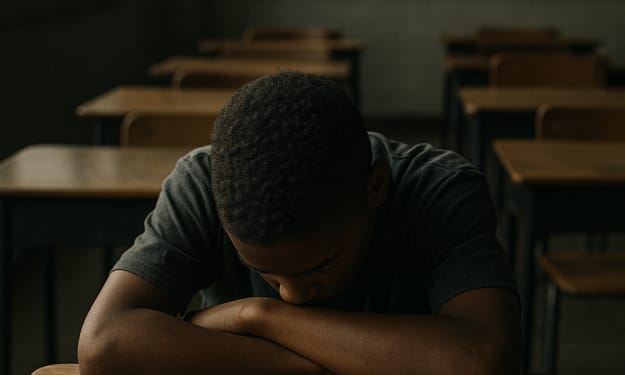
In third grade, he still struggled to recognize words other kids had mastered in kindergarten. When the class read aloud, Eli froze. His palms got sweaty. The letters danced on the page, flipping, sliding, mocking him. He pretended to be sick on reading days. His stomach always hurt before spelling tests.
His teachers called it “inattention.”
His classmates whispered “slow.”
But inside, Eli wasn’t slow. His mind raced constantly — full of ideas, pictures, inventions. He loved building things from scrap parts at home, creating elaborate maps for imaginary cities, and asking questions no one else thought to ask.
Still, none of that showed up on his report card.
When he was finally diagnosed with dyslexia in fourth grade, his parents felt relief. There was a name for it. But for Eli, it just felt like confirmation: he was broken.
He started seeing a specialist twice a week. The progress was slow. Painfully slow. Reading exhausted him. Writing felt like punishment. His self-esteem cratered. He withdrew. Teachers marked his assignments with red Xs. He stopped raising his hand in class.
But then came Mrs. Patel, his fifth-grade teacher.
Unlike the others, she didn’t focus on what Eli couldn’t do. She started with what he could.
She noticed how he explained complex ideas through drawings. How he remembered every detail from science videos. How he could build working circuits from broken toys and a handful of wires. She didn’t ignore the dyslexia, but she didn’t center it either.
“You’re not behind,” she told him. “You’re on a different path. Same mountain. Different route.”
Instead of asking Eli to read aloud, she let him record his answers as audio. Instead of written book reports, she encouraged him to make dioramas and give presentations. She pushed the school to get him assistive tech — text-to-speech software and audiobooks.
The first time Eli presented a project to the class, a 3D model of a future city that used renewable energy, jaws dropped. He explained urban planning, solar panel efficiency, and water recycling with passion and precision.
His classmates didn’t call him “slow” anymore.
In sixth grade, Eli was invited to join the STEM club. By seventh, he was winning district science fairs. Reading was still a challenge, but it no longer defined him. He read what he needed to, listened when he could, and expressed himself in ways that played to his strengths.
Years later, as a high school senior, Eli gave a TEDx talk called “Flipping the Page: Learning My Way.” It went viral in the education world. Teachers shared it. Parents cried over it. Other kids with learning differences wrote to him: “You made me feel less alone.”
And when college acceptance letters came in, Eli chose a university known for its engineering program, and its commitment to neurodiverse learners.
He didn’t just survive school.
He changed it.
Motivational Takeaway:
Struggle doesn't mean failure, it means you're finding your own way. Some minds aren’t meant to follow straight lines. They’re meant to build new paths. Eli didn’t need to be “fixed.” He needed someone to see that he worked differently, and that different is powerful.
About the Creator
Keep reading
More stories from Mohammadreza Gholami and writers in Motivation and other communities.
"The Student Who Failed Every Class — Until One Teacher Noticed"
Jamal had failed every class by the time he was 14. He was the kind of student teachers dreaded having on their rosters, disruptive, defiant, and detached. He never brought a pencil. He never made eye contact. If you asked him a question, you’d get silence or sarcasm. His report cards read like obituaries for potential: “Does not apply himself.” “Disrupts class.” “Fails to complete assignments.”
By Mohammadreza Gholami9 months ago in Motivation
Am I a Failure?
I think almost every teenager has had a moment where they look at their life and think, “What am I even doing?” Sometimes it feels like everyone else is moving forward while you’re just standing in the same place. You see people getting good grades, being talented at sports, having a clear plan for their future, or just seeming confident about everything. And then you look at yourself and start wondering if you’re falling behind.
By frenzied about 21 hours ago in Motivation
The Man Who Became a Lightning Rod: The Unbelievable Life of Roy Sullivan
In the vast, unpredictable theater of the natural world, there are statistical anomalies, and then there is Roy Cleveland Sullivan. To the average person, the odds of being struck by lightning in a given year are roughly one in a million. The odds of being struck seven times? Those are calculated at approximately 1 in 100,000,000,000,000,000,000,000,000 (that’s a septillion).
By Frank Massey about 15 hours ago in Motivation
Worth the Wait: Puerto Viejo, Costa Rica
Beach bumming in a small Caribbean beach town sounded like a perfect way to end our 6-month trip through Mexico and Central America. Or so we thought. The foul, fishy stench of rotten seaweed hit our nostrils as we stepped from the cramped bus and looked out at a rather depressing, empty, and underwhelming black sand beach. It was pouring with rain, and we had to quickly fish out our ponchos. We thought, this couldn’t be it, could it?
By Sh*t Happens - Lost Girl Travel5 days ago in Wander



Comments
There are no comments for this story
Be the first to respond and start the conversation.