
The Patriots Behind Barbed Wire: How the Men America Imprisoned Saved America From Defeat
In 1942, the U.S. government locked 120,000 Japanese Americans in internment camps, questioning their loyalty. Months later, the military realized they had made a catastrophic mistake: they needed those same "enemies" to translate the secrets that would win the Pacific War

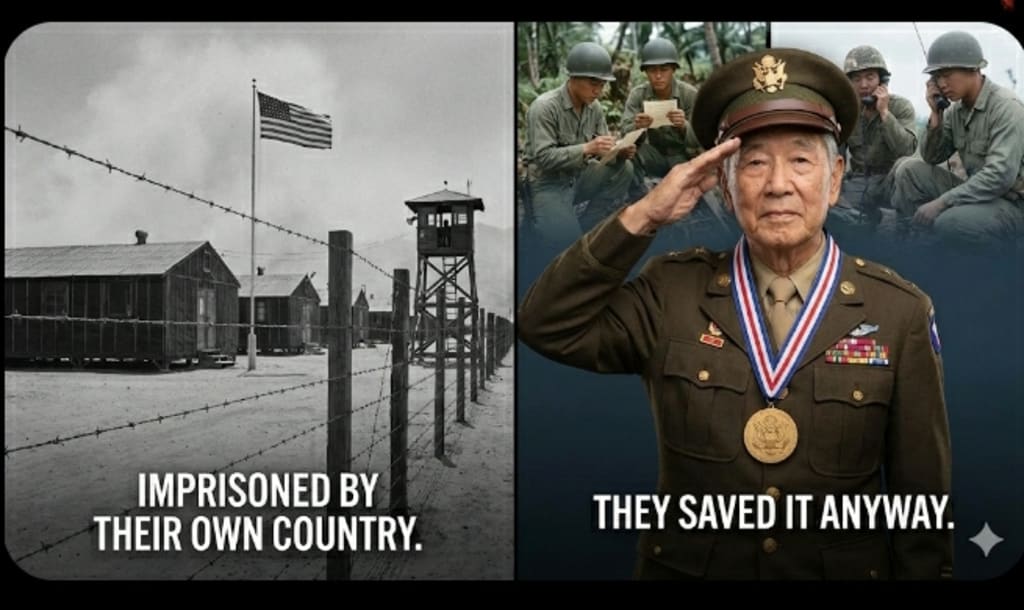
The untold true story of the Nisei linguists of the Military Intelligence Service (MIS) during WWII. How Japanese Americans recruited from internment camps translated enemy codes, shortened the war, and proved their loyalty to a country that had betrayed them.
Introduction: The Betrayal
February 19, 1942, is a date that cleaved the American soul in two. With the stroke of a pen, President Franklin D. Roosevelt signed Executive Order 9066.
The order was fueled by panic, racism, and the smoking ruins of Pearl Harbor. It declared that anyone of Japanese ancestry living on the West Coast was a potential threat to national security. It did not matter if they were elderly. It did not matter if they were infants. It did not matter—crucially—that two-thirds of them were American citizens by birth.
Within months, 120,000 people were stripped of their homes, their farms, their businesses, and their dignity. They were tagged like luggage and herded onto trains with blacked-out windows. They were dumped into desolate camps in the deserts of California, the swamps of Arkansas, and the plains of Wyoming. They lived in tar-paper barracks behind barbed wire, with machine guns in the guard towers pointing inward at them, not outward at an enemy.
The message from the United States government was clear: You are not one of us. You are the enemy.
But history is full of strange and bitter ironies. At the exact moment the U.S. Army was locking these citizens away, the U.S. Army realized it had a massive, potentially fatal problem.
They were fighting a war against Japan, and almost no one in the American military could speak Japanese.
The Empire of Japan used a language that was notoriously difficult for Westerners to master. It wasn't just about vocabulary; it was about Kanji (thousands of complex characters), military dialects, and a high-context culture where what was not said was often as important as what was.
The U.S. Navy could intercept radio messages, but they couldn't understand the nuance. They captured diaries, maps, and operation orders, but to a white officer from Iowa or New York, they were indecipherable scratches on rice paper.
The military brass looked at their roster. They had virtually no white linguists fluent enough to handle battlefield interrogation.
They realized, with a sinking feeling, that the only people in North America who possessed the skills to save American lives in the Pacific were the very people they had just put behind fences.
Part I: The Visit to the Camps
In late 1942, a small group of military recruiters drove up to the gates of the internment camps. They walked past the armed guards and into the barracks.
The scene was surreal. These recruiters were asking young Japanese American men—known as Nisei (second generation)—to volunteer for a secret unit: the Military Intelligence Service (MIS).
Imagine the psychological weight of that moment. Imagine sitting on a cot in a dusty barrack, your father bankrupt because the government seized his store, your mother weeping because of the shame of imprisonment. And then, a man in a uniform asks you to pledge your life to defend the Constitution that is currently failing you.
The logical answer would have been "No." The logical answer would have been "Free my family first, then we’ll talk."
But thousands of young Nisei men didn’t choose logic. They chose a profound, complicated form of honor. They volunteered.
Some did it to prove their loyalty. They wanted to show, with blood and sweat, that "American" was not a skin color. Others did it for Giri—a Japanese concept of duty and obligation. Some simply wanted to get out of the camps.
They were shipped to a secret language school, first at the Presidio in San Francisco, then to Camp Savage in Minnesota. They studied fourteen hours a day. It was a pressure cooker. They weren't just learning words; they were learning how to think like the enemy imperial officers. They were learning to read cursive handwriting scrawled in blood-soaked diaries.
They were preparing to go to war against the land of their ancestors, for the sake of the land of their birth.
Part II: The Human Weapon
When the Nisei linguists deployed to the Pacific, they became the "eyes and ears" of the Allied forces. They were attached to every major combat unit—from the Marines storming the beaches of Iwo Jima to the Army units hacking through the jungles of Burma.
Their impact was immediate and devastating to the Japanese forces.
General Charles Willoughby, the chief of intelligence for General Douglas MacArthur, later estimated that the Nisei linguists shortened the war in the Pacific by two years.
Consider what that means. Two years of war in the Pacific would have meant the invasion of mainland Japan. It would have meant hundreds of thousands of American deaths and potentially millions of Japanese deaths.
How did they do it?
They did it by translating captured documents in real-time. In one famous instance, known as the "Z Plan," the Nisei translated a captured set of top-secret Japanese naval battle plans. These documents outlined the entire defensive strategy of the Japanese Combined Fleet for the Philippines. Because the Nisei translated it immediately, the U.S. Navy knew exactly where the Japanese ships would be. The resulting battle was such a lopsided American victory it was nicknamed the "Great Marianas Turkey Shoot."
They did it by listening to the radio. The Japanese military often didn't bother to use complex codes for tactical talk because they assumed Americans couldn't understand them. They assumed their language was a natural code. They were wrong. The Nisei were listening to their frequencies, telling American commanders exactly when the mortar fire would start.
But perhaps their most valuable tool was not translation, but culture.
Part III: The Danger of the Face
For a Nisei soldier, the Pacific theater was a nightmare of dual danger.
To the Japanese soldiers, the Nisei were traitors. If a Nisei linguist was captured by the Japanese, he wasn't treated as a Prisoner of War. He was often executed on the spot, sometimes tortured first. They were viewed as having betrayed their blood.
But the danger from their own side was just as acute.
In the chaos of a jungle firefight, an American soldier shooting at "the enemy" just saw an Asian face. He didn't see the U.S. uniform. He didn't see the rank. He saw the face of the people trying to kill him.
Nisei linguists lived in constant fear of "friendly fire."
To mitigate this, many Nisei linguists were assigned white bodyguards. On paper, the bodyguard was there to protect the valuable asset—the translator. But there was a darker, unspoken order given to some of these bodyguards: If the linguist tries to defect, or if we are about to be captured, shoot him.
The Nisei knew this. They fought alongside men who had been ordered to watch them for treachery. They ate in mess halls where other Americans called them slurs. They read letters from home describing how their parents were still behind barbed wire, enduring dust storms and humiliation.
And yet, they did the job.
Part IV: The Cave Flushers
One of the most harrowing roles the Nisei played was in the caves of Okinawa and Saipan.
As the Japanese army retreated, they often holed up in extensive cave networks, taking civilians with them. The Japanese propaganda machine had terrified the civilians, telling them that Americans were monsters who would rape and torture them. As a result, thousands of civilians were committing suicide—jumping off cliffs or blowing themselves up with grenades—rather than surrendering.
The American flamethrowers were ready to burn out the caves. It was a brutal, efficient method of clearing the enemy.
But the Nisei linguists volunteered to go in first.
Unarmed, a Nisei soldier would crawl to the mouth of a cave. He would speak into the darkness. He wouldn't speak the formal, stilted Japanese of a textbook. He would speak the Japanese of a neighborhood.
He would say: "I am Japanese American. I am from California. We have food. We have water. We have doctors. No one will hurt you."
He would talk about rice. He would talk about family. He would use the correct honorifics to show respect to the elders hiding in the dark.
It was an act of supreme courage. At any moment, a fanatic soldier inside the cave could have shot him.
But it worked. By the thousands, civilians and soldiers walked out of the caves, blinking into the sunlight, surrendering to the man who sounded like their cousin.
The Nisei didn't just kill the enemy; they saved the enemy's humanity.
Part V: The Silent Return
When the war ended in 1945, the soldiers of the 442nd Regimental Combat Team—the all-Nisei combat unit that fought in Europe—came home to some fanfare. They were the "Purple Heart Battalion," the most decorated unit of their size and length of service. Their heroism was physical and visible.
But the Nisei linguists of the MIS faced a different reality.
Their work was classified. The Cold War was starting, and the U.S. occupation of Japan needed those linguists to help rebuild the country. The government didn't want the world to know how thoroughly they had compromised Japanese communications.
So the MIS veterans were told to keep their mouths shut.
They returned to an America that was still deeply racist. They returned to families that had lost their farms and grocery stores. They returned to the West Coast to find "No Japs Wanted" signs still hanging in windows.
They had saved American lives. They had shortened the war. They had proven their loyalty a thousand times over. And they couldn't tell anyone.
They became gardeners, pharmacists, and accountants. They raised families. They went to church. They buried their trauma and their glory in silence.
Part VI: The Long Road to Recognition
For fifty years, the story of the MIS was a footnote.
It wasn't until the year 2000—more than half a century after the war ended—that the U.S. government finally conducted a full review of their records.
The Presidential Unit Citation was finally awarded to the MIS. Then, in November 2011, the surviving veterans—now men in their 80s and 90s, stooped and gray—gathered in Washington D.C. to receive the Congressional Gold Medal, the highest civilian honor the United States can bestow.
They sat in wheelchairs, wearing their old garrison caps. They watched as the leaders of the country finally said the words they had waited a lifetime to hear: We were wrong to doubt you. And we are free because of you.
For many, it was too late. The accolades were placed on graves.
Conclusion: The Definition of an American
The story of the Nisei linguists forces us to confront an uncomfortable question: What is a patriot?
Is a patriot someone who loves their country because it is easy? Or is a patriot someone who loves their country even when it has lost its way?
These men were placed in an impossible crucible. They were rejected by the land of their blood (Japan) and rejected by the land of their birth (America). They belonged nowhere.
So they carved out a place for themselves in the history books using nothing but their integrity.
They teach us that true Americanism isn't about ancestry, or name, or the shape of one's eyes. It isn't about unquestioning obedience to a government, and it certainly isn't about blind nationalism.
True Americanism is what happened in those caves in Okinawa. It is the willingness to stand in the gap between hatred and humanity. It is the willingness to serve the ideal of a nation, even when the reality of that nation is failing you.
The Nisei linguists were the ultimate rebuttal to racism. The government built fences to keep them in, claiming they couldn't be trusted. The Nisei walked out of those fences and proved that they were the most trustworthy men in the room.
They were the spies behind barbed wire, the heroes without a country, who ended up saving the very nation that had locked them away.
About the Creator
Frank Massey
Tech, AI, and social media writer with a passion for storytelling. I turn complex trends into engaging, relatable content. Exploring the future, one story at a time
Keep reading
More stories from Frank Massey and writers in Motivation and other communities.
The Invisible Army: How 10,000 American Women Broke the Axis Codes and Were Ordered to Forget It
The untold true story of the "Code Girls" of World War II—American women recruited to break German and Japanese codes in total secrecy, only to be forced into silence for decades.
By Frank Massey 20 days ago in Motivation
Looking back: 2025 was a beast
It's difficult to know how to start this. I've suggested that it's been a tough one from my title and in many ways, it has; however, there is an argument that it's not been that extraordinary at all, merely this wonderful thing we call "life" with all its climaxes and pitfalls.
By Rachel Deeming28 days ago in Motivation
I Didn’t Burn Out From Working Too Hard — I Burned Out From Caring Too Much
I didn't burn out from working too hard. Nah, the real reason I got burned out was caring too much. "I always thought burnout was about working too much, but it's actually way more nuanced." "Working for extended periods." Deadlines, ugh. Always on the go. Nah. That wasn't me, for real. I actually didn’t burn out from work itself. I just ran out of steam trying to care anymore. I just cared too much, you know? It all comes down to doing things right. It's tough when you really don't want to let folks down. Being the strong one means you're always there for everyone else, never really showing your own struggles. You just deal with stuff without making a big deal out of it. It felt pretty cool at first. Folks counted on me. They really put their trust in me. They needed me. I liked that. I just really enjoyed feeling important. Needed. Useful. But over time, caring slowly started to feel more like carrying a burden. I really felt the weight of everyone else's stress on my shoulders. Other people's expectations feel a bit like carrying baggage that isn't yours. Other people's problems. And I never stopped to check myself. I was really tired when I agreed to that. I showed up empty-handed. I really just ignored all the signs because I didn't want to upset anyone. I figured that made me tough. It didn't. The burnout didn't hit like a bomb. It just kind of snuck in. Quiet. It's really slow. You know that feeling when you wake up, and you're just... wiped? Like you haven't slept at all, even though you just spent hours in bed. It's a bummer, really, to start the day already feeling completely drained. Ugh, it's those tiny annoying things that just get under your skin, right? Things I really liked: It just didn't hit the same way, you know? Some days, even brushing my teeth felt like a huge effort. My least favorite part was probably the constant feeling of needing to be ready for anything. It’s hard to just relax when you’re always anticipating the next challenge. No one could see it. My life looked good. That's the main idea. Normal. "Inside?" Empty. I'm not sad. Not angry. Just done. That's the sort of emptiness you feel when you pour all your energy into everyone else and leave nothing for yourself. Being there for everyone else, always, but never really for yourself. Then someone hit me with a question I couldn’t dodge: When was the last time you did something just for you? And in that moment, when the unexpected happened, I just froze. I just couldn't recall. That really caught me off guard. I realized I only made room for others, never for me. I used to think that being selfless meant I was strong. "Rest = lazy" is definitely not true. "Boundaries = failure." I just kept going. Never paused. Didn't check in. Burnout doesn't really announce itself, does it? It whispered. "I just don't care about the stuff I used to anymore." Not 'cause I didn't wanna. I just didn't have anything left to give, you know? That really startled me. So I started doing something weird. It was uncomfortable. That really freaked me out. I just started saying no. Quiet. Not rude, just straightforward. Just being honest. No. I'm not able at this moment. No. I really need a break. No. I don't have it today. It just felt bad from the start. It felt like I was blowing some test I didn't even know I was taking. "Everyone would just think I was weak." But the world didn’t fall apart that day. Folks got used to it. A few of them understood. Some just didn't get it. And you know what? That was fine. I figured out that being caring doesn't mean you have to destroy yourself in the process. It's about knowing your limits. It's really about valuing yourself. You can be kind without getting drained. It’s possible to support others without sacrificing your own well-being. It's totally possible to care deeply about things without letting it drain all your energy. Burnout really showed me something important: You know, rest isn't something you have to earn. It's not a prize for working hard. It's okay to slow down; nobody needs your permission. It's totally okay to not give everyone all of yourself. When that heavy feeling creeps in, it can make everything feel a bit much. I paused. I'm here. I asked: “I wonder if I have enough energy for this.” It's like, when you give too much of yourself, and totally forget your own needs, that's not healthy. That's not strength. You know, that really sounds like self-neglect. I'm not going to mix those up anymore. It's true, we often put others first and forget about ourselves. Remember, you deserve care and attention too.
By Beshoy Zayerabout 8 hours ago in Motivation
Ludacris and Nelly draw backlash over bookings at MAGA-coded music festival
Ludacris and Nelly headlining a mostly right-wing event is good for them. It’s also great for the genre of hip hop. The two rap veterans have showcased their talents on other stages. Why can’t they perform for mostly MAGA folks and grab that bag?
By Skyler Saunders5 days ago in Beat


Comments
There are no comments for this story
Be the first to respond and start the conversation.