
The Monk in the Matrix: How Keanu Reeves Outlived His Own Ghosts
Hollywood wanted a star. Life gave them a survivor. The true story of how the most tragic figure in cinema became its most unshakeable pillar

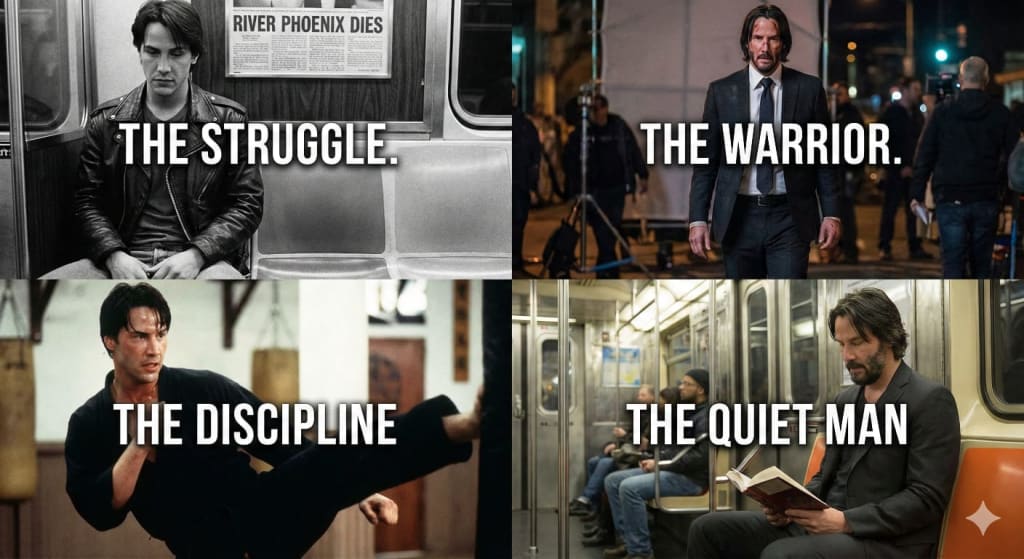
The harrowing and inspiring true story of Keanu Reeves, who endured the loss of his best friend, his child, and his partner, only to channel his grief into a discipline that redefined action cinema.
Introduction: The Man on the Bench
There is a famous photograph of Keanu Reeves. You have seen it. He is sitting on a park bench in New York City, eating a sandwich alone. He looks disheveled. He looks sad.
The internet turned it into a meme: "Sad Keanu." People photoshopped chickens next to him, or cheerleaders, or Forrest Gump. It became a joke about a rich, famous actor having a bad day.
But if you know the timeline of Keanu Reeves’ life, that photo isn’t funny. It is a portrait of a man who is carrying a weight that would crush most of us.
Keanu Reeves is not the "nice guy" the internet loves to praise. That is too simple a label. "Nice" implies a lack of edge. "Nice" implies naivety.
Keanu Reeves is not nice. He is kind. And there is a massive difference.
Kindness is a choice made by people who have seen the cruelty of the world and decided not to replicate it.
Keanu Reeves is a man who was systematically dismantled by life, piece by piece, and refused to become bitter. This is the story of the man Hollywood tried to erase, not by blacklisting him, but by breaking his heart.
Part I: The Drift
Keanu was born into instability. Born in Beirut, 1964. His father was a geologist who dealt heroin. He abandoned the family when Keanu was three years old.
Keanu never really knew him. He just knew the absence.
His mother was a costume designer, a free spirit who moved them around the world like chess pieces. Sydney. New York. Toronto.
Keanu attended four high schools in five years. He was expelled from one. He was dyslexic. The words swam on the page. Teachers called him "slow." They called him "dreamy." They said he wouldn't amount to much because he couldn't sit still and he couldn't read well.
He didn't fit in the classroom. He fit on the ice. He was a hockey goalie. They nicknamed him "The Wall."
It was the first sign of his future character. A goalie is a solitary position. You stand alone, waiting for projectiles to be fired at you at 100 miles per hour, and your job is to take the hit.
He planned to go pro. Then, a knee injury ended his career.
The first door slammed shut.
So, he packed a Volvo and drove to Hollywood. He was twenty years old. He had no connections. He had a strange name that agents told him to change. (They suggested "Chuck Spadina." He declined.)
He was just another kid with a dream. But he had a shadow following him.
Part II: The Other Half
In the late 80s, Keanu met River Phoenix.
If Keanu was the cool wind, River was the fire. River Phoenix was the most talented actor of his generation—the James Dean of the 90s.
They met on the set of I Love You to Death and became soulmates. Not just friends. Brothers.
When Keanu got the script for My Own Private Idaho, a risky, arthouse film about street hustlers, he knew he couldn't do it alone. He rode his motorcycle from Canada to Florida—over 1,000 miles—to hand-deliver the script to River and convince him to take the role.
They made the movie. It was a masterpiece. They were the future of Hollywood. Two young kings.
Then came Halloween, 1993.
River Phoenix collapsed outside The Viper Room in Los Angeles. Overdose. He died on the sidewalk at the age of 23.
Keanu was filming Speed when he heard the news.
The person who understood him best in the world was gone.
Most actors would have taken a hiatus. Keanu went to work. He channeled the grief into the physicality of Speed. If you watch that movie, Keanu isn't playing a generic action hero. He is intense. He is serious. He looks like a man who knows that if he slows down, the bomb will explode.
He saved the bus. He became a superstar.
But inside, the silence was growing.
Part III: The Decade of Ash
If the story ended there, it would already be tragic. But the universe was not done with Keanu Reeves.
In 1998, Keanu met Jennifer Syme. She was a personal assistant to a director. She was intelligent, quiet, and understood Keanu’s need for solitude.
They fell in love. It was the kind of love that quiets the noise.
A year later, Jennifer was pregnant. They were expecting a daughter. They named her Ava.
They prepared the nursery. They bought the clothes. Keanu, the boy whose father left at three, was finally going to be the father he never had.
On Christmas Eve, 1999, eight months into the pregnancy, something went wrong.
Ava Archer Syme-Reeves was stillborn.
There is no pain like the death of a child. It is a violation of the natural order. It broke them.
Grief is a heavy roommate. It takes up all the space in a house. Keanu and Jennifer tried to stay together, but the pain was too vast. They separated a few weeks later, though they remained close friends.
Eighteen months later. April 2001.
Jennifer Syme was driving her Jeep Grand Cherokee in Los Angeles. She lost control. She hit a row of parked cars. She was thrown from the vehicle and died instantly.
Keanu was in the middle of filming the sequels to The Matrix.
In the span of two years, he had lost his daughter and the love of his life.
He buried Jennifer next to Ava.
And then, he had to go back to work. He had to put on the sunglasses. He had to play Neo, the man who saves the world.
But the man under the trench coat was hollow.
Part IV: The Construct
This is the part of the story where Keanu Reeves should have self-destructed.
Look at the history of Hollywood. When tragedy strikes this hard, people turn to heroin. They turn to alcohol. They drive their Porsches off cliffs. They become angry, destructive divas.
Keanu Reeves went quiet.
He didn't do interviews. He didn't write a memoir about his pain. He didn't go on Oprah to cry.
He turned his grief into discipline.
During The Matrix training, Keanu was suffering from a spinal injury that was causing paralysis in his legs. He had a two-level fusion of his cervical spine.
He was training for Kung Fu four months post-surgery. He was in agony. He didn't complain.
He realized that physical pain was easier to manage than emotional pain. If he was training, he wasn't thinking. If he was memorizing choreography, he wasn't remembering the funeral.
He became a machine.
When the Matrix sequels wrapped, Keanu did something that baffled Hollywood.
He had made millions. But he looked at the special effects team and the costume designers—the people who actually built the world—and he felt they were underpaid.
He signed away his back-end points (his profit sharing). He gave away an estimated $75 million to the crew.
He bought Harley Davidson motorcycles for the entire stunt team.
Why?
Because when you have stood at the graves of everyone you love, you realize that money is just paper. It cannot buy life. It cannot buy time.
He didn't give the money away because he was "nice." He gave it away because he was detached. He had learned the hardest lesson of all: Possession is an illusion.
Part V: The Ghost in the Subway
For the next ten years, Keanu drifted.
He made movies, but they were mostly forgettable. He directed a Tai Chi movie. He played bass in a band called Dogstar.
He lived in hotels. He didn't buy a house until he was 40. He wandered the streets of New York and London.
This is when the stories started to emerge.
Stories of Keanu giving up his seat on the subway.
Stories of Keanu driving a stranger home because her car broke down.
Stories of Keanu hanging out with homeless men, sharing a bottle of water and just listening.
He wasn't doing it for Instagram. Instagram didn't exist.
He was doing it because he was lonely, and he recognized loneliness in others.
He was a ghost haunting the world of the living.
Then, his sister, Kim—the one constant in his life—was diagnosed with leukemia.
Keanu stopped everything. He moved her into a hotel. He sat by her bed. He held her hand. He cooked her meals.
"She is the most important thing to me," he said. "When you’re facing a tragedy like that, everything else fades."
He donated millions to cancer hospitals anonymously. He didn't attach his name to the foundation. He didn't want the credit. He just wanted the cure.
She survived.
And Keanu, finally, began to wake up.
Part VI: Baba Yaga
In 2014, a script circulated around Hollywood. It was a B-movie action flick about a retired hitman whose dog gets killed.
It sounded ridiculous. Most agents passed.
Keanu read it. And he saw something.
He saw a man who was grieving his wife. A man who was trying to keep it together. A man who had buried his violence, but was forced to dig it up.
He didn't just play John Wick. He was John Wick.
At age 50, when most actors are transitioning to "dad roles" or golf, Keanu Reeves entered the dojo.
He trained for 8 hours a day. Judo. Brazilian Jiu-Jitsu. 3-Gun tactical shooting.
He did 90% of his own stunts.
When you watch John Wick, you aren't watching a stunt double. You are watching a 50-year-old man exorcising his demons through violence. The exhaustion on his face is real. The sadness in his eyes is real.
The movie became a global phenomenon.
Suddenly, Keanu was back. The "Keanussance."
But he didn't change.
He still wore the same boots. He still rode the subway. He still ate alone.
Part VII: The Unbreakable Vow
In an interview, Stephen Colbert asked Keanu a question that went viral.
"Keanu, what do you think happens when we die?"
It was a comedy show. The audience expected a joke. Or a philosophical evasion.
Keanu took a deep breath. He looked at the floor. Then he looked at Colbert.
"I know that the ones who love us will miss us."
That was it.
In one sentence, he summarized the entirety of human grief. He didn't make it about himself. He made it about love.
That is the secret power of Keanu Reeves.
He is not bulletproof. He has been shot a thousand times by life. But he refuses to let the wounds make him cruel.
He realizes that we are all walking around with broken hearts. The clerk at the grocery store. The driver of the taxi. The fan asking for a selfie.
So he treats them with gentle precision.
He is the "nice guy" not because he is naive, but because he knows how easily a person can break.
Part VIII: The Real Motivation
Keanu Reeves’ story is not a fairytale. It is a survival guide.
It teaches us that you can lose everything—your father, your best friend, your child, your soulmate—and you can still stand up.
You can still be useful.
Most people let trauma define them. They become their trauma. I am the victim.
Keanu Reeves let trauma refine him. I am the survivor.
He reminds us that success is not about the cars, the mansions, or the awards. Keanu has all of those, and he knows they are worthless compared to one more hour with a friend who is gone.
Conclusion: The Warrior in the Garden
There is an old saying:
"It is better to be a warrior in a garden, than a gardener in a war."
Keanu Reeves is the warrior in the garden.
He has the skills to kill (on screen). He has the discipline to conquer. But he chooses to sit on a bench and eat a sandwich. He chooses to ride a motorcycle into the sunset. He chooses to be kind.
He didn't win the game of life. The game of life beat him up.
But he is still playing.
And that is the ultimate victory.
If you are reading this, and you feel like you have lost too much... like the world has taken things from you that you can never get back...
Look at Keanu.
He didn't endure so you would admire him.
He endured so you would know it’s possible.
Grief changes shape, but it never ends. But neither does love.
And as long as you are breathing, you have a choice:
You can let the darkness consume you.
Or you can be the light for someone else who is stumbling in the dark.
Be the light.
About the Creator
Frank Massey
Tech, AI, and social media writer with a passion for storytelling. I turn complex trends into engaging, relatable content. Exploring the future, one story at a time
Keep reading
More stories from Frank Massey and writers in Motivation and other communities.
One Hard Thing
Stop me if you’ve heard this one before: You have the number, you know your schedule- you’ve even picked out the perfect day and time to make this appointment. Shoot, you’ve even picked out alternative days and times just in case their schedules can’t accommodate you!
By Taylor Rigsby11 days ago in Motivation
The secret life of the librarian.
I love books, I’ve been a voracious reader all my life, and if I buy a book, I can’t get rid of it. I’ll read it 2 or 3 times, and shelve it in my library in case I want to read it again. My collection has got out of control, and the room I’ve designated as my library is full, crammed full, the overflow of books has crept into the other rooms of the house, and also the garage. On shelves, packed in boxes stacked 8 high. There’s no room for the car. Like I said, out of control. So instead of buying books and reading them at home, and then storing them, I decided to join the local library. It’s just a short walk into town , a very pleasant walk, next to a park, and a coffee shop, not too many kids go there, at least during the times I’m there, and the libarian is sweet and helpful. Oh, and did I mention kind of cute. I’m not attached, so although I’m not on the prowl I’m always looking at the female scenery. I mean, why not?
By Guy lynn3 days ago in Motivation


Comments
There are no comments for this story
Be the first to respond and start the conversation.