
"The Light of Noorabad"
How a curious village boy and a devoted teacher turned dreams into light for an entire community.

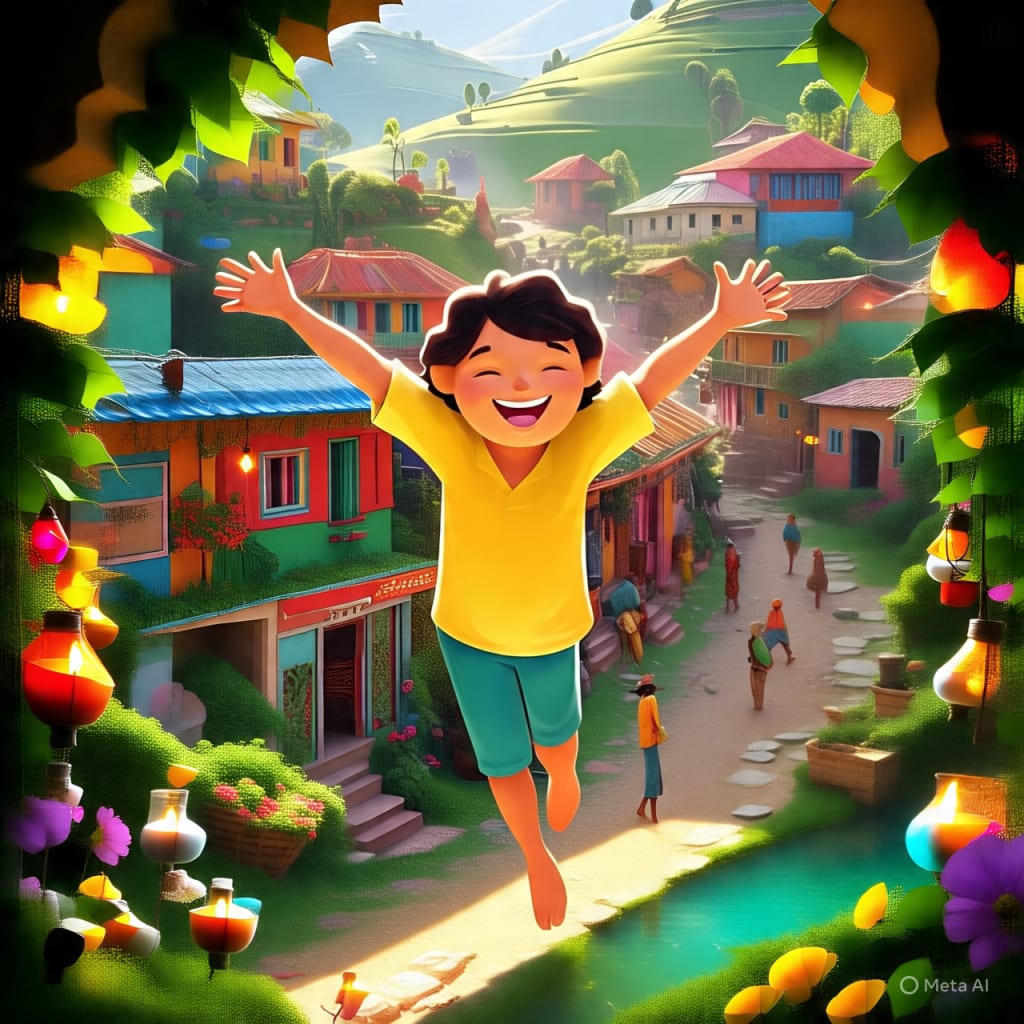
Nestled between green hills and whispering wheat fields was a peaceful village called Noorabad. The name meant "The Land of Light," and indeed, there was something magical about this small place — not because of electricity or wealth, but because of the warm hearts of its people.
Life in Noorabad was simple. The villagers woke up with the call of the rooster, drank tea brewed over wood fires, and worked under the open sky. Children played barefoot in the fields, women gathered at the village well to fetch water and exchange stories, and old men sat under the banyan tree, discussing the news and the old days.
At the center of this lively village was an old school, made of mud bricks with a rusted tin roof. It had only two classrooms, no fan, and broken desks, but it had something far more valuable — a teacher named Master Najeeb.
Master Najeeb wasn’t born in Noorabad. He had once been a city man, a university graduate with big dreams. But a tragedy in his life had made him retreat from the noise of the world. One day, many years ago, he had come to Noorabad looking for peace, and the village welcomed him with open arms. Since then, he had made it his mission to educate the children of the village.
Every morning, he would ring the old brass bell and children would come running from all directions — some with shoes, some without; some carrying books, others bringing slates and chalk. Master Najeeb taught them not just to read and write, but to think, to imagine, and to dream.
One of his brightest students was a young boy named Amir. He was the son of a poor farmer, but his eyes sparkled with curiosity. He asked questions no one had ever thought to ask: "Why is the sky blue?" "How do birds know where to fly?" "Can we make our own electricity so we don't need kerosene lamps?"
The villagers laughed at Amir's questions, but Master Najeeb saw hope in them.
Years passed. Amir studied hard, often by lantern light. He helped his father in the fields by day and studied by night. Master Najeeb encouraged him to apply for a scholarship to the city. Though reluctant to leave his village, Amir finally went — carrying with him the dreams of Noorabad.
Time moved on. Seasons changed. Letters came from Amir now and then. He was studying engineering and doing well. The village felt proud, but missed him deeply — especially Master Najeeb.
Then one summer evening, after many years, a car rolled into Noorabad — the first ever to drive into the village. Out stepped Amir, no longer a boy but a young man with confidence and kindness in his eyes. He hugged Master Najeeb and wept.
Amir had returned, not just to visit, but to give back.
With help from the government and some of his professors, he started a small solar power project in Noorabad. Within months, homes began to glow at night with electric light. Children could study, farmers could store their crops, and women could cook with ease.
But Amir didn’t stop there. He helped renovate the school, built a small clinic, and arranged clean water for the village. All the while, he remained humble, always calling himself "a student of Master Najeeb."
Noorabad slowly changed. It still had the same fields, the same trees, and the same laughter, but now it also had light — both on the walls, and in the minds of its people.
And every morning, Master Najeeb would still ring the brass bell — but now, with a heart full of pride, knowing that the seeds he planted had grown into trees of hope.
Moral:
A single teacher, a curious student, and a small village can change the world — one light at a time.
About the Creator
Keep reading
More stories from Maaz and writers in Motivation and other communities.
The Council of the Jungle
In the heart of a vast and ancient jungle, where the sun's golden rays barely pierced the dense canopy, lived a wide variety of animals. From the mighty elephant to the tiny ant, all creatures called this wild paradise their home. Life in the jungle was often harsh, ruled by survival and instinct, yet a delicate balance held it all together. This balance, however, was about to be tested in a way none of the animals could have foreseen.
By Maaz 7 months ago in Motivation
One Hard Thing
Stop me if you’ve heard this one before: You have the number, you know your schedule- you’ve even picked out the perfect day and time to make this appointment. Shoot, you’ve even picked out alternative days and times just in case their schedules can’t accommodate you!
By Taylor Rigsby11 days ago in Motivation
Why Being Liked is Overrated and Self-Respect is Everything
For a long time, I thought being liked was the goal. If people were comfortable around me, I felt successful. If no one was upset with me, I felt safe. If I could smooth things over, stay agreeable, and avoid conflict, I believed I was doing something right.
By Stacy Valentine5 days ago in Motivation
Writing About Writing: The Rainbow Trap
The good thing about living in modern times is that LGBTQ representation in media is increasing. Not just in niche and Independant media, either, but also in mainstream media. Books, movies, TV shows, comics... they're finally catching on that LGBTQ+ people form a significant part of their audience, and deserve to see themselves on screen and in fiction, not just as victims in documentaries and true crime shows.
By Natasja Rosea day ago in Writers




Comments (1)
Please give me response about my story. So that I will bring more stories like this.