
The Lessons of a Rebuilt Nation
A story of growth, reflection, and resilience.

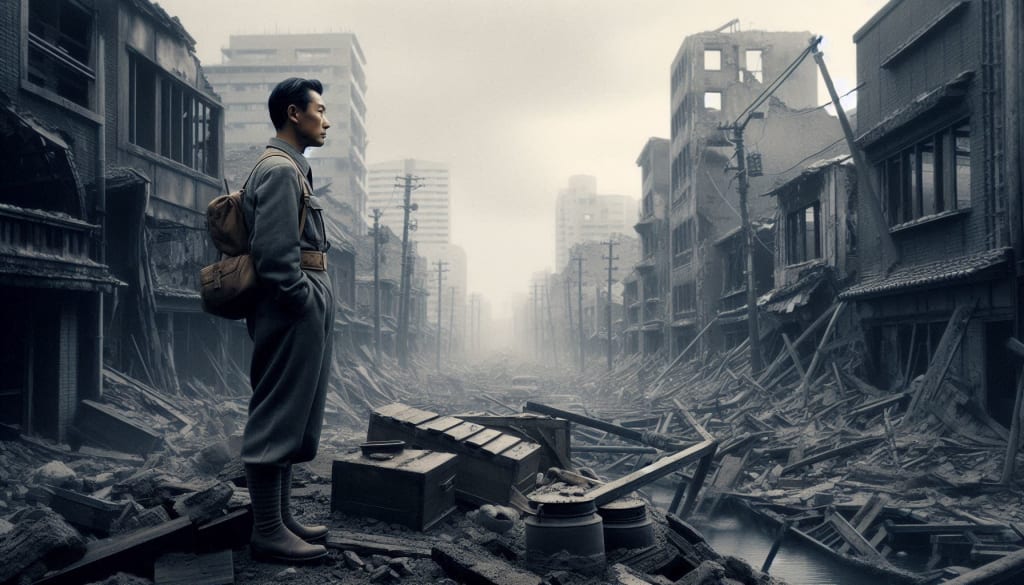
In post-World War II Japan, a young entrepreneur learns the value of learning from the mistakes of others while navigating the complexities of rebuilding his business and his life. A story of growth, reflection, and resilience.
________________________________________
In the spring of 1947, the ruins of Tokyo still bore the scars of World War II. Buildings lay in crumbled heaps, and the air was thick with dust and memories of loss. Yet, amidst this shattered landscape, small signs of life and hope began to emerge. Tetsuo Nakamura, a 27-year-old man with a determined glint in his eyes, stood on the edge of his family’s property, now a charred skeleton of what had once been a thriving textile shop. The war had taken everything—his father, their livelihood, and even his sense of certainty about the future.
As the country began its slow and painful recovery, Tetsuo knew one thing for certain: he had to rebuild. But rebuilding wasn’t just about brick and mortar. It was about learning from the ashes, understanding the mistakes that had led to this devastation, and ensuring they were never repeated. His father’s words echoed in his mind, the last advice he'd given before leaving for the front: “Learn from the mistakes of others, Tetsuo... you can’t live long enough to make them all yourself.”
It was a heavy lesson, one that resonated now more than ever. The Japan he once knew had been reshaped, not just physically, but culturally and economically. To survive in this new world, Tetsuo had to learn not just from the devastation of war, but also from the mistakes of others who had tried—and failed—to rebuild too quickly, too recklessly.
________________________________________
The First Steps of Rebuilding
Morning light filtered through the skeletal remains of the city, casting long shadows on the streets. Tetsuo stood outside a newly rebuilt café, one of the few signs of life in his neighborhood. He watched as workers hurried inside, carrying materials to finish the last touches. The owner, Mr. Ito, had been one of the first to open his doors again after the war, his eyes set on rebuilding not just his business, but his community.
Tetsuo approached, his heart heavy with the weight of the decision he was about to make. He had a plan—to reopen the textile shop under a new name, Nakamura Fabrics, and to learn from the failures of others as he navigated the unpredictable waters of post-war commerce.
“Mr. Ito,” Tetsuo called out, bowing as the older man emerged from the café. “Do you have a moment?”
Mr. Ito smiled, his face weathered by years of hardship but softened by the hope that flickered in his eyes. “Tetsuo, of course. How can I help you, my boy?”
Tetsuo hesitated for a moment before speaking. “I need advice. I want to reopen my family’s shop, but I’m not sure how to proceed. I’ve seen so many others try to rebuild too quickly, and they’ve failed. I don’t want to make the same mistakes.”
Mr. Ito’s expression shifted to one of contemplation. “Ah, yes. You’re wise to be cautious. The rush to rebuild can blind us to the lessons we should have learned. Many of our countrymen have tried to return to the way things were, but they forget—Japan has changed. We can’t ignore the past, but we must adapt to the future.”
________________________________________
Learning from the Past
Tetsuo spent the next few months immersing himself in the stories of those around him. He visited other shop owners, sat in on business meetings, and even traveled to Osaka to observe how the city's textile industry was recovering. Everywhere he went, he saw the same patterns—those who rushed, who tried to replicate the past exactly as it had been, faltered. But those who adapted, who took the time to understand the new economic landscape, thrived.
One evening, as he sat by the remnants of his family’s shop, his notebook filled with observations, a young woman named Aiko approached him. She had been a classmate of his in school, before the war had torn their lives apart. Now, she worked as a seamstress in a nearby factory, her hands skilled but worn.
“I heard you’re reopening your shop,” Aiko said, her voice tentative but hopeful. “I’ve been looking for a place to work closer to home. Would you consider hiring me?”
Tetsuo looked at her, realizing that Aiko’s experience—her ability to create something new from the threads of the past—was exactly what he needed. “Yes,” he said with a smile. “But I’ll need your help. We won’t just be making the same fabrics as before. I want us to innovate, to create something new that speaks to the Japan of today.”
Aiko’s eyes lit up. “I’ve been experimenting with different fabrics and designs. I think we can create something beautiful, something that honors our past but embraces the future.”
________________________________________
The Road to Success
By the fall of 1948, Nakamura Fabrics was reborn. The shop, now a symbol of resilience, stood proudly in the same spot where it had been reduced to rubble just a few years earlier. Inside, the shelves were lined with fabrics that blended traditional Japanese styles with modern innovations—fabrics that told the story of a country rebuilding itself, thread by thread.
Tetsuo’s cautious approach, inspired by his father’s advice to learn from the mistakes of others, had paid off. He had watched as other businesses fell into the trap of trying to restore the past, while his own had thrived by embracing the lessons of both failure and adaptation.
One evening, as Tetsuo closed the shop, Aiko approached him with a new design—a fabric that wove together the old and the new, much like their journey. “We’ve done it,” she said softly. “We’ve created something that will last.”
Tetsuo nodded, his heart swelling with pride. “Yes,” he replied. “But we must continue to learn, to adapt. The world keeps changing, and so must we.”
________________________________________
Conclusion:
In post-war Japan, Tetsuo Nakamura’s journey is a testament to the power of learning from the mistakes of others. By carefully studying the failures around him and embracing innovation, he rebuilt not just his family’s shop, but his future. His story is a reminder that while the past holds valuable lessons, the key to success lies in adapting to the present and preparing for the challenges of tomorrow.
About the Creator
Keep reading
More stories from RAJEEVAN N P NADUMURI and writers in Motivation and other communities.
A Diary of My Troubles and Success
The Beginning of Uncertainty I never thought my life would take such a challenging turn. As I sit here in my small, cluttered apartment, staring at the pages of this diary, I feel the weight of everything pressing down on me. It’s strange how quickly life can change. One day you feel invincible, brimming with dreams and hope, and the next, you’re barely getting by.
By RAJEEVAN N P NADUMURIabout a year ago in Motivation
Stop Making Excuses. Someone Is Already Doing What You Think Is Impossible
The Brutal Truth About Excuses : Right now, somewhere in the world, someone with fewer advantages than you is doing the exact thing you believe is impossible. They might have less money. Less education. Less support. Yet they are moving forward while many others remain stuck in the same place — not because they lack potential, but because they are trapped in a cycle of excuses. Excuses are comforting. They protect us from failure and embarrassment. But they also quietly steal our potential. The uncomfortable truth is that the biggest obstacle for most people is not lack of ability. It’s hesitation.
By Shahid Zaman4 days ago in Motivation


Comments
There are no comments for this story
Be the first to respond and start the conversation.