
The Invisible Man: How Bryan Cranston Conquered Hollywood by Letting Go of Success
For thirty years, he was a ghost in the industry. Here is the true story of how giving up on stardom allowed Bryan Cranston to become a legend at age 52

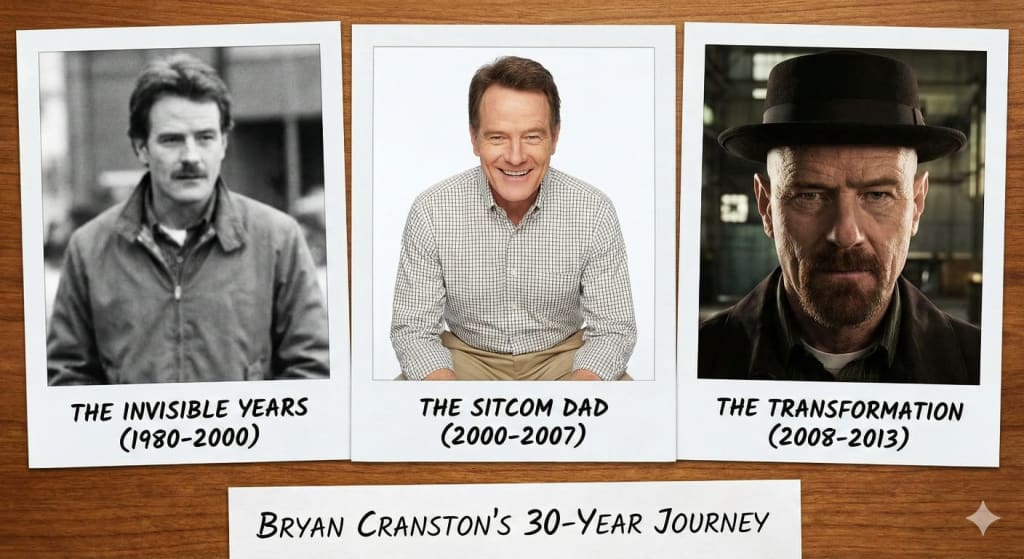
The Myth of the Overnight Success
If you look at the landscape of American pop culture today, Bryan Cranston is a titan. He is the face of Breaking Bad, the show often cited as the greatest television drama in history. He is a multi-time Emmy winner, a Tony winner, and an Oscar nominee. He carries an air of gravitas and authority that feels permanent, as if he was born sitting on the throne of Hollywood acting.
But that perception is a lie.
For the vast majority of his life, Bryan Cranston was invisible. He wasn't the star. He wasn't the "next big thing." He wasn't even the guy you loved to hate. He was just... there. A background texture. A blur in the periphery of a shot focused on someone more famous, more beautiful, or more "important."
For three decades, he lived the reality that nobody in America likes to talk about. We love stories about the 20-year-old prodigy. We obsess over the "30 Under 30" lists. But we rarely discuss the man who grinds in silence for thirty years, watching his youth evaporate while the world ignores him.
This isn’t just a story about an actor. This is a story about the terrifying, unglamorous, and necessary art of endurance. It is about the specific kind of hell that comes from waiting for a train that might never arrive.
The Ghost of a Father
To understand why Cranston’s success is so anomalous, you have to understand the fear that drove him. Most actors are driven by a desire for attention. Cranston was driven by a desire to avoid a curse.
Bryan didn’t grow up with stars in his eyes. He grew up watching the wreckage of a dream.
His father, Joe Cranston, was an actor. He was a man who wanted it all—the fame, the adoration, the "movie star" life. Joe spent his life chasing the big break, convinced that his talent entitled him to stardom. But Hollywood is a cruel machine, and it didn't give Joe what he wanted.
When the big break didn't come, Joe didn't just pivot; he crumbled. The failure turned into bitterness, and the bitterness turned into abandonment. When Bryan was just a child, his father left the family. He didn't leave because he was a monster; he left because he was broken. He was ashamed of his own mediocrity.
This was the foundational trauma of Bryan Cranston’s life. He saw firsthand that the pursuit of fame could eat a man alive. He saw that wanting to be a "star" was a dangerous addiction.
For a long time, Bryan resisted acting entirely. He planned to be a police officer. He wanted stability, structure, and reality—everything his father lacked. But the itch was there. When he finally gave in and decided to pursue acting, he made a silent vow to himself, one that would define the next thirty years of his life:
He would not try to be a star. He would just be a working actor.
He would treat it like a trade. Like plumbing. Like carpentry. He wouldn’t chase the high of fame; he would chase the dignity of a paycheck.
The Decades of "That Guy"
There is a term in Hollywood for actors like the young Bryan Cranston: "Journeyman."
It sounds noble, but often it feels like purgatory. Throughout the 80s and 90s, Cranston was the definition of a grinder. He wasn't starving, but he wasn't feasting either. He was hustling.
He did commercials for Preparation H. He did voiceovers for English-dubbed anime (often using a fake name). He showed up on soap operas, delivered three lines, and exited stage left. He played the "generic doctor," the "generic lawyer," the "generic dad."
Casting directors knew his face, but they didn’t know his soul. He was safe. He was reliable. If you needed a guy to walk into a scene, deliver some exposition, and not trip over the furniture, you hired Cranston.
He was:
* "That guy from that one episode of Seinfeld."
* "The dad type."
* "Solid, but not special."
By the time he reached his 40s, the industry had made its decision. In Hollywood, if you haven't popped by 35, you are generally considered "inventory." You are part of the furniture. You are useful, but you are not a destination.
Most people would have quit. The psychological toll of being "good enough but not great" is heavier than failure. Failure is a sharp pain; mediocrity is a dull ache that lasts for years. But remember the vow: he wasn't trying to be a star. He was trying to work. So he kept showing up.
The Trap of Success: Malcolm in the Middle
Then, the first twist happened. In 2000, at the age of 44, Cranston landed the role of Hal in Malcolm in the Middle.
For a working actor, this was the jackpot. A steady gig. A hit show. A regular paycheck. For seven seasons, Cranston played the goofy, terrified, subservient suburban father. He was brilliant at it. He threw himself into physical comedy, wearing roller skates, covering himself in bees, and screaming in high-pitched terror.
The world loved Hal. But the industry put Cranston in an even tighter box.
Before Malcolm, he was a generic actor. After Malcolm, he was a "Sitcom Dad."
In the eyes of producers and casting agents, Bryan Cranston was a clown. He was non-threatening. He was soft. He was the guy who wore tighty-whities and fell down for laughs.
When the show ended in 2006, Cranston was 50 years old. He was wealthy, successful by normal standards, and effectively retired from serious acting in the eyes of the elite. He had "made it," but in a way that usually signals the end of a career’s artistic potential. He was expected to ride off into the sunset, maybe do a few guest spots on other sitcoms, and enjoy his golf game.
But inside, the fire was burning hotter than ever. The craft still mattered.
The Impossible Audition
This brings us to the moment that changed television history.
Vince Gilligan was casting for a new show called Breaking Bad. The script was dark, twisted, and tragic. It required an actor who could transform from a mild-mannered teacher into a ruthless drug kingpin.
The studio executives at AMC had a list of stars they wanted. They wanted Mathew Broderick. They wanted John Cusack. They wanted someone with an edge.
When Vince Gilligan suggested Bryan Cranston, the executives laughed.
" The guy from Malcolm in the Middle?" they asked. "You want the guy who shaved his back hair in the kitchen to play a meth dealer?"
It was a hard "No."
They couldn't see past the decades of "safe" roles. They couldn't see the depth. They saw the mask Cranston had worn for seven years, and they assumed that's all there was.
But Gilligan had seen something the executives hadn't. Years prior, Cranston had guest-starred in an episode of The X-Files that Gilligan wrote. In that episode, titled "Drive," Cranston played a frantic, anti-Semitic, terrifying man trapped in a car.
Gilligan showed the tape to the executives.
The room went silent.
The man on the screen wasn't Hal. He wasn't a goofy dad. He was a cornered animal. He was terrifying. He was human.
Reluctantly, the studio agreed. They offered the role to the 52-year-old sitcom actor.
The Heisenberg Effect: Success at 52
When Breaking Bad aired, the cultural whiplash was severe. Audiences tuned in to see the funny dad from Malcolm, and instead, they were introduced to Walter White.
Over the course of five seasons, Cranston didn't just act; he disintegrated. He took the character of Walter White and peeled him like an onion, revealing layers of ego, rage, and power that had been dormant for a lifetime.
He won the Emmy for Outstanding Lead Actor three years in a row. He became the first actor in history to win a Tony, an Emmy, and a Golden Globe for the same role. Anthony Hopkins wrote him a fan letter saying his performance was the best acting he had ever seen.
At 52 years old—an age when society tells us we are supposed to be slowing down, winding down, and settling in—Bryan Cranston became the biggest star on the planet.
The Lesson: Talent Doesn’t Expire, Ego Does
The story of Bryan Cranston is satisfying because it feels like justice. But if we look closer, there is a harsh, pragmatic lesson that goes beyond "never give up."
The reason Cranston survived the 30 years of obscurity was his mindset.
In his memoir, he talks about the "Hollywood Audition" trap. For years, he went into auditions trying to get the job. He was seeking validation. He was asking the casting directors to like him. And because he was needy, he failed.
Then, he made the shift. He realized that an audition wasn't an interview for a job. It was an opportunity to act.
He told himself: "I am not here to get something from them. I am here to give them something. I will show them what I can do with this character, and then I will walk away. The decision is theirs. The performance is mine."
He detached his self-worth from the outcome.
He focused on the process, not the prestige.
This is why he didn't burn out like his father. His father needed the applause to feel alive. Bryan only needed the work. By focusing on being good rather than being famous, he built a foundation of skill that was ready and waiting when the opportunity finally arrived.
Why This Matters to You
We live in a culture that fetishizes youth and speed. We are told that if you haven't founded a startup by 22, made your first million by 25, or found your dream career by 30, you have failed. We are constantly checking the clock, terrified that we are running out of time.
Bryan Cranston’s life is the antidote to that anxiety.
He proves that you can spend decades in the shadows without losing your light. He proves that being "invisible" isn't a death sentence—it's a training ground.
While everyone else was posturing, taking shortcuts, and burning out on their own ego, Cranston was in the gym of life, doing the reps. He was preparing.
When the door finally opened, he didn't stumble through it. He kicked it off its hinges.
So, if you feel behind today. If you feel like you’ve been working in the dark for too long. If you feel like the world hasn’t noticed your value yet.
Remember the man who waited 30 years to say his name.
You aren't late. You're just getting into character.
Key Takeaways for the Reader:
* Detach from the Outcome: Focus on your output, not the reception. The world controls the reward; you control the effort.
* The "Invisible" Years Count: Time spent unrecognized is not time wasted. It is time spent refining your craft so you are ready when the spotlight hits.
* Redefine Success: If Bryan Cranston defined success by "fame," he would have quit in 1985. By defining it as "working," he survived long enough to become a legend.
About the Creator
Frank Massey
Tech, AI, and social media writer with a passion for storytelling. I turn complex trends into engaging, relatable content. Exploring the future, one story at a time
Keep reading
More stories from Frank Massey and writers in Motivation and other communities.
The Girl Who Walked Through Fire: How Charlize Theron Burned Down the Box Hollywood Built
If you look at Charlize Theron today, you see the epitome of gold-plated Hollywood success. You see the Dior campaigns, the Academy Award, the net worth estimated in the hundreds of millions, and the action-star physicality that rivals any man in the industry. You see a woman who commands a room simply by walking into it.
By Frank Massey about 23 hours ago in Motivation
One Hard Thing
Stop me if you’ve heard this one before: You have the number, you know your schedule- you’ve even picked out the perfect day and time to make this appointment. Shoot, you’ve even picked out alternative days and times just in case their schedules can’t accommodate you!
By Taylor Rigsby12 days ago in Motivation
The Painter’s First Masterpiece
Ever since I was a child, I loved to paint. Colors, shapes, and brushes fascinated me, but I was never confident in my work. I would spend hours sketching in my notebook, only to tear it up because I thought it wasn’t good enough. I wanted my art to impress people, but I was terrified of criticism. The idea of showing my work to anyone made my hands shake and my stomach tighten. I dreamed of becoming a painter, but fear kept me from trying.
By Sudais Zakwana day ago in Motivation



Comments
There are no comments for this story
Be the first to respond and start the conversation.